The Gecko That Waited 90 Years
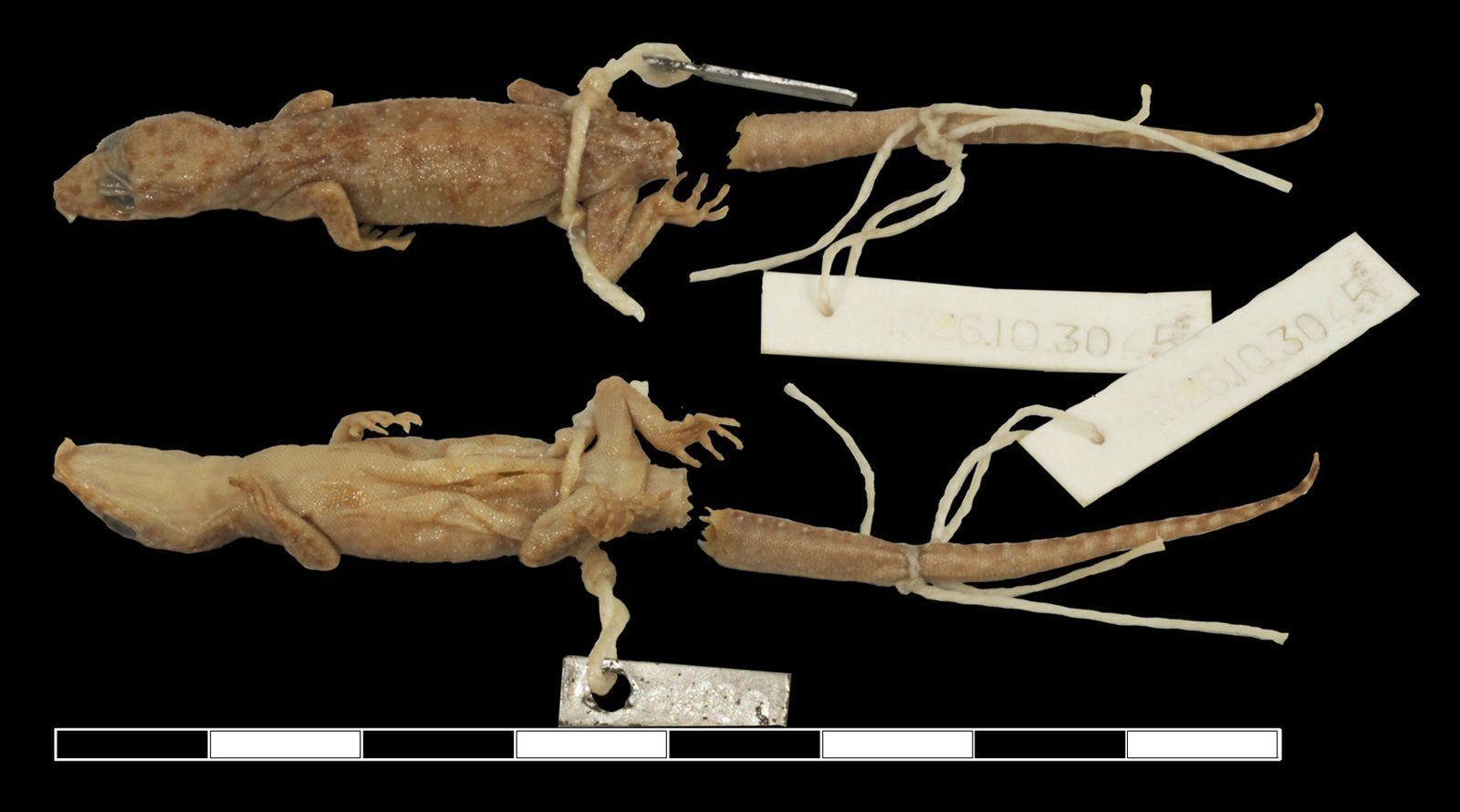
Photo: from Kathriner et al. 2014, Zootaxa
Its body is less than four centimetres long. It is faded to the colour of weak tea, its tail has broken off, and a few mites are still clinging to its belly. For ninety years it lay in a jar in London, and for ninety years nobody realised that it belonged to a species no one had ever named.
It is a good reminder of how discovery often works. We tend to picture new species being found at the end of a muddy trail. Some of them are. But a surprising number are found in museum drawers, on shelves, in jars, waiting for someone to look at them properly.
A single line in 1927
The gecko was collected in 1924 by Malcolm Smith, a British physician and one of the great herpetologists of his time. Between late February and late April of that year he visited Djamplong, a village 55 kilometres by road from Kupang in what is now West Timor, Indonesia. Today the place is spelled Camplong. Smith described the area as "well wooded, with numerous small streams."
Smith was not impressed with Timor's reptiles. In his 1927 report he wrote that "from a herpetological point of view, Timor is one of the most disappointing places that one can visit," and that there was "probably no other island so barren in reptilian and batrachian life." Among his finds he listed a single bent-toed gecko, with a question mark after its name: Gymnodactylus (?) marmoratus. That one line was all he ever wrote about it.
The name he used belonged to a Javan species that does not live on Timor, so other herpetologists found the record odd. One called it in need of confirmation. Another reassigned it to a gecko from the island of Wetar. Someone even slipped an anonymous handwritten label into the jar with that new name. The specimen itself, registered at the Natural History Museum in London as BMNH 1926.10.30.45, simply stayed on the shelf.
Looking properly
By the time we got to it, my colleagues and I had spent several years surveying the reptiles of Timor-Leste, the eastern half of the island. Those surveys had already turned up at least four bent-toed geckos (genus Cyrtodactylus) that did not match any named species. So we were very interested in the one old record from the west.
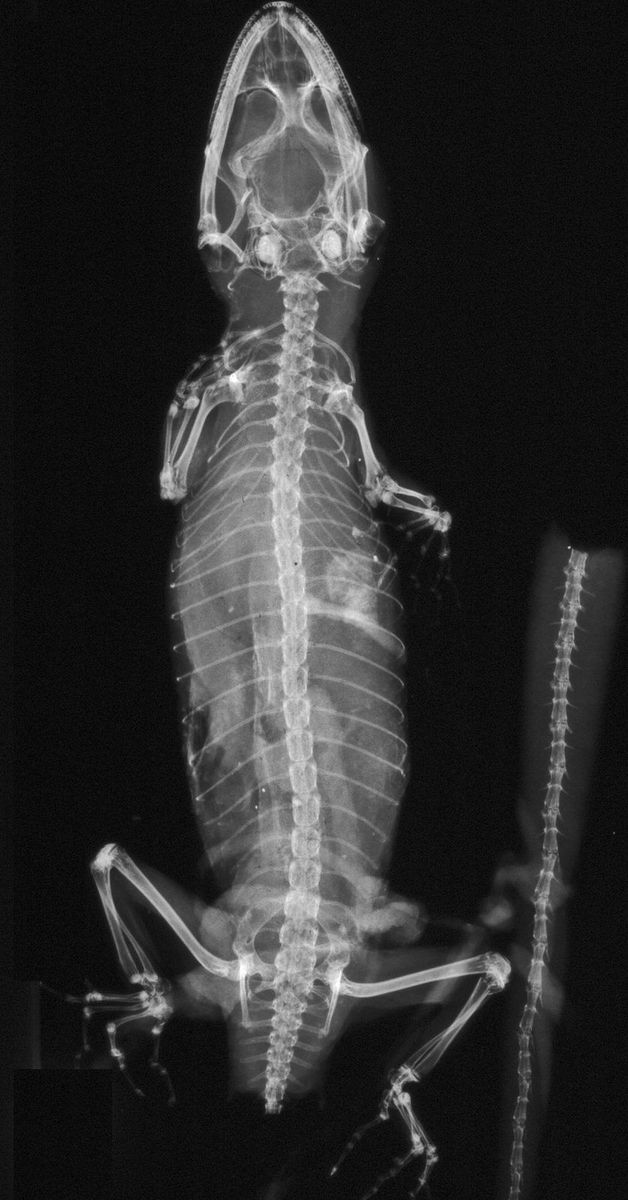
Caitlin Sanchez and I visited the Natural History Museum in London. Patrick Campbell there arranged x-rays and a loan of the specimen, and the Smithsonian's museum support centre in Maryland produced further x-rays. Andrew Kathriner, then at Villanova University with Aaron Bauer, led the detailed work, and Mark O'Shea completed the team.
The first question was whether the gecko was simply a baby. At only 38.4 mm from snout to vent, it was tiny. The x-rays settled that: the growth plates in its bones had fused, which only happens in adults. It was a grown female, and she still held eggs in her body. That told us something else: this species lays its eggs in the wet season, between December and April.
Then came the careful comparisons, scale by scale, with the original specimens of every bent-toed gecko known from the region. We counted the rows of bumpy scales along the back, the plates under each toe and the scales across the belly. We even compared the pattern of the small plates under the chin, a feature that had been largely ignored. Smith's gecko matched none of them. It was a new species.
We named it Cyrtodactylus celatus, from the Latin for "hidden away". In English we called it Smith's Hidden Bent-toed Gecko. It had hidden behind a single line of Smith's report and on the shelves of the museum. Remarkably, it was also the first gecko thought to be found only on Timor to be described from that island, nearly two centuries after the first reptile surveys there.
"It appears that at the beginning of the 21st Century there still is plenty of opportunity in the Indonesian Archipelago to uncover new species, even through specimens that have hidden in a museum for nearly a century." — Kathriner et al. 2014
There was a sobering end to the story. When we looked at satellite images of Camplong, Smith's "well wooded" landscape was gone. The forest appeared to have been replaced by rice paddies and houses. We may have named a species from a place where it can no longer live.
An even older gecko in Munich
Two years later the story took a twist. My friend Herbert Rösler, a gecko specialist in Dresden, was going through bent-toed geckos in the Zoological State Collection in Munich that had only ever been labelled Cyrtodactylus sp., meaning "species unknown". One of them was clearly Cyrtodactylus celatus.
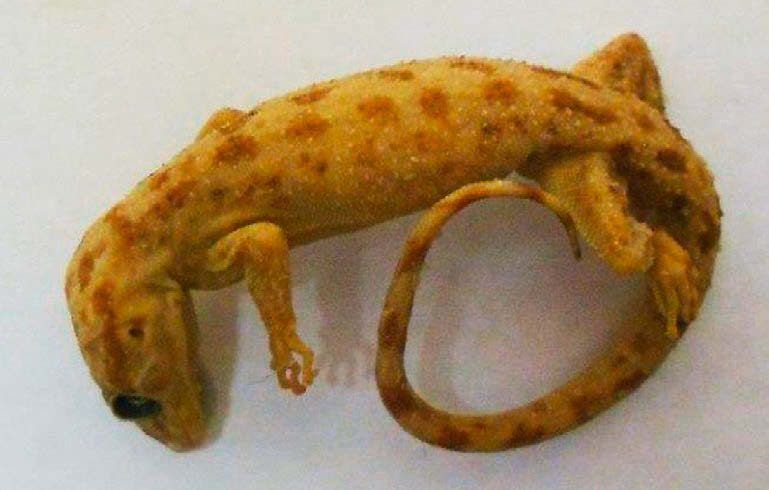
This one had been collected by C. B. Haniel in July 1911, during a Timor expedition led by the German geologist Johannes Wanner, at a place called Ofu, about 63 km east of Smith's site. That made it thirteen years older than Smith's specimen, and the oldest known bent-toed gecko from Timor. Better still, it was a male. Males carry features that females lack, such as a short row of scent-producing pores in front of the vent, and we could finally add them to the species' description.
A parade of forgotten specimens
Once you start looking, the drawers keep giving. With my colleague George Zug at the Smithsonian I described Carlia sukur, a four-toed skink from Pulau Sukur, a small island off Flores. George had found eleven specimens while measuring museum skinks for another project. They had been collected in March 1908.
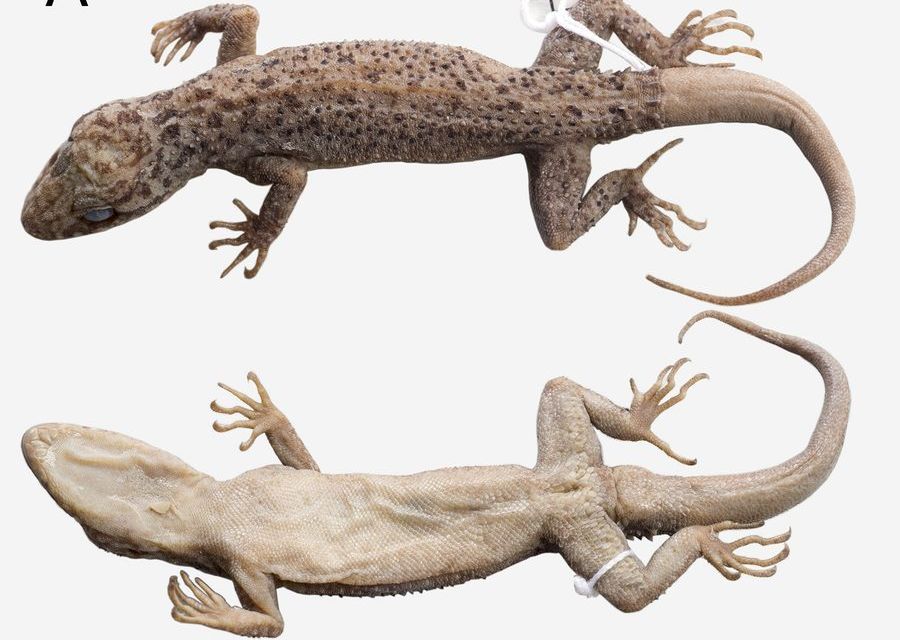
With Lukas Hartmann, Sven Mecke and others I described Cyrtodactylus klakahensis from four geckos in the Senckenberg Museum in Frankfurt. They had been collected in East Java in 1928 or 1929 by a German expedition studying lakes. At the time it was only the third bent-toed gecko known from Java.
Then there were the pipesnakes: burrowing snakes that, when threatened, hide their head and raise the flattened rear of their body to flash its boldly patterned underside. Felix Kopstein collected a series in Central Java in 1937, and they sat in Leiden until Max Kieckbusch, Sven Mecke and I showed they were a new species. We called it Cylindrophis subocularis, after a single small scale beneath the eye that no other pipesnake has. Our paper's title called it "an inconspicuous, conspicuous" new species: easy to overlook, obvious once you know.
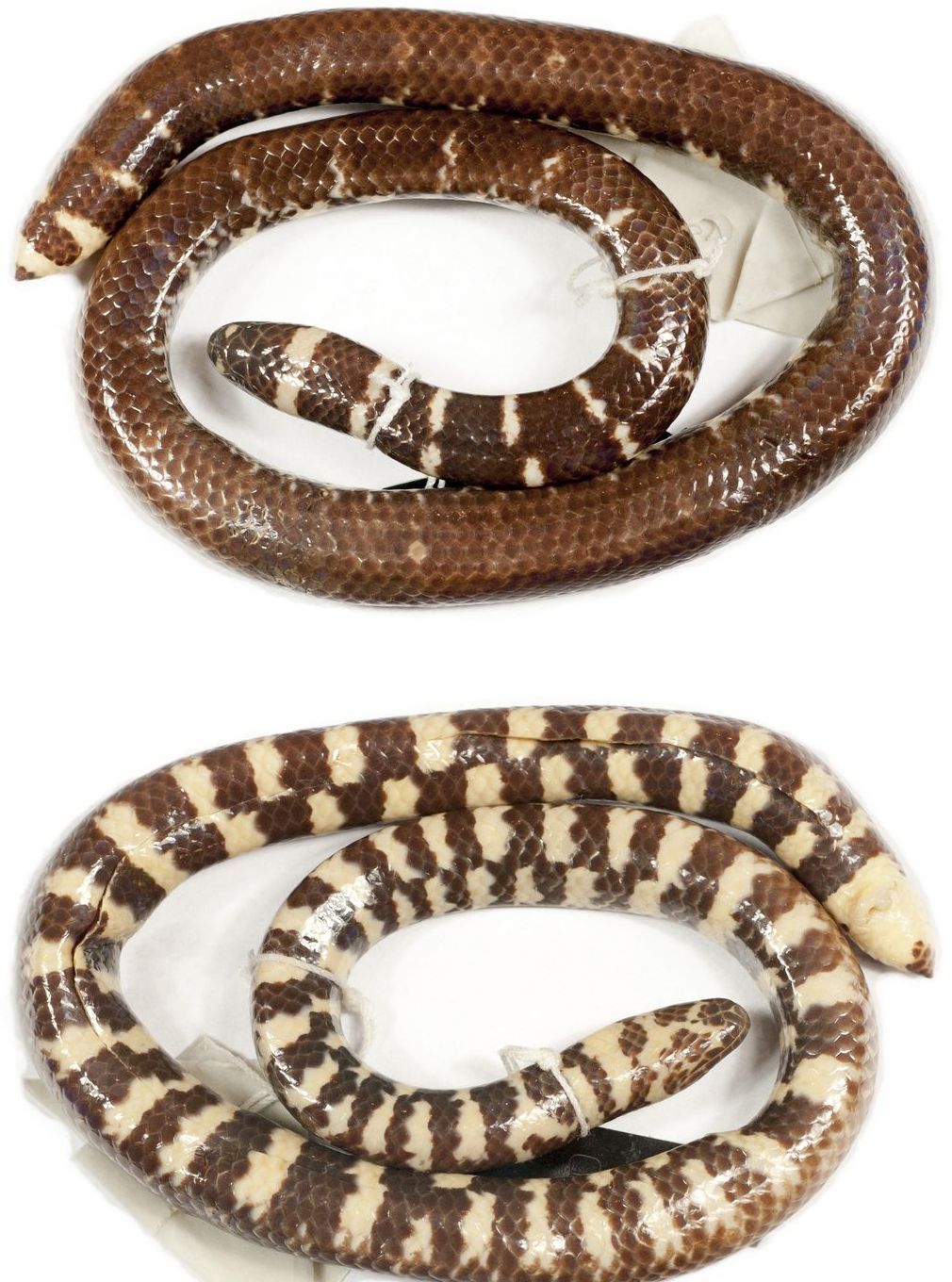
The record holder in my collection of late bloomers is a pipesnake collected on Boano Island in the Moluccas in 1865 by Dirk Samuel Hoedt. We described it in 2018 and named it Cylindrophis osheai for my friend and long-time field partner Mark O'Shea (it is pronounced "oh-shay-eye"). That is 153 years between collection and name.
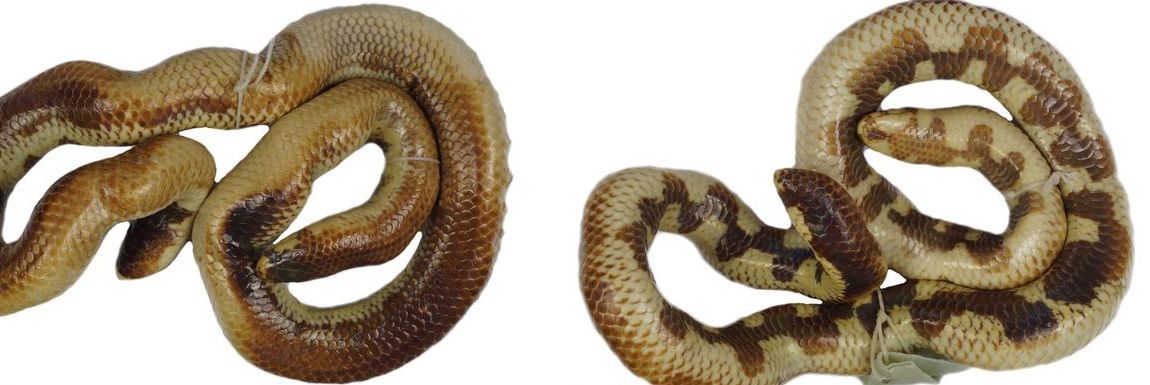
Sometimes the surprise is not a new species but a mix-up. When we re-examined the house geckos of Timor and the neighbouring island of Roti, the smallest of the three original specimens of Hemidactylus tenkatei, described in 1895, turned out not to be a house gecko at all but a bent-toed gecko, apparently the first ever recorded from Roti.
The other kind of fieldwork
Not every collection survived long enough to be rediscovered. In one night of bombing in February 1945, the reptile collection in Dresden shrank from 6,704 specimens to 98. Even so, Sven Mecke, several colleagues and I later found, in a Dresden jar with the wrong name on it, one of the original specimens of an Australian skink everyone had assumed was lost.
When Aaron Bauer, George Zug and I wrote about Germany's zoological collections, I described how my search for old Caribbean frog specimens gave me "a fondness for a different type of 'fieldwork,' removed from the outdoors yet essentially just as productive when it comes to making discoveries." Fieldwork in the tropics remains at the heart of what I do. But a good number of my discoveries were made under a museum lamp, with a microscope, a pair of calipers and a jar that nobody had opened in a very long time.
Every one of these animals was collected by someone who thought it worth keeping. Museums kept them safe through wars, moves and changes of name. The least we can do is keep looking.
The papers
- (2014) Hiding in plain sight: a new species of bent-toed gecko (Squamata: Gekkonidae: Cyrtodactylus) from West Timor, collected by Malcolm Smith in 1924 Zootaxa 3900(4): 555–568
- (2014) A new species of four-toed skink (Squamata: Scincidae: Carlia peronii species group) from Pulau Sukur, Indonesia, with biogeographic notes on the herpetofauna of Flores Island Proceedings of the Biological Society of Washington 126(4): 379–392
- (2014) Re-examination of Hemidactylus tenkatei van Lidth de Jeude, 1895: Populations from Timor provide insight into the taxonomy of the H. brookii Gray, 1845 complex (Squamata: Gekkonidae) Zootaxa 3887(5): 583–599
- (2016) Male secondary sexual characteristics of Cyrtodactylus celatus Kathriner et al., 2014 Spixiana 39: 125–129
- (2016) A new species of bent-toed gecko, genus Cyrtodactylus Gray, 1827 (Reptilia: Squamata: Gekkonidae), from Jawa Timur Province, Java, Indonesia, with taxonomic remarks on C. fumosus (Müller, 1895) Zootaxa 4067(5): 552–568
- (2016) An inconspicuous, conspicuous new species of Asian pipesnake, genus Cylindrophis (Reptilia: Squamata: Cylindrophiidae), from the south coast of Jawa Tengah, Java, Indonesia, and an overview of the tangled taxonomic history of C. ruffus (Laurenti, 1768) Zootaxa 4093(1): 1–25
- (2016) Tracking a syntype of the Australian skink Anomalopus leuckartii (Weinland, 1862): ‘lost’ treasures in the Senckenberg Natural History Collections Dresden highlight the importance of reassessing and safeguarding natural history collections Vertebrate Zoology 66(2): 169–177
- (2018) A new species of Cylindrophis Wagler, 1828 (Reptilia: Squamata: Cylindrophiidae) from Boano Island, northern Maluku Province, Indonesia Zootaxa 4486(3): 236–250
- (2018) Germany’s zoological collections: an international and personal view on an important historical and contemporary scientific resource Zoological Collections of Germany: The Animal Kingdom in its Amazing Plenty at Museums and Universities (L Beck, ed.). Springer, Cham, Switzerland pp. 7–15