The Snake Hiding on the Shelf
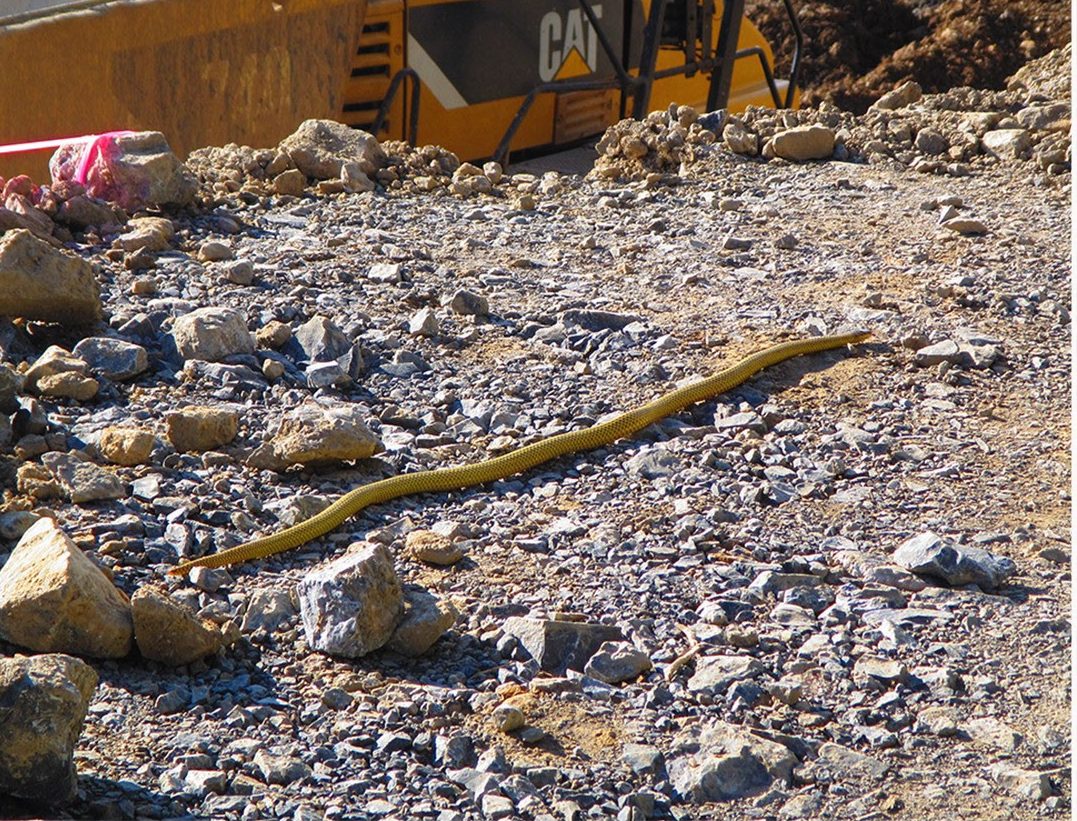
Photo: Blaise Paivu, from O'Shea et al. 2018, Amphibian & Reptile Conservation
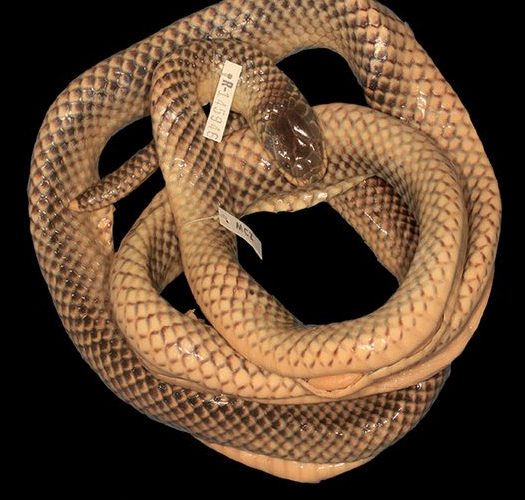
In May 2014, my friend and long-time collaborator Mark O'Shea was examining the New Guinea snakes in the collection of Harvard's Museum of Comparative Zoology. He had come on a travel grant named for the great evolutionary biologist Ernst Mayr, who had once directed that museum. Among a row of New Guinea small-eyed snakes, Micropechis ikaheka, one specimen did not look right.
It was big: 1.2 metres long. And when Mark examined it closely, it turned out not to be a Micropechis at all. It belonged to Toxicocalamus, a genus of secretive New Guinea snakes that almost nobody had studied, and it did not match any species anyone had ever named.
The snake had been collected 45 years earlier, and it had spent decades in that jar under the wrong name.
A patrol officer's snake
The label told part of the story. The snake had been collected on 23 December 1969 at Wangbin, a small village in the Star Mountains of western Papua New Guinea, by Fred Parker. Fred was a kiap, the Tok Pisin word (borrowed from the German Kapitän) for the Australian patrol officers who walked vast distances through the country before independence, settling land disputes and bringing law to remote valleys. Fred was also a keen naturalist, and he sent many specimens to museums in the United States. This one had been killed by a villager, who brought it to him.
Fred joined Mark and me as a co-author when we described the snake in 2015. He had even written about it back in 1982, remembering vividly that "the head was black, the lips bright yellow. The body scales were a deep yellow," and that the people of Wangbin "agreed with him that it was extremely rare in the area."
Toxicocalamus are called worm-eating snakes, and they are strange animals. They belong to the same family as cobras and are venomous, yet as far as anyone knows they eat earthworms. They live partly underground, in the leaf litter and soil. This one took its diet seriously. When the freshly killed snake was examined back in 1969, its stomach held a single giant earthworm about 500 millimetres long, half a metre. That worm is still preserved at the museum.
We named the species Toxicocalamus ernstmayri, the Star Mountains Worm-eating Snake, after Ernst Mayr. The links were almost too neat: Mayr had done fieldwork in New Guinea in the 1920s, he had directed the museum where the snake lay unrecognized, the specimen arrived there in the very month he retired, and it was a grant in his name that took Mark to the shelf. The description appeared in 2015, ten years after Mayr's death at the age of 100.
The golden snake at the mine
A species known from one dead snake is a species you worry about. Did it still exist?
On 9 October 2015, just months after our paper came out, Blaise Paivu, who worked at the Ok Tedi copper and gold mine in the Star Mountains, saw a snake crossing the active mine workings in broad daylight, about 13 kilometres from Wangbin. It was bright yellow, with a grey spot at the base of every scale. He watched it for about 20 minutes and photographed it several times as it crossed bare ground, slid over rubble and passed under a parked digger, before it vanished into the forest on the slope above.
His photographs reached specialists, and from them we could count the scales on its head and body. There was no doubt: it was Toxicocalamus ernstmayri, alive, the first seen in more than 45 years and the first ever photographed in life. It had crossed a tyre track 747 millimetres wide from end to end, so we estimate it was about 85 centimetres long.
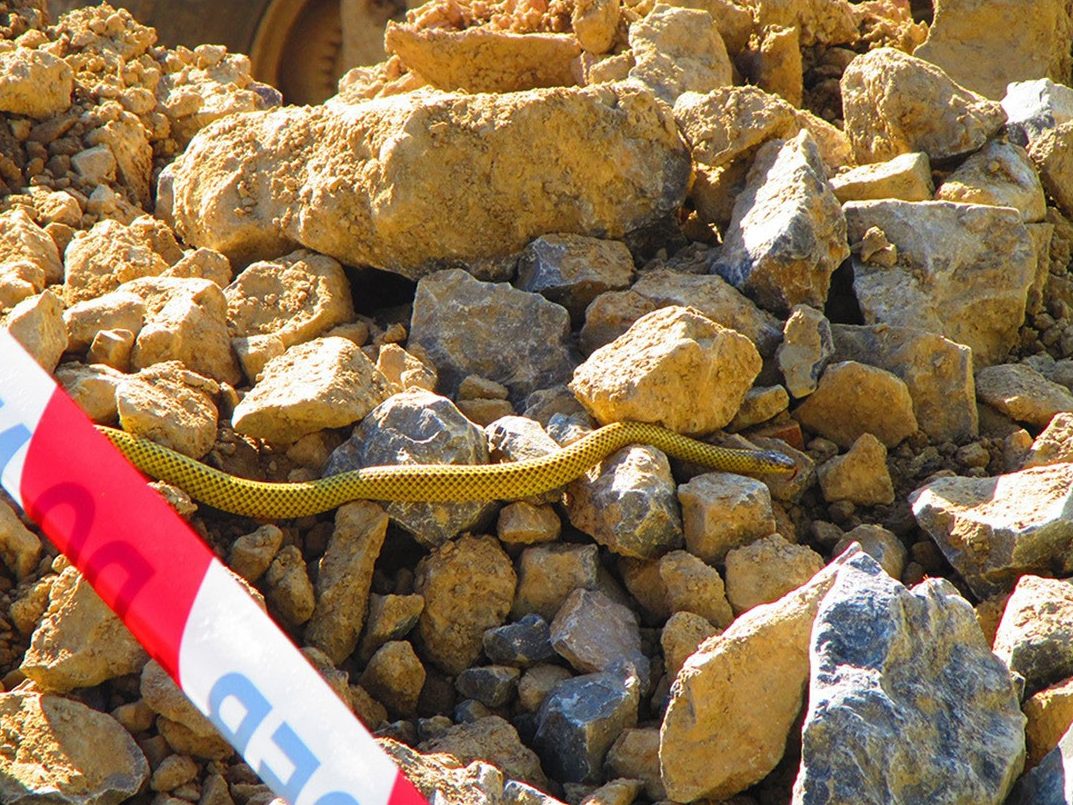
What moved me most was how people at the mine treated it. Nobody hurt it. They photographed it, asked experts what it was, and featured it in the mine's own magazine, which ended with a plea to readers to "observe it from a distance and let it go on its way. They are very rare and recorded sightings are even rarer."
A snake wrapped in leaves
The third T. ernstmayri had been waiting in a museum too. In the Bavarian State Collection of Zoology in Munich, Mark examined a small collection of snakes brought back from the mountains of Indonesian New Guinea in the 1970s by Paul Blum, a member of a 1976 expedition, run by Berlin's Ethnological Museum, that studied the language, culture and natural surroundings of the Eipo people. One snake, tentatively labelled as a different species, was another ernstmayri: the first from the Indonesian half of the island, about 150 kilometres from the others.
Paul, who became our co-author, recounted how he got it. On 18 June 1976, at the village of Dingerkon, a villager named Ewinde killed the snake in a garden and brought it to him in secret, wrapped in three layers of leaves so that no one else would see it. The Eipo called this snake amau and considered it so dangerous that even looking at it was undesirable. Paul was warned never to prick himself on its sharp tail tip. He laid it on a flat rock and photographed it discreetly.
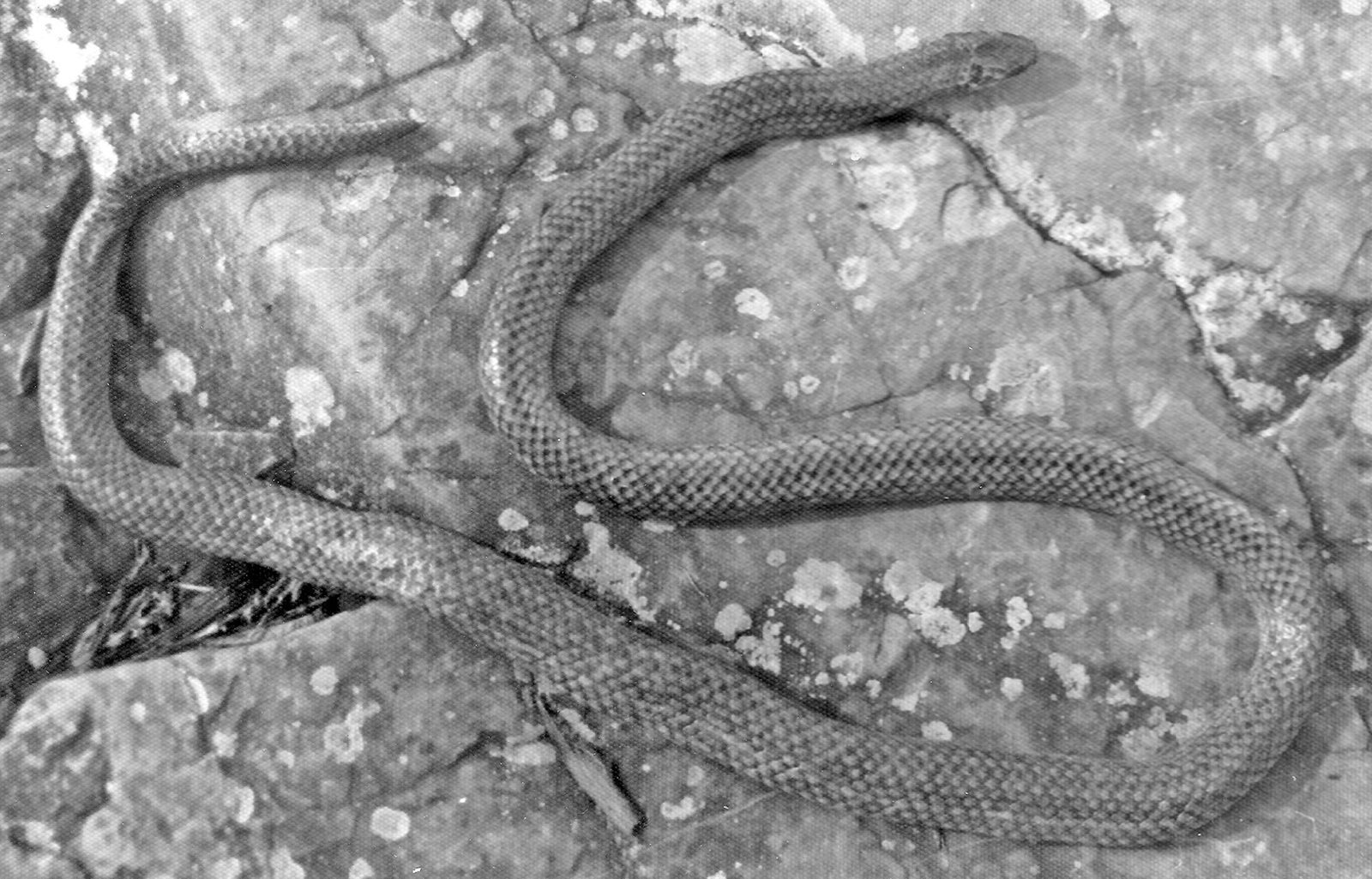
That garden setting is a clue. These snakes seem especially common in highland vegetable gardens, perhaps because the well-worked, composted soil is full of giant earthworms.
Smaller, stranger, and many more
Once you start looking, Toxicocalamus keeps surprising you. In 2018 Mark, Allen Allison of Hawai'i's Bishop Museum and I described Toxicocalamus pumehanae, the Managalas Plateau Snake, from a single tiny juvenile female that Allen had collected in 2010: just 241 millimetres long, the smallest holotype (the one specimen that officially defines a species) in the genus. We named it for Kathleen "Pumehana" Imada, a collection technician at the Bishop Museum who had made Mark's visit possible and arranged the loan of the specimen. Museums run on people like her.
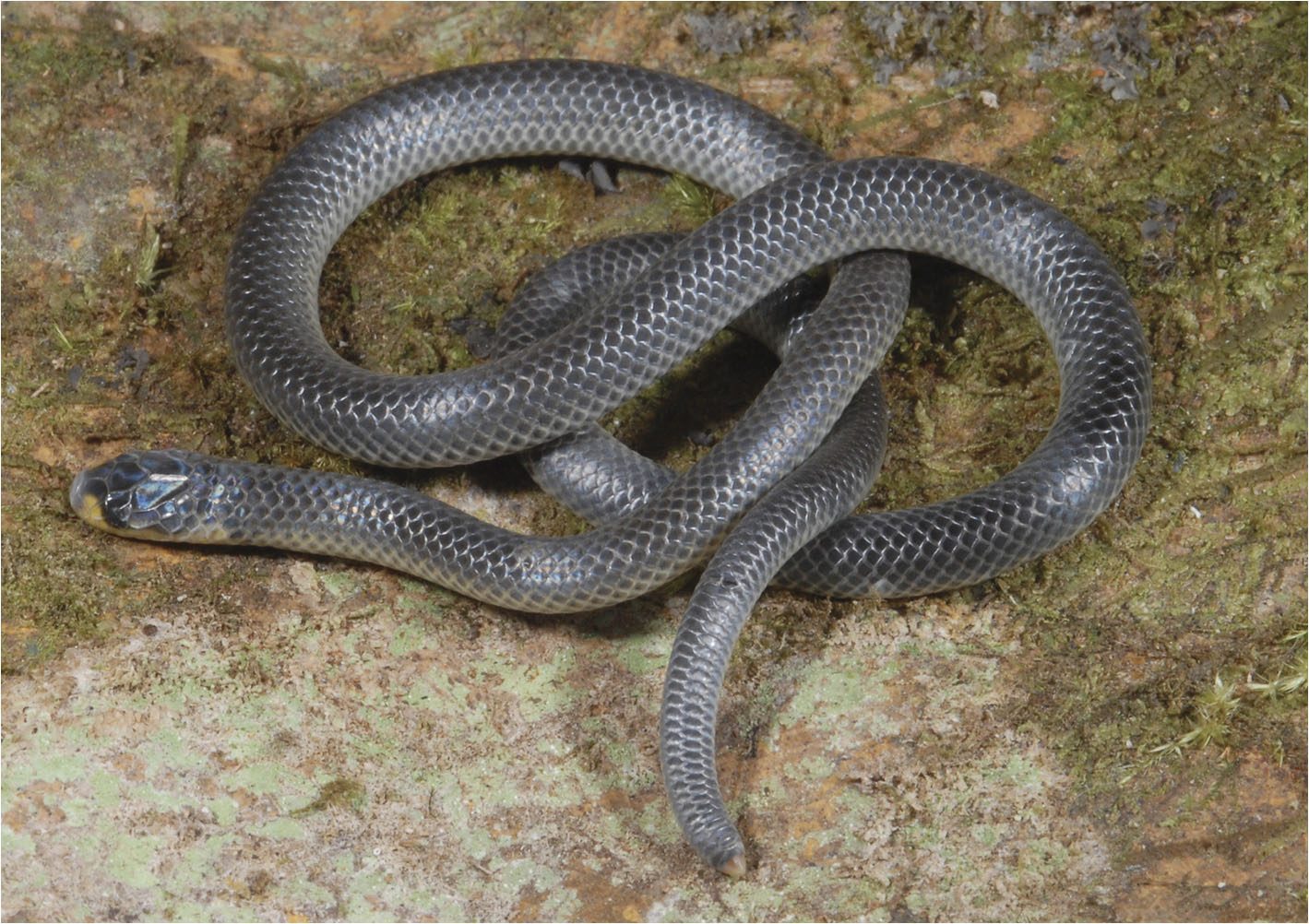
Museum labels can also lie. In 2018 Mark and I tried some forensic historical herpetology: we dug through old expedition narratives and records to show that three specimens with baffling localities were probably labelling mix-ups, not snakes in impossible places.
"To use a computing term, garbage in, garbage out!" — O'Shea & Kaiser 2018
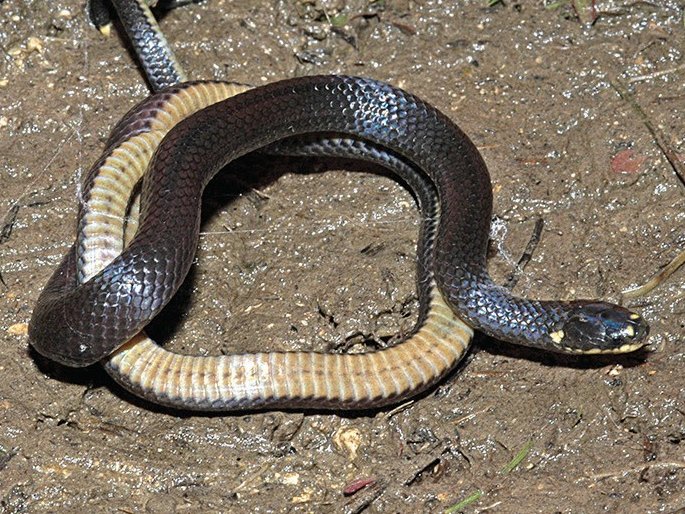
Then came the big one. With Fred Kraus, Mark and I went through 224 museum specimens that had all been called Toxicocalamus loriae. They were not one species. In 2022 we brought three old, forgotten names back into use and described three species new to science: T. atratus, "dressed in black," from the Central Highlands; T. vertebralis, named for the dark stripe down its back; and T. spilorhynchus, the "spot-snout."
Fred Parker's memories and field notes from the 1960s turned out to be treasure. At Kundiawa, where the black species was common, 88 of them were obtained from gardens on a single day, 3 December 1967; most were found by day under piles of vegetation in sweet potato gardens. One female laid eggs on 25 May 1964, and one of them hatched on 23 December: an incubation of seven months.
Why it matters
In 2015 the genus held 11 species and one subspecies. Today it holds more than twenty, and I expect more to come. Most of those discoveries were not made by hacking through jungle, but by looking again at specimens collected decades ago and at the notes of the people who collected them.
Every one of those specimens passed through many hands: a villager who killed a snake in a garden, a patrol officer who kept it, a curator who catalogued it, a technician who packed a loan. Natural history collections are how we know what lives on Earth, and some of their best secrets are still sitting on the shelves, under the wrong names.
The papers
- (2015) A new species of New Guinea worm-eating snake, genus Toxicocalamus (Serpentes: Elapidae), from the Star Mountains of Western Province, Papua New Guinea, with a revised dichotomous key to the genus Bulletin of the Museum of Comparative Zoology 161(6): 241–264
- (2018) Rediscovery of the rare Star Mountains Worm-eating Snake, Toxicocalamus ernstmayri O’Shea et al., 2015 (Serpentes: Elapidae: Hydrophiinae) with the description of its coloration in life Amphibian and Reptile Conservation 12(1): 27–34
- (2018) The taxonomic history of the enigmatic Papuan snake genus Toxicocalamus (Elapidae: Hydrophiinae), with the description of a new species from the Managalas Plateau of Oro Province, Papua New Guinea, and a revised dichotomous key Amphibia-Reptilia 39(4): 403–433
- (2018) Erroneous environs or aberrant activities? Reconciling unexpected collection localities for three New Guinea Worm-eating Snakes (Toxicocalamus, Serpentes, Elapidae) using historical accounts Herpetological Review 49: 189–207
- (2020) Discovery of the second specimen of Toxicocalamus ernstmayri O’Shea et al., 2015 (Squamata: Elapidae), the first from Papua Province, Indonesia, with comments on the type locality of T. grandis (Boulenger, 1914) Bonn Zoological Bulletin 69(2): 395–411
- (2022) Hidden diversity in semi-fossorial Melanesian forest snakes: A revision of the Toxicocalamus loriae complex (Squamata, Elapidae) from New Guinea Vertebrate Zoology 72: 997–1034