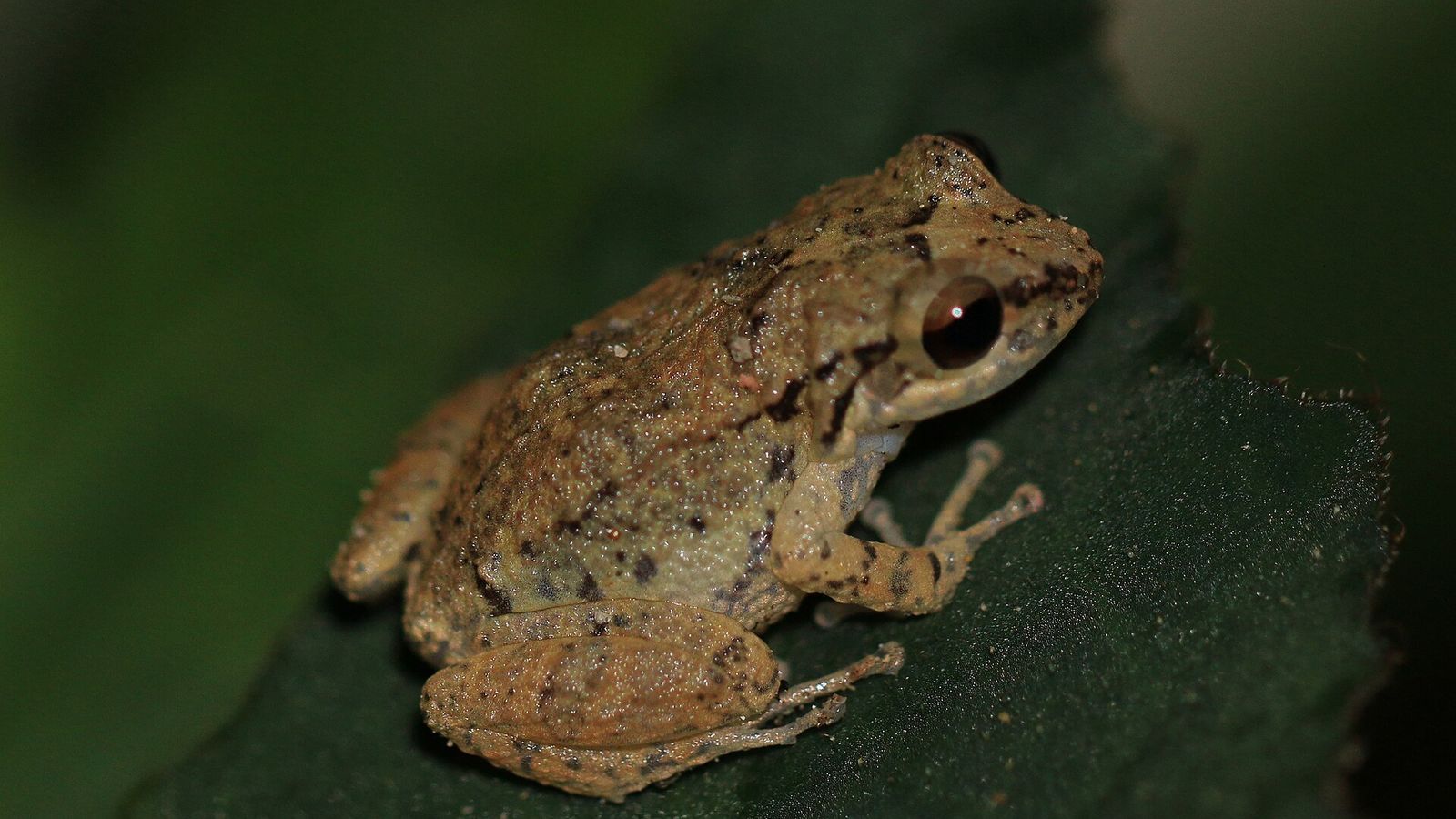
The Frog That Hitchhiked
Photo: Charles J. Sharp, CC BY-SA 4.0, via Wikimedia Commons
In 1967 the herpetologist Albert Schwartz wrote something about the island of St. Barthélemy that stayed with me. The island, he said, "seems suitable ecologically" for frogs, yet the "stillness of the nights" there "is startling to anyone who is accustomed to hearing tropical frog choruses." No frog had ever been recorded on St. Barths.
When I visited in 1989 and 1990, the nights were no longer still. I found three small populations of whistling frogs calling away, all three of them at spots with a lot of recent building work: the grounds of the Hotel Jean Bart in St. Jean, the Hotel La Normandie in Lorient, and Anse aux Flamandes. They were the first amphibians ever documented on the island. The obvious question was: where had they come from?
Two frogs that look alike
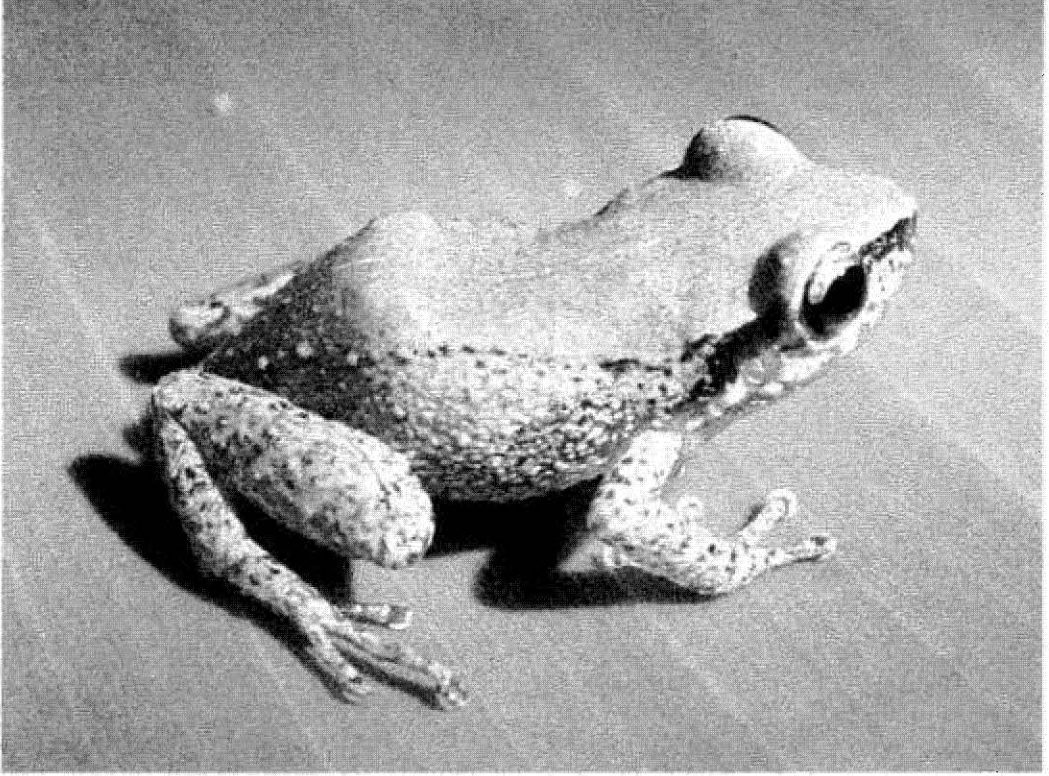
Whistling frogs are small brown frogs of the genus Eleutherodactylus. They are the reason a Caribbean night sounds the way it does. Two species are especially widespread in the Lesser Antilles, the chain of small islands that arcs from the Virgin Islands down to Grenada. They are Eleutherodactylus johnstonei, Johnstone's whistling frog, and E. martinicensis, the Martinique whistling frog. They are so alike that museum curators confused them for decades. In the 1930s the name johnstonei was quietly dropped altogether, and it took until the 1960s to come back into use.
These frogs have one habit that matters a great deal for this story. They skip the tadpole stage. Scientists call this direct development: the eggs are laid on land and hatch as tiny, fully formed froglets. So these frogs don't need a pond or a stream. A damp flowerpot will do.
To work out which frogs had reached St. Barths, I carried 25 of them alive back to the lab at McGill University in Montréal. I compared them with nearly 500 frogs from across the islands, using twenty body measurements per frog. I also compared their proteins, since small differences in those can tell populations apart, and I recorded their calls in the field on a Sony Walkman. The St. Barths frogs were not johnstonei, the species found on all the neighboring islands. They were martinicensis, and they most closely matched frogs from Guadeloupe, 220 km to the south. Guadeloupe is far away on the map, but it is close in business terms, since both islands are part of the French Antilles.
The frogs had almost certainly arrived with construction materials shipped to the building sites where I found them.
A map drawn by trade
That small discovery led me to a much larger idea, which I published in 1992. For three centuries the Lesser Antilles were split between British and French colonies, and laws on each side banned trade with the other. Sugar plantations replaced forests, and the islands grew so little food that fruit and vegetables had to be shipped in constantly from neighboring islands. That is exactly the kind of cargo a whistling frog can hide in.
"The present ranges of Eleutherodactylus johnstonei and E. martinicensis in the Lesser Antilles match the former boundaries of colonial trade exactly." — Kaiser 1992
Broadly speaking, johnstonei lives on the old British islands and martinicensis on the old French ones. The frogs had followed the colonial shipping routes.
A long list of stowaways
Once I started looking, E. johnstonei turned up in the historical record over and over. By 1997 I could show that, among amphibians, only the cane toad was more widespread. The difference was that the cane toad was mostly moved on purpose, while the whistling frog mostly traveled "frequently unnoticed by the vectors of transport," as I put it then.
The frog's history is full of surprises. It was named in 1914 after Robert S. Johnstone, the Chief Justice of Grenada. But the frogs may have reached Grenada from Barbados only around 1885, and even the scientist who named them, Thomas Barbour, suspected the frogs weren't native to where he found them. He wrote that he was "very loath to designate as types of a new species individuals from a locality of which the species is not truly a native."
Other introductions were deliberate. In 1880 Lady Bedford released a single pair at Admiralty House in Bermuda. In 1890 Lady Blake, the governor's wife, introduced the frogs at Government House in Kingston, Jamaica. Around 1885 a small population turned up in a greenhouse at Kew Gardens in London. In 1969 a couple on the island of Bequia carried twelve frogs over from St. Vincent. Their name, fittingly, was Johnston.
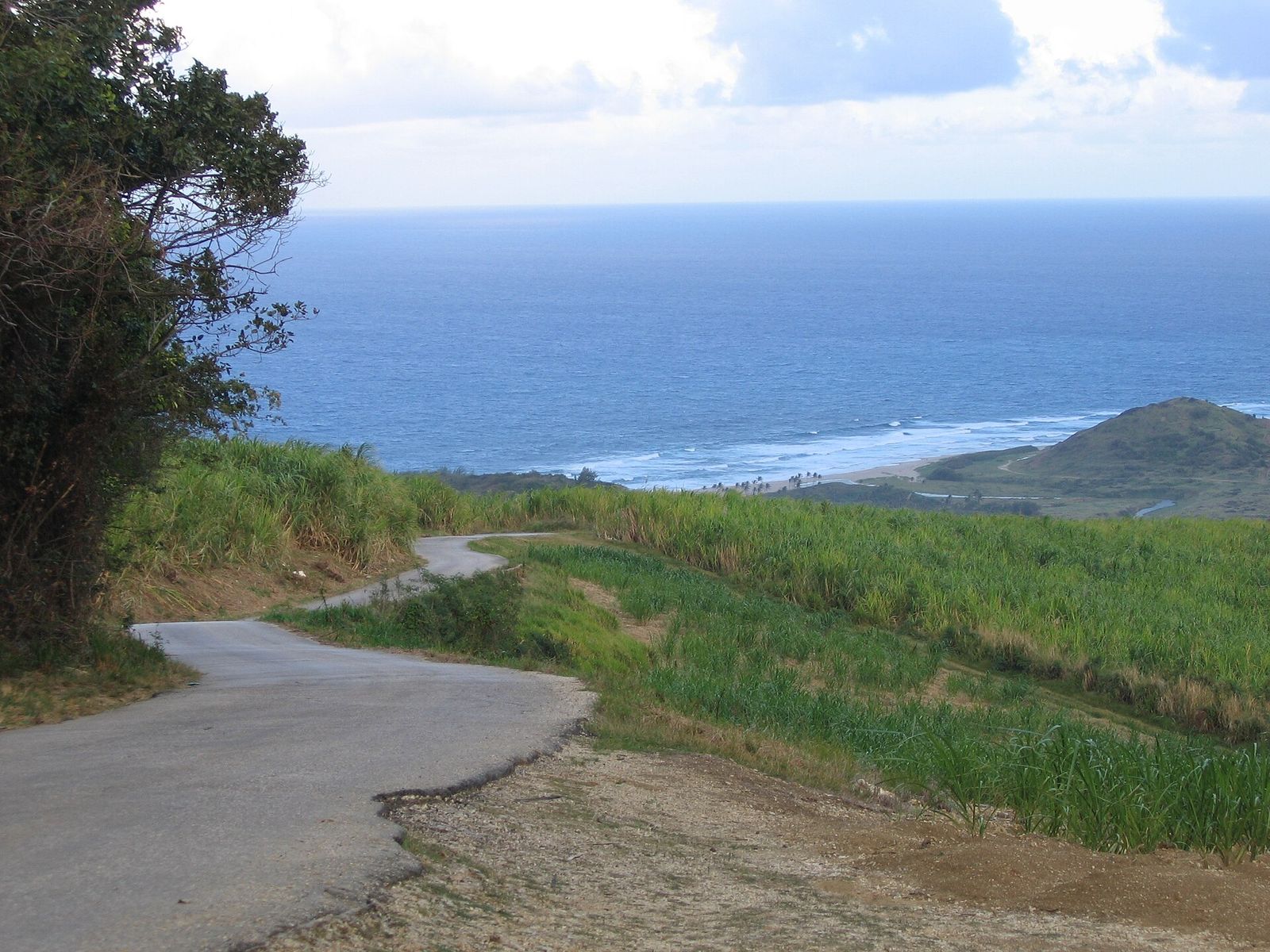
On Barbuda, a very dry island, the frogs once lived only in the water cisterns of Codrington village. On Barbados I could hear them calling from inside the sugar cane fields. On my first frog-collecting trip to the Caribbean, over New Year's 1988/89, my cousin Helmut Schwarten and I saw in the new year sitting in a Barbados cane field at midnight, sipping champagne out of plastic specimen cups and surrounded by a chorus of E. johnstonei.
Hurricane relief with a passenger
Dominica gave me a chance to watch an invasion almost as it happened. People suspected that johnstonei had arrived with the emergency supplies sent after Hurricane David in 1979. In November 1993 and September 1994, my colleague Ross Wagenseil and I surveyed the island's west coast by ear, recording calling frogs at stop after stop so that we could tell the two whistling frog species apart by their voices. Scientists call this an audio transect.
The frogs were concentrated right where foreign goods came ashore: around the cement jetty, Canefield village and airport, and the deep-water harbor. They were not yet in the capital, Roseau. Fifteen years after the hurricane, they had spread only along two main roads. The steep, intact forests that give Dominica its nickname, the "Nature Isle of the Caribbean," seemed to be holding them back.
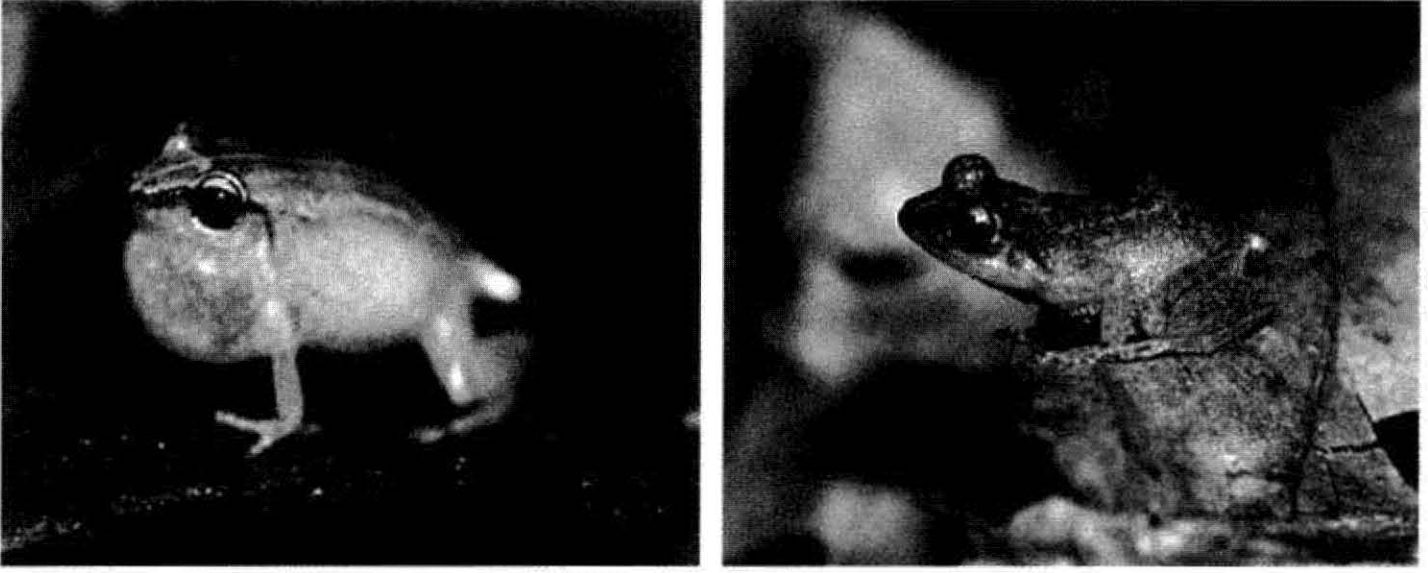
The same pattern showed up on St. Vincent. In 1991 the island's own frog, E. shrevei, lived around the crater of the Soufrière volcano, while johnstonei stayed down in the coconut groves at the foot of the mountain. By 1994 johnstonei had reached the upper slopes. It had not come up through the forest, but along the bare ground left by the volcano's eruptions in the early 1980s.
That became my main conclusion. E. johnstonei is not a bully that forces its way into healthy forest. It waits for disturbance, whether a new road, a plantation, a lava flow or a hurricane, and moves in. Once it is established, the native frogs rarely come back.
"La rana burguesa"
The story didn't end in the islands. The frog was probably released in a Caracas garden in the late 1950s, perhaps just to enjoy its song, and in 1967 more were let go on purpose in Cumaná. In September 2000, Lee Grismer and I found it calling around hotels in Maturín and in Caripe, the mountain town that tourists pass through on their way to the famous Cueva del Guácharo.
We had not heard it in the small city of Irapa during that 2000 trip. A year later, in September 2001, it was there. So my colleagues and I surveyed every street in the downtown area by ear and mapped where males were calling, block by block. We found them in gardens, empty lots and construction sites, but not yet in the city's three parks.
In Venezuela the frog even has a nickname: la rana burguesa, the bourgeois frog. Its favorite gardens are full of imported ornamental plants that need watering all year, and only wealthier households can afford that. In 2002 we predicted it would reach every major city in Colombia and Venezuela, and head south along the Andes.
Why a small frog matters
It's easy to smile at a frog that travels in flowerpots. But E. johnstonei is a clear, well-documented case of something happening all over the world: species riding along with trade, and settling wherever people have disturbed the land first. The frogs on St. Barths turned out to be a living record of colonial trade routes, and those in Irapa of the plant business. Their lesson for conservation has stayed the same since I first wrote it down in 1997. Stop further introductions, keep watching where the frogs spread, and above all protect the native forests where the island species still hold their ground.
The papers
- (1992) The trade-mediated introduction of Eleutherodactylus martinicensis (Anura: Leptodactylidae) on St. Barthélémy, French Antilles, and its implications for Lesser Antillean biogeography Journal of Herpetology 26: 264–273
- (1994) Eleutherodactylus johnstonei Catalog of American Amphibians and Reptiles 581: 1–5
- (1994) Eleutherodactylus martinicensis Catalog of American Amphibians and Reptiles 582: 1–4
- (1995) Colonization and distribution of Eleutherodactylus johnstonei Barbour (Anura: Leptodactylidae) on Dominica, West Indies Caribbean Journal of Science 31: 341–344
- (1997) Origins and introductions of the Caribbean frog, Eleutherodactylus johnstonei (Leptodactylidae): management and conservation concerns Biodiversity and Conservation 6: 1391–1407
- (2001) Geographic distribution. Eleutherodactylus johnstonei (Johnstone’s frog) Herpetological Review 32: 54
- (2002) Expansion of Eleutherodactylus johnstonei in northern South America: rapid dispersal through human interactions Herpetological Review 33: 290–294