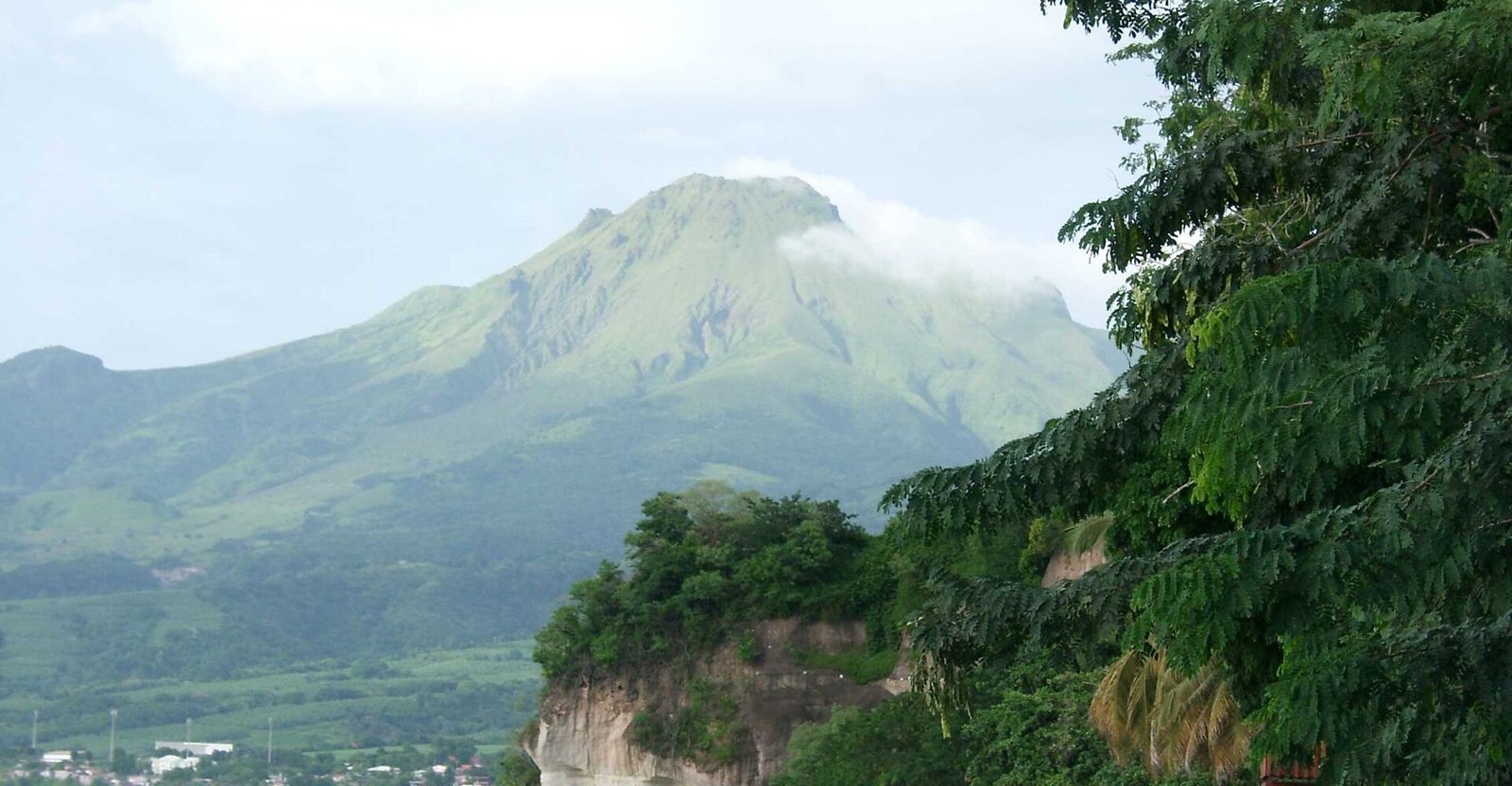
Of Copper Eyes and Ample Nymphs
Photo: public domain, via Wikimedia Commons
"It's right there on the leaf in front of you!"
Heather Gray, my undergraduate field assistant, was getting irritated. It was our last day on Martinique, and for nearly three nights we had been searching the ravines on the slopes of Montagne Pelée, the island's volcano, for a frog. The problem was that I couldn't tell her what it looked like. Nobody could. It had never been described.
I turned my headlamp towards the leaf in the beam of her flashlight and saw a tiny dark-brown frog. "Looks just like another juvenile Eleutherodactylus to me," I said.
"Not that one," Heather said. "The other one, with the squared snout."
The peep on the volcano
The hunt had started months earlier, in January 1990, with my cousin Helmut Schwarten. We were touring Martinique looking for whistling frogs, the small brown Eleutherodactylus frogs I was studying for my PhD at McGill University. One evening we stopped on the slopes of Montagne Pelée to watch the sun go down. I was busy watching the sky change color when Helmut cocked his head.
"What's this?"
"What's what?"
"What's all the peeping over there?"
It took me a moment to tune my ear, which was used to the lower whistle of Eleutherodactylus, to a higher-pitched sound. It sounded like a whole group of frogs that had no business being there. With the light fading we tracked one caller to a small, mossy bush. Helmut took it apart branch by branch, and we both glimpsed a tiny frog-like shape retreating deeper into the dark, until it leapt out through our flashlight beams and vanished. We had a recording of the call, and nothing else. But the words "new species" were now in my head.
Gotcha
Back to Heather and the leaf. With visibly shaking hands, I came up close. I remember thinking: what if I miss, and lose this new species forever? Then I pounced. In one sweep I ripped the whole leaf off the plant, stuffed it into a plastic bag and let go of the greenery inside. At the bottom of the bag sat a small, confused frog with a saffron-colored belly and copper-colored eyes. Its companion, caught soon after, had a yellowish-gray belly and a black throat. Those two were all we found on that trip.
We sent both to Luis Coloma at the University of Kansas. His answer surprised us. This wasn't a whistling frog at all. It was a dendrobatid, a member of the family of poison-dart frogs and their relatives, which live on the South and Central American mainland.
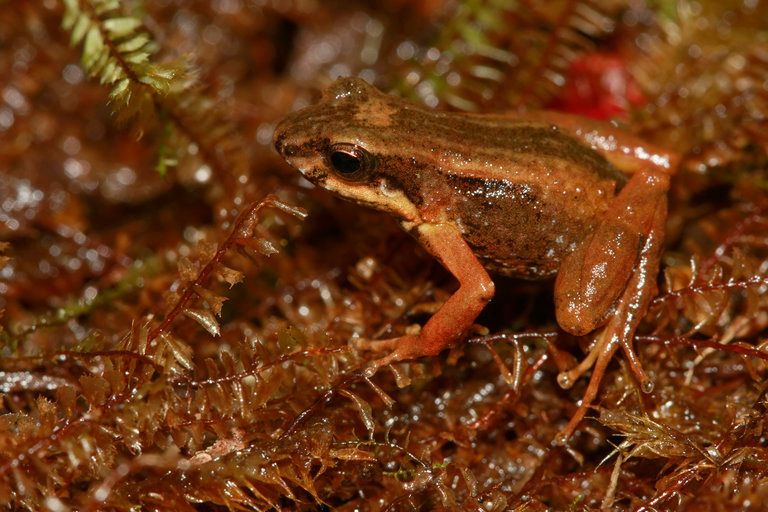
In 1994 Luis, Heather and I described it as Colostethus chalcopis. The name comes from the Greek for "copper-eyed," after the copper sheen on the upper part of its iris. The frog is now called Allobates chalcopis, the Martinique rocket frog, and it is tiny: adults are under 2 cm long. It is also a genuine puzzle. It is the only dendrobatid known to be native to an oceanic island, meaning an island that rose from the sea floor and was never joined to a continent. How its ancestors crossed the sea to Martinique is still unknown. It is too secretive and localized to have hitched a ride with people.
It was also very hard to catch. The frogs call mostly at dawn and dusk and hide under leaves and rocks. As we wrote in the description, "Not one frog was caught without considerable pursuit, often over distances > 10 m."
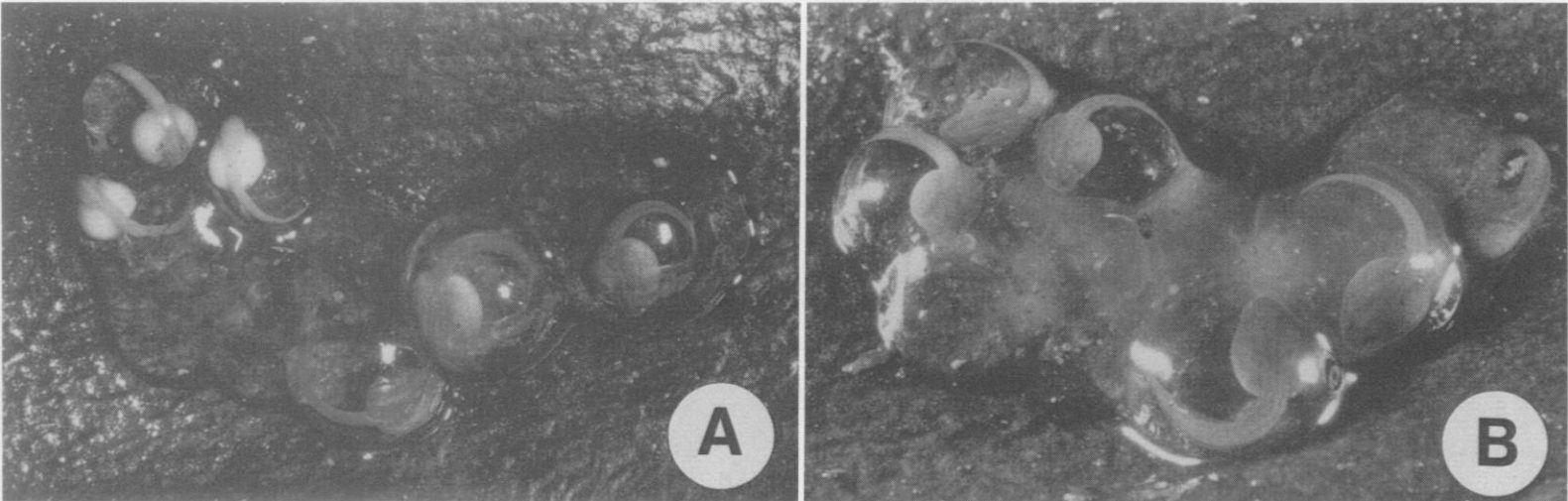
That little copper-eyed frog has followed me ever since. Its name, chalcopis, became my email address.
Ample nymphs
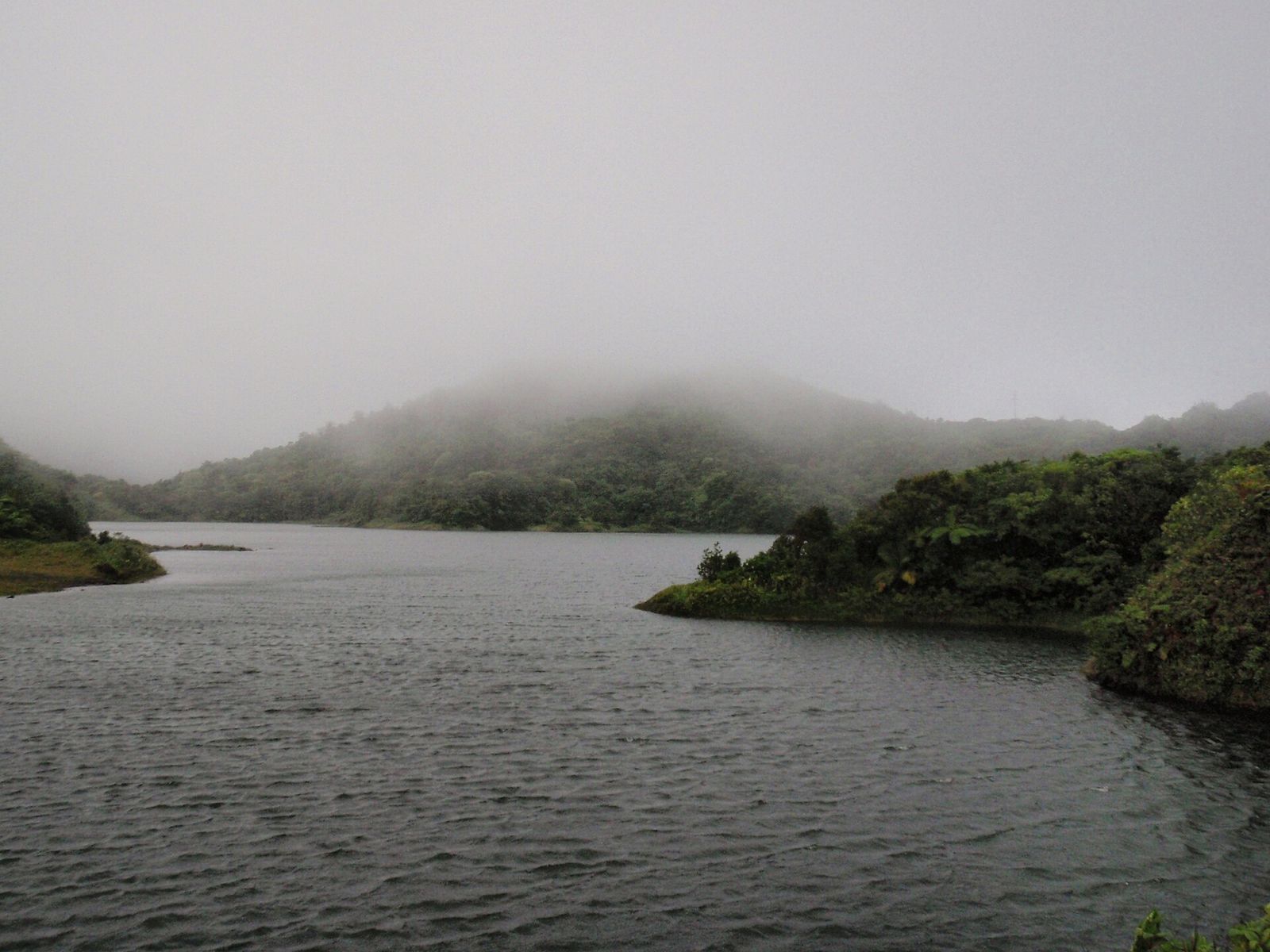
Dominica was the next island to surprise me. Christopher Columbus is said to have described the island as a "crumpled piece of paper" thrown into the sea, and there is always another mountain or cliff ahead of you. A new road had just been cut up the side of Morne Macaque in Morne Trois Pitons National Park, to reach Freshwater Lake and a hydroelectric project. Helmut and I planned to drive up it one evening and count calling E. martinicensis along the way, to see how their numbers changed with altitude.
At about 700 m, on the windy, foggy upper slopes, the calls suddenly changed. Every one of them ended in a click, and they seemed lower-pitched too. We backed down until the clicks stopped, at around 600 m. In between was a quiet gap, about 50 m of altitude where no frogs called at all. By Freshwater Lake the "wheep-click" was everywhere, and the calling males were orange rather than the usual brown.
What a neat population difference, I thought, and then I saw her. Looking downhill from the road, I was eye to eye with a giant orange frog sitting on the branch of a small tree. She was so heavy that the branch sagged and swayed in the gusts and fog. I leaned over, grabbed the bottom of the branch, pulled the tree closer and snatched her.
"Helmut," I called. "Check out this one. It's huge!"
"Oh," he answered, "I just caught a really big one, too."
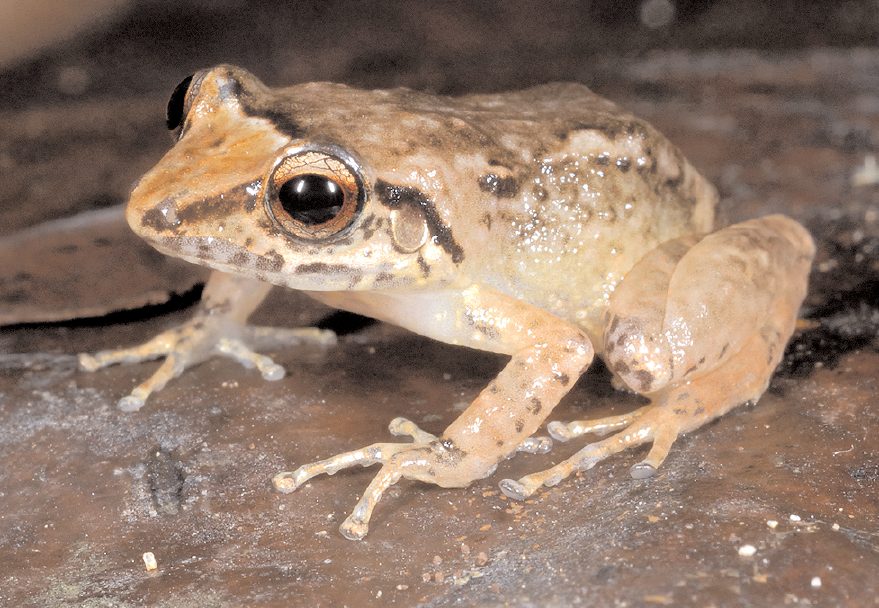
Every orange giant we caught that night was a female. Females of this frog grow to about one and a half times the size of males. That makes them the largest whistling frogs in the Lesser Antilles, sometimes over 5 cm long. By day the frogs are brown, and at night they turn a deep orange. Their call, their size, their proteins and their chromosomes all set them apart. In 1994 David Green, Michael Schmid and I named the species Eleutherodactylus amplinympha.
I thought the name amplinympha was right for a high-altitude frog whose large females you suddenly meet like forest spirits on fog-covered branches.
The name comes from the Latin amplus (large) and nympha, a female spirit of forests and mountains. On an island where stories of forest spirits are part of local lore, it seemed fitting. People on Dominica know the frog as the gounouj.
We reported the find to the Forestry and Wildlife Division and to the field station at Springfield, and it caused quite a stir. People came out with us to see the frogs, and with the help of local foresters we found them across most of the island's higher forests. A photo of the species even made the cover of the local wildlife magazine, The New Forester. I felt the discovery changed how some Dominicans thought about their own forests. Here was a frog that was theirs alone.
A friendly town on Tobago
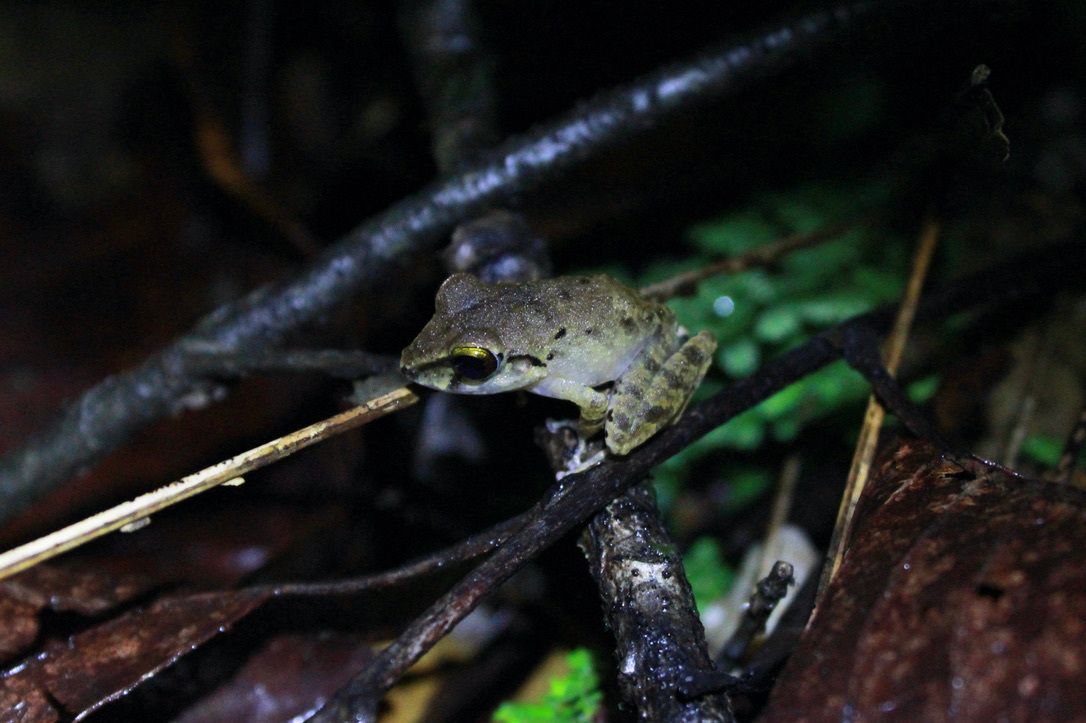
Tobago, farther south, delivered the third new frog. The whistling frogs of its Main Ridge forest had always been counted as a Venezuelan species, E. terraebolivaris. Then, near the village of Charlotteville, my Würzburg colleagues Wolfgang Feichtinger and Michael Schmid realized that the frogs they were hearing sounded wrong for that species. Their calls, body shape and chromosomes all turned out to be different. In 1995 Christine Dwyer (today my wife, Christine Kaiser), Wolfgang, Michael and I described the frog as E. charlottevillensis, now Pristimantis charlottevillensis. We named it after Charlotteville, "whose friendly populace has aided herpetologists during their surveys for many decades."
Why it matters
The Lesser Antilles were supposed to be well known. Naturalists had been cataloguing their frogs for more than a century. Yet within five years, patient listening at dusk turned up a poison-dart frog relative where none should exist, a giant forest frog on Dominica and a new species on Tobago. Each one lives only on its own island, and mostly in mountain forest. That makes their forests irreplaceable, and it is a good reminder that you can still find new species by going out at night and listening.
The papers
- (1994) A new species of Colostethus (Anura: Dendrobatidae) from Martinique, French Antilles Herpetologica 50: 23–32
- (1994) The atypical tadpole of the dendrobatid frog Colostethus chalcopis (Anura, Dendrobatidae) from Martinique, French Antilles Journal of Herpetology 28: 374–378
- (1994) Systematics and biogeography of Eastern Caribbean frogs of the genus Eleutherodactylus (Anura: Leptodactylidae) with the description of a new species from Dominica Canadian Journal of Zoology 72: 2217–2237
- (1995) A new species of Eleutherodactylus (Anura: Leptodactylidae) from Tobago, West Indies, and its morphometric and cytogenetic characterization Herpetological Natural History 3: 151–163
- (2003) Chromosome banding of six dendrobatid frogs (Colostethus, Mannophryne) Herpetologica 59: 203–218
- (2003) Of copper eyes and ample nymphs Islands and the Sea: Essays on Herpetological Exploration in the West Indies (RW Henderson & R Powell, eds.). Society for the Study of Amphibians and Reptiles, Ithaca, New York pp. 249–254
- (2010) Eleutherodactylus amplinympha Catalog of American Amphibians and Reptiles 863: 1–4