Counting Frogs in the Miombo
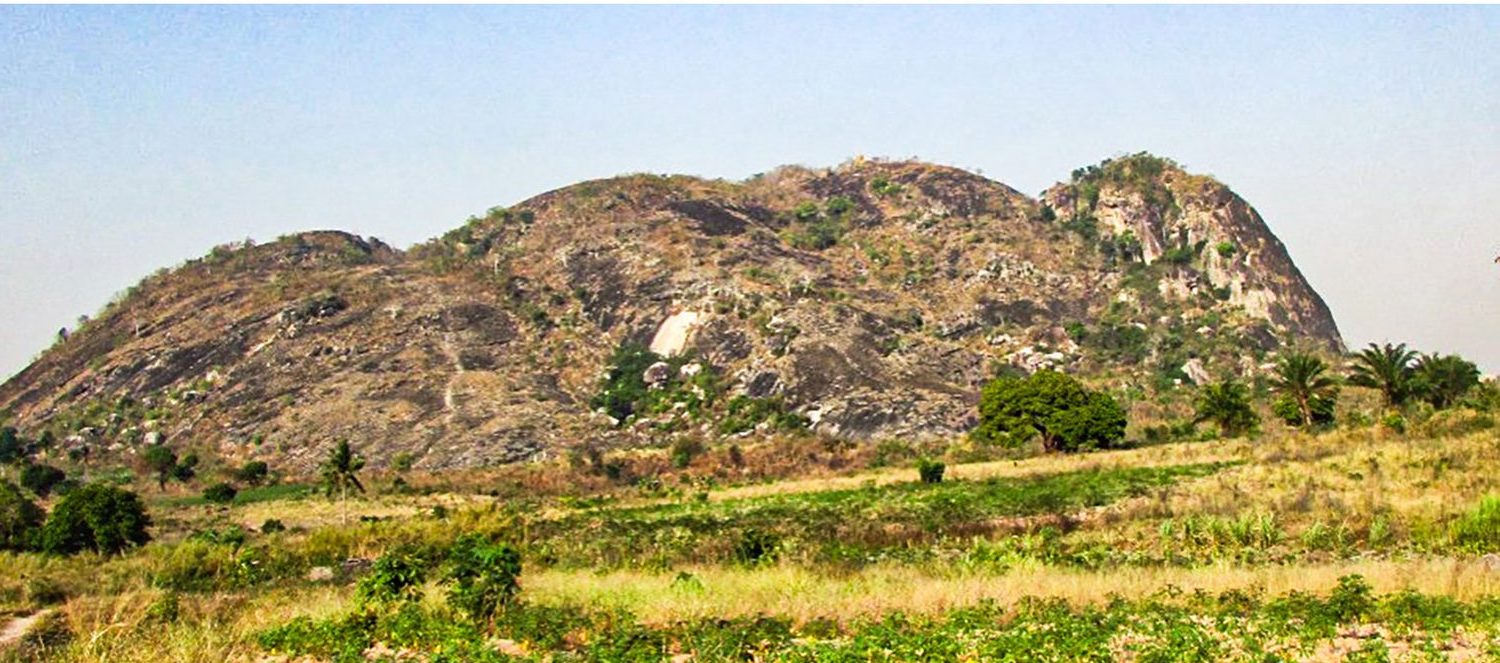
Photo: Avelino Miguel, from Miguel et al. 2025, Herpetology Notes
Around 70 percent of Mozambique is covered by a single kind of landscape, miombo woodland. It is an open, dry forest of low, spreading trees, and in the rainy season the grass grows tall beneath them. Miombo stretches across much of south-central Africa. You would think the most common habitat in a country would also be the best known. It is the opposite.
Most herpetologists who came to Mozambique went to the exciting places, the misty mountaintops and isolated forests where new species are most likely to turn up. That approach has worked well, but it left the ordinary landscape, where most Mozambicans actually live and farm, largely unexplored. My colleague Avelino Miguel set out to change that. Avelino taught in the Faculty of Agronomy and Forestry Engineering at Zambezi University in Mocuba, in Zambezia Province. Over several years I have had the pleasure of working with him to turn his fieldwork into a series of papers.
Starting on campus
Avelino began close to home, on and around his own university campus, a patch of dry miombo of about 57 hectares on the edge of Mocuba. In April and May 2021 he and his team monitored six sampling sites for 48 days. They combined two methods. One was walking and searching by hand. The other was pitfall traps, buckets sunk into the ground along low plastic fences that steer passing animals into them.
They recorded 150 frogs of 12 species. Almost half were Shovel-footed Squeakers, Arthroleptis stenodactylus, small brown leaf-litter frogs that skip the tadpole stage altogether. Twelve species in a university's backyard may not sound dramatic. But until then there had been almost no careful counts of frogs in Mozambique's dry miombo at all.
Later, with Berta Sitole, Nando Calonga and other colleagues, Avelino did the same for reptiles on the campus and on Mount Morué, a bare granite dome just outside the city. They found 23 species. Most came from the pitfall traps. The commonest was a tiny dwarf gecko, Lygodactylus grotei. One find stood out. A juvenile Boulenger's Scrub Lizard, Nucras boulengeri, was seen hunting insects near a house. Its bright red-orange tail is more than twice as long as its body. The nearest earlier record of the species was 662 kilometres to the north.
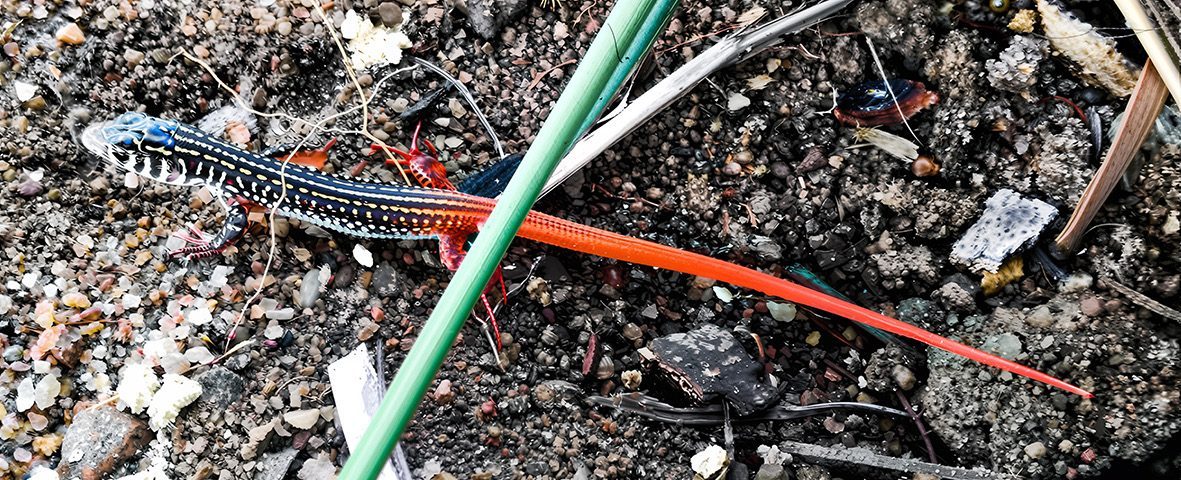
We called that paper "Beyond the asymptote." In a survey, the asymptote is the point where extra effort stops adding new species. This time our counts came close to it, so we can be fairly confident we found nearly everything there. We dedicated the paper to Arlindo Matsinhe, a co-author on the frog survey, who had since died. He had built a small reference collection of amphibians and reptiles at the faculty so that students could learn to identify the animals around them.
Gilé National Park
Avelino's biggest project was in Gilé National Park, 2,861 square kilometres of miombo, riverside forest and dambos in the northeast of Zambezia Province. Dambos are grassy hollows that flood in the rains and dry out completely in the dry season. Between February and June 2019, he sampled three sites in each of the three habitats.
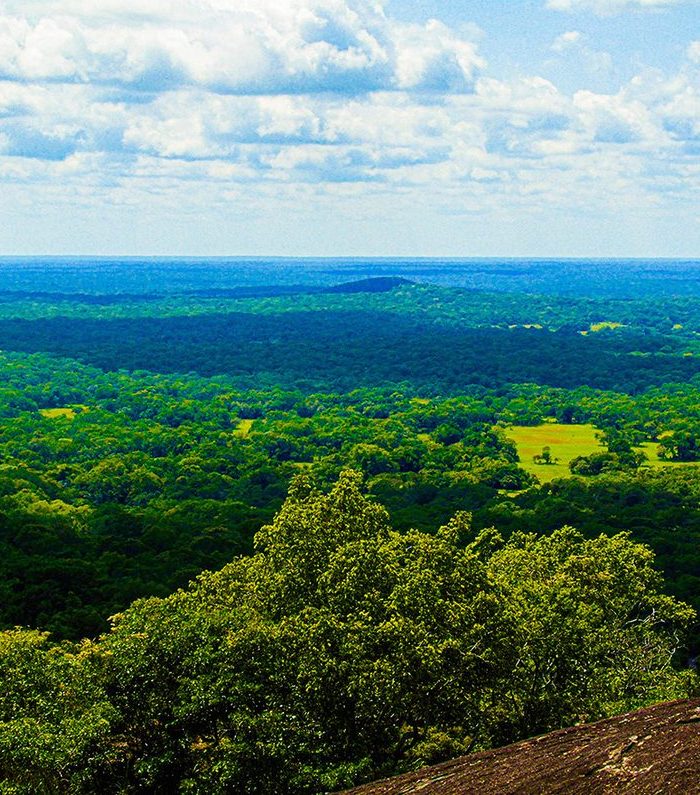
The reptile count came to 36 species: 16 lizards, 16 snakes, three turtles and a crocodile. These were the first reptile records for this part of the country. Miombo woodland held the most, 25 species. The frog survey turned up 22 species, about a fifth of all the frogs known from Mozambique. Several of them were a very long way from anywhere they had been recorded before. A Beira Pygmy Toad, known only from around the port city of Beira, turned up more than 880 km to the north. A Golden Leaf-folding Frog, previously known only from southern Mozambique, appeared more than 800 km away. A bullfrog, Pyxicephalus angusticeps, extended its known range by more than 770 km. On the reptile side, a tiny leaf chameleon, Rieppeleon brachyurus, was found resting in the grass 350 km beyond its nearest known records.
I especially like that the reptile paper lists the local names in Elomwé, the language of the park rangers. The Mozambique agama is nipokololo, the puff adder evili, and both species of hinged tortoise are simply kaba. The rangers also described several animals we did not find ourselves, among them the Gaboon viper, which they call evili thanu. That tells us there is more still to record.
We also noted a threat. In the park we saw impounded vehicles loaded with cut wood, clear evidence of illegal logging.
Dinner, feet first
Fieldwork also brings moments that no survey design can plan for. On 4 March 2019, at 5:20 in the afternoon, after a light rain in the Gilé miombo, Avelino heard a frog giving distress calls from the leaf litter. He found a Snouted Night Adder, Causus defilippii, a small, stout African viper, swallowing a Shovel-footed Squeaker. The frog was still alive and had puffed itself up to look bigger, which is a standard frog defence. It did not help. The unusual part was the direction. The snake was swallowing it feet first.
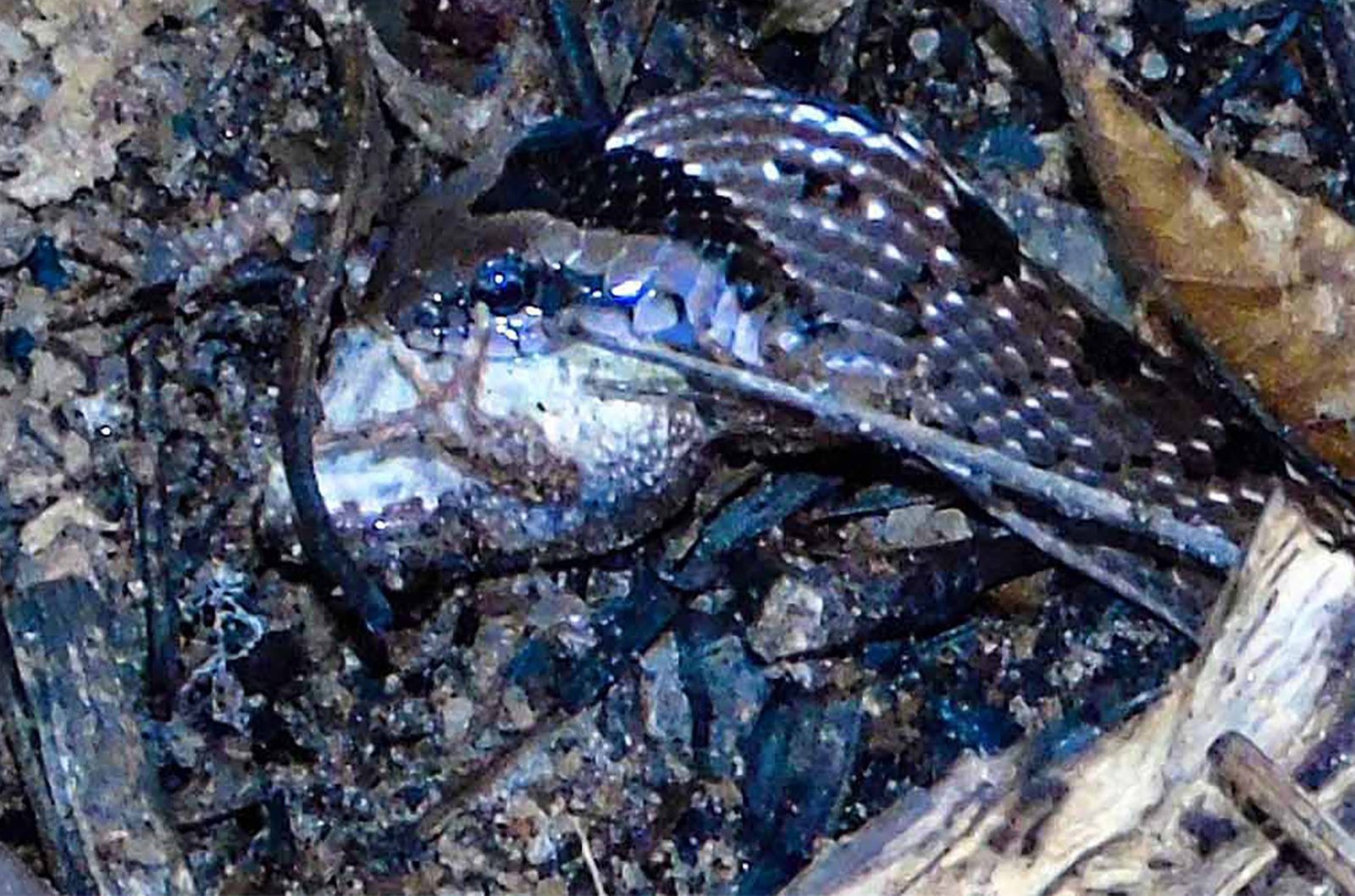
Night adders are known to eat mainly frogs, but no one had described one swallowing a frog feet first. It was also the first published record of a live predator-and-prey encounter for either species, and the first for these animals in Mozambique. We titled the note "There is a first for everything."
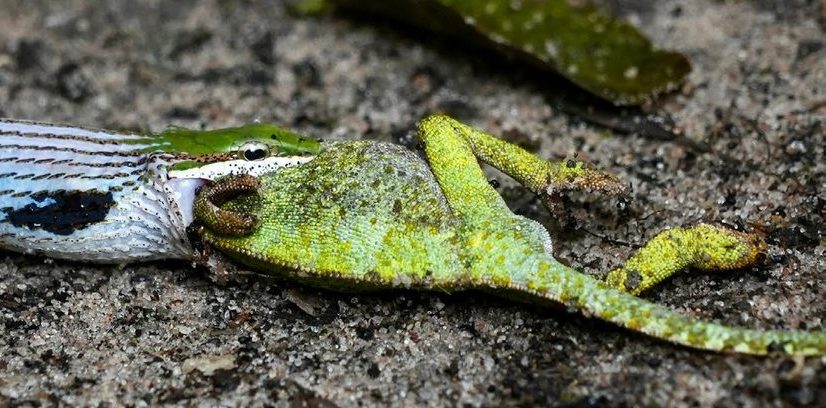
Later, in the Zambezi Delta, colleagues at Zambeze Delta Conservation twice found an Eastern Vinesnake eating a Flap-necked Chameleon. Both animals are tree specialists. The chameleon relies on camouflage and eyes that swivel independently. The vinesnake looks like a twig and has unusually sharp, forward-facing vision. The attacks almost certainly began in the branches, but both pairs ended up on the ground. In the first case the snake seemed to have trouble swallowing its heavy prey on the sand. So it dragged the limp chameleon up a staircase and into a tree, and only then began to eat.
The snakes that bite people
Counting animals is one thing. But in rural Mozambique, snakes are also a public health problem. Snakebite is something I think about a great deal, because I lead a multinational project on snake venoms in Asia. So I was glad to help when Avelino's team set out to measure snakebite in Nicoadala District, a coastal rice-growing area of Zambezia.
The team went through the handwritten registers of three health centres for the six years from 2015 to 2020. They found 430 snakebite cases, about 72 a year. Bites peaked from November to January, when rice fields are planted in flooded paddies. People walk on the narrow earth banks between them, and snakes use those same banks. Women were about 27 percent more likely to be bitten than men, most likely because they do much of the farm work. The district had one doctor for its entire population of more than 186,000 people.
The registers were missing almost everything else. There was no record of which snake had bitten anyone, what treatment was given, or whether the patient lived. Then, in 2023, Cyclone Freddy, the longest-lasting tropical cyclone ever recorded, crossed Mozambique twice. Both our electronic database and the original notebooks were lost in the storm. To help the next study, we designed a simple snakebite intake form in English and Portuguese for health centres to use.
The most common landscape in a country can still be the least known.
Why the ordinary matters
None of these papers describes a new species, and that is rather the point. Knowing which animals live in the everyday landscape, how common they are, what eats what, and which snakes send people to the clinic is the groundwork for everything else. That includes park management, conservation assessments and antivenom supplies. It also means that Mozambican scientists and students hold the knowledge of their own wildlife, instead of it arriving in occasional snapshots from visiting expeditions. Watching Avelino and his team build that knowledge has been one of the real pleasures of my recent work.
The papers
- (2022) Terrestrial frog diversity in a dry Miombo woodland in Mocuba, northern Mozambique Herpetology Notes 15: 769–779
- (2023) There is a first for everything: feet-first feeding by a Snouted Night Adder, Causus defilippii (Jan, 1863), on a Shovel-footed Squeaker, Arthroleptis stenodactylus Pfeffer, 1893, the first live predator-prey interaction reported for these genera and species and the first for Mozambique Herpetology Notes 16: 623–626
- (2024) Diversity and natural history of reptiles from coastal environments in Gilé National Park, northern Mozambique Herpetology Notes 17: 173–199
- (2025) Snakebite in Nicoadala District, central Mozambique: a first assessment based on hospital records Transactions of The Royal Society of Tropical Medicine and Hygiene 119: 872–880
- (2025) Assessing amphibian richness in coastal habitats of Gilé National Park, northern Mozambique, with a key to species identification Herpetology Notes 18: 635–650
- (2025) Beyond the asymptote: a near-complete reptile inventory in the Miombo woodland and on Mount Morué, Mocuba Municipality, with a major range extension for the lizard Nucras boulengeri Neumann, 1900 Herpetology Notes 18: 1051–1071
- (2026) Arboreal duels in a shared niche: direct observations of vinesnake (Thelotornis mossambicanus) predation on chameleons (Chamaeleo dilepis) reveal complex foraging dynamics African Journal of Ecology 64: e70190