Three Bites on Lombok
Photo: Mark O'Shea
Every expedition leader worries about the students getting sick. On our eighth trip to Timor-Leste, in June 2013, the one who got sick was me.
Phase VIII was an international team of eleven. Mark O'Shea came from the University of Wolverhampton and Sven Mecke from Marburg University in Germany. Julia Pozo and Claudia Rivas came from Victor Valley College. Kevin Burns and Jay Paris came from James Madison University in Virginia. Britta Döring and Franziska Wagner were Sven's students from Marburg. Laca and Paulo Pinto, by now graduates, joined us in Dili.
Following Wallace
We did not go straight to Timor. Mark's trip started badly: at 4:25 in the morning a text told him that his flight from London had been cancelled because of a French air-traffic control strike. British Airways rebooked him on a direct flight to Kuala Lumpur, and he wrote that it "was a better option than my original flights." We met up there and worked our way east through Bali to the island of Lombok.
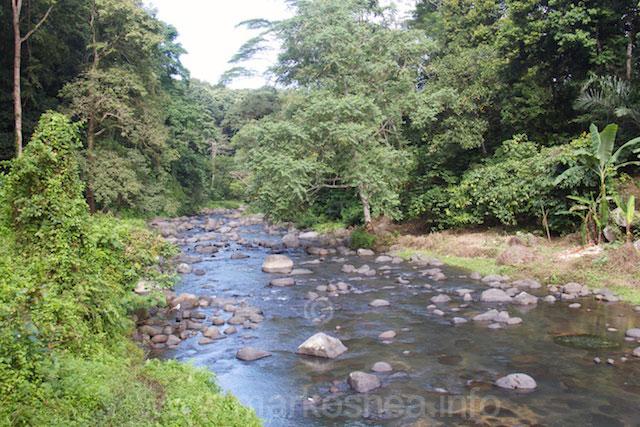
Mark titled his notes for 17 June "Following Alfred Russel Wallace." Lombok sits just across a deep, narrow strait from Bali, and it was there that Wallace noticed that the birds on either side were strikingly different. That boundary is now called Wallace's Line, and a detour to see it is a pilgrimage for any biologist working in the islands. On Lombok I saw three tiger mosquitoes, the day-flying Aedes kind. They are big and obvious, and I even killed one to show my students. I do not remember being bitten, but I do remember having one sizeable bite at the end of that day. I did not think anything of it.
On 18 June we flew from Bali to Dili, just over an hour on Sriwijaya Air. In the baggage hall Mark lifted one of our heavy equipment cases and, in his words, "pulled my back badly."
A pipesnake in the banana garden
Mark's back meant he stayed at our base the next day to work on photographs, and I took the team out. We went to the place where the Comoro and Bemos rivers meet, a few kilometres south of Dili, where three municipalities touch: Dili, Liquiça, and Aileu. We searched the dry riverbed, the river cliffs, and the banana gardens.
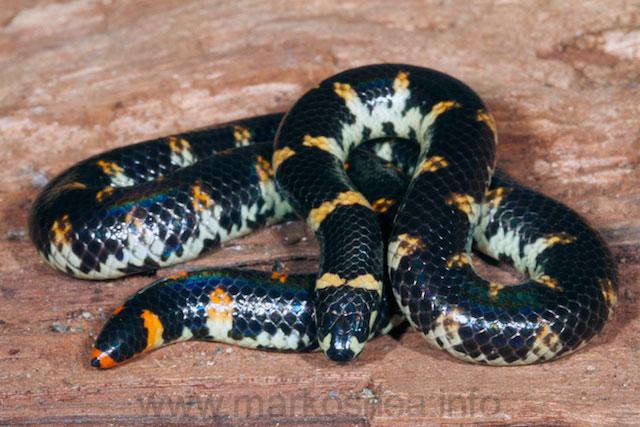
In one of the banana gardens Sven raked back the leaves and found a Boulenger's pipesnake, Cylindrophis boulengeri. Pipesnakes are burrowers, and as Mark wrote, "being fossorial (burrowing) they are often overlooked and poorly sampled in collections." Mark counted it as only the 13th specimen ever collected, and I think at that point it really was. We included it in our 2015 update on the herpetofauna of Timor-Leste. None of us except Laca had ever seen one alive. We planned to surprise Mark with it when we got back, but, as he wrote, "Laca blurted it out and spoiled their surprise."
Two crocodiles and a chicken
On 22 June we went down to the dock for the Saturday ferry to Ataúro, only to find that our vehicle places had been given away. We had learned the hard way that fieldwork on Ataúro needs a vehicle, so we cancelled. That evening Sven found a young Timor monitor lizard in the grounds of our hotel.
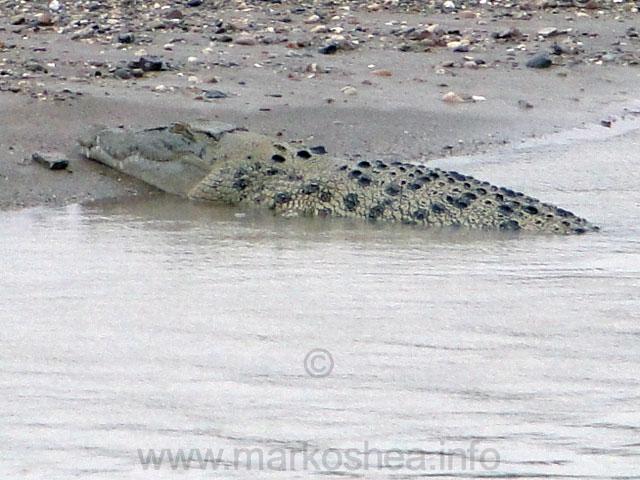
The next day we set off instead on the 200 km drive east to Com, near the country's eastern tip. I drove one of our two Troop Carriers, with most of the kit tied under tarpaulins on the roof. The rivers were swollen with unusually heavy rain, so we slowed at every bridge to look for crocodiles. Britta spotted a 4-metre saltwater crocodile on the riverbank below the Seisal River bridge in Baucau Municipality. Sven found a 3-metre one on a sandbank by the Malailada River bridge in Lautém.
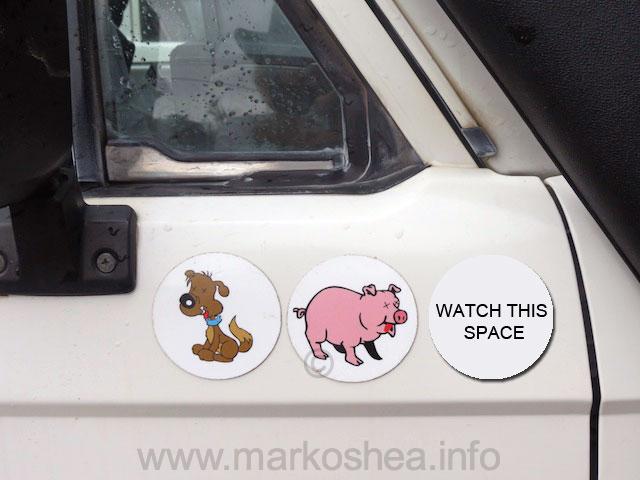
The third animal of the day was less fortunate. On one of the bridges I ran over a chicken, and I paid its owner for the loss. Mark noted that earlier phases had cost a puppy and a piglet, and that plans were being made for another "'Hinrich's Kills' decal." I would like it on the record that the crocodiles were unharmed. I tell this because it shows how tricky doing research in Timor-Leste can be.
The day after that it was Mark's turn. On a new forest road north of Com, his Troop Carrier slid in deep mud towards a gorge. "Anymore of this and I was going over, so I decided to abandon the Troopie," he wrote. I drove the same road in mine without trouble, and we all rode back together while the rental company sent help from Dili.
Dengue
By 25 June I was not well. Rain had cancelled our trip to Jaco Island, so the team hiked on the limestone plateau above Com, near the village of Raça, looking for a night skink we had seen but not caught. Mark wrote that "Hinrich told me he felt too unwell to join up on the hike," and I stayed in the vehicle. That afternoon the team released a rescued young hawksbill turtle into the sea at Com.
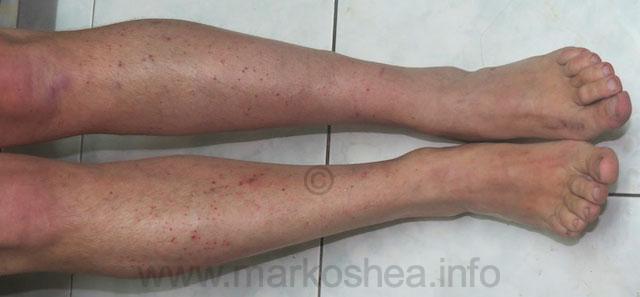
On 26 June we left Com at 9:30, and I managed to drive almost six hours back to Dili so that I could see a doctor. That afternoon, at the Stamford Clinic, the diagnosis was dengue fever, a viral disease spread by mosquitoes. My platelet count was critically low, and I was told to come back for another test the next morning. That morning the count was the same as the afternoon before, which meant it had bottomed out. Had it been any lower, I would have been medevac'd to Darwin that same day. When I went back the following morning, my platelets were climbing again.
I was mostly bedridden for six days. Based on how the disease developed in me, Lombok is the only place where I could have caught it. It was my first (and, I hope, only) bout of dengue, and nobody else on the team fell ill. It is not called breakbone fever for no reason: it is debilitating. My sense of taste was way off, too. Water tasted terrible, and only adding an entire lemon to a 1.5-litre bottle made it drinkable.
The team carried on without me. They went back to the Comoro River, collected toads from the roads, and spent a last day on 29 June among the skinks of the Meleotegi River in the mountains. The Asian toads from those two weeks went into our study of what this invasive toad actually eats. I did what I could from my room. Mark described how I would "emerge from his room a few times a day for a limited period, visit the hospital, examine specimens collected by the team, make suggestions for fieldwork locations, and then return to his room."
A President in first class
On 1 July the team made its farewell visits. We called on Constâncio da Conceição Pinto, whom Mark's notes call the Foreign Minister; he was actually the Minister of Commerce, Industry and Environment. That evening the American ambassador, Ms Fergin, gave us a barbecue at the US Embassy.
On 2 July we flew out to Bali on Sriwijaya Air, about an hour and a half late. Sitting in first class was José Ramos-Horta, the former President, who had supported our work from the very beginning. By then we had met six or seven times. The first was in December 2008, a half-hour coffee at his private residence, arranged by Claudia Abate (before she married and added Debat), that turned into a visit of more than two hours. We really hit it off. He even lifted his shirt so that I could see the scars from the assassination attempt earlier that year. On the plane we chatted about our research, about where he was going, about the state of the country, and about various other things. It was a surprisingly long and very enjoyable visit to first class for me. Another time I literally ran into him at Changi Airport in Singapore: he was walking one way and I the other, we recognized each other, and he asked me to help him choose a point-and-shoot camera at a duty-free shop.
Then we flew on to Jakarta and Bogor, and I eventually went home with a story I would rather not have had, and three mosquitoes I will never forget.
Why it matters
Fieldwork is not only about the animals you find. It is also about what the place can do to you. Dengue is common across the tropics, and field biologists catch it like anyone else. What stays with me from 2013 is how well the team managed without me. Mark, Sven, Laca, Paulo, and the students kept the fieldwork going and kept finding animals. A survey that can carry on when its leader is flat on his back is one that has really taken root.
Sources: Mark O'Shea's Phase VIII expedition page, markoshea.info/research_fieldwork_timor13.php, the page Com to Dili, and his field notes for 13–14 June, 17 June (Sesaot), 18 June, 19 June (the find), 22 June, 23 June, 24 June (continued), 25 June, 26 June, 30 June, 1 July, and 2 July 2013.
The papers
- (2015) Herpetological diversity of Timor-Leste: updates and a review of species distributions Asian Herpetological Research 6(2): 73–131
- (2017) Food spectrum analysis of the Asian toad, Duttaphrynus melanostictus (Schneider, 1799) (Anura: Bufonidae), from Timor Island, Wallacea Journal of Natural History 51: 607–623