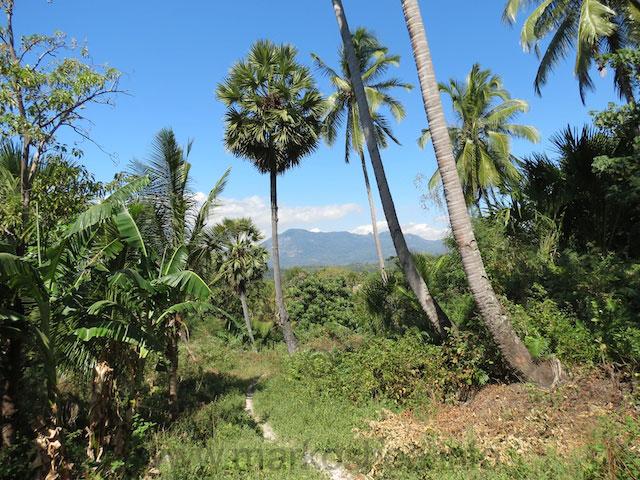
Machetes on the Venilale Road
Photo: Mark O'Shea
Most of our days in Timor-Leste were spent turning over rocks and logs, and most of the time the only thing that bit back was an ant. The one day I remember as genuinely tense had nothing to do with an animal. It had to do with whose land we were standing on.
It happened in 2012, during Phase VII of our survey. By then we were an experienced team, and Mark O'Shea noted on his website that it "was the first phase not to include new students." Mark was my deputy. Caitlin Sanchez was back. Andrew Kathriner came as our gecko specialist and Sven Mecke from Marburg as our skink specialist. With us too was a new Timorese recruit, Paulo Pinto. We flew into Dili from Bali on 21 June and then set off to work our way east and south.
Caves dug by prisoners
On 26 June we drove to Baucau, the country's second town, on the north coast. From there we worked the roads south into the hills. As on every phase, Mark and I did the driving: we always rented two troopies, he drove one and I the other, and I was always in the lead. On 27 June we planned a long day and a late night, searching the cliffs north of Ossu after dark for bent-toed geckos, the nocturnal lizards that were turning out to be one of Timor's great surprises.
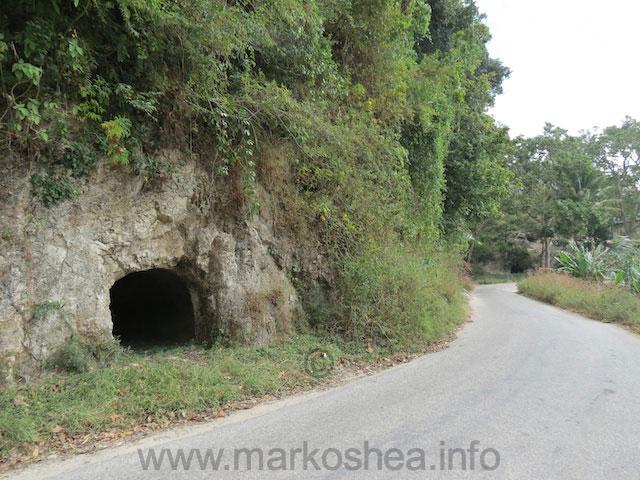
On the way we stopped at the caves near Venilale. They are not natural caves but tunnels. Mark wrote that "Timorese prisoners were forced to dig" them for the Japanese during the Second World War, "for purposes unknown." It was a reminder that almost every hillside in Timor-Leste has a history, and most of it is not a happy one. The day's animals were more modest: a young Lesser Sunda racer killed on the road south of Baucau, and a big scolopendrid centipede crossing the tarmac.
The Carlia spot
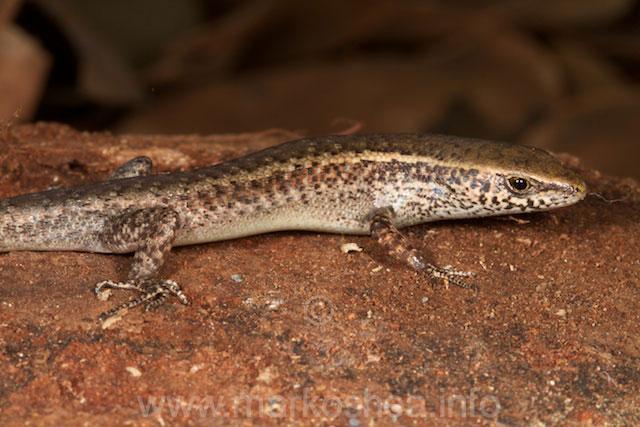
On 29 June Mark stayed at our lodging in Baucau to catch up on work on his laptop while the rest of us packed. We had spare hours, and I did not want to waste them. So I took the students and Paulo back to a place just south of Baucau on the Venilale road that we had started calling "the Carlia spot." Carlia are the four-fingered skinks, small brown lizards of the leaf litter, and several of Timor's were looking like species that had never been named.
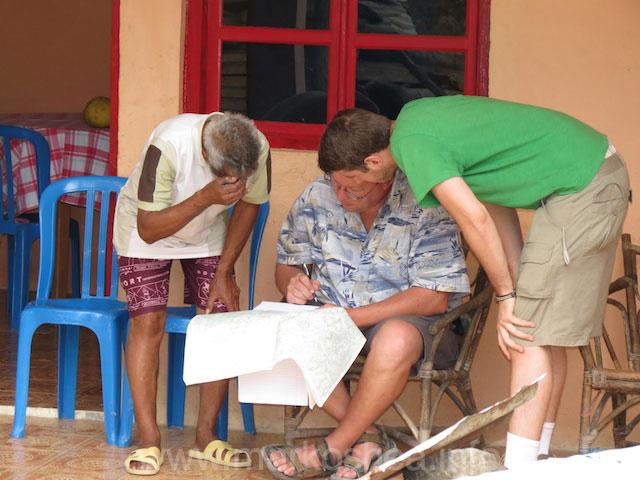
We had not been there long when, in Mark's words, we were confronted by "angry men on motorcycles wielding machetes and demanding to know what they were doing." To be fair to them, a group of foreigners poking around under rocks and bushes near your village is an odd sight. They made us go with them to a nearby village, which was a bit unsettling, and Paulo and I had to explain ourselves.
I texted Mark our GPS coordinates, "just in case," as he put it, and brought out our papers: the research permit and a letter from the Prime Minister. Their question was whether I was really the person who had permission to be on their land. Nobody from their leadership had properly told them we were coming. There was no phone reception in the village, so two of the men rode off on their motorcycles to find a signal and check.
We were there for about three hours. It was disconcerting to have no connection at all to the outside world. I was worried about the safety of my students and of Paulo, who I think was the most frightened of us. But the mood was fairly neutral, they fed us and treated us well, and we learned what they had to eat: rice and boiled beef offal. Besides, I knew we had permission. It looked as if the message from the chefe de suco simply had not reached this remote corner of his area.
When the all-clear came back, everyone was all smiles. Mark wrote that "apologies were offered and the entire team was fed lunch." We left with our skinks, a large blindsnake that might have been Ramphotyphlops polygrammicus, and a lesson worth passing on.
"A conversation with the local Chefe de Suco would have avoided any tensions, and it was a lesson learned: even just off the road in Timor-Leste, you are in someone's backyard!" — Mark O'Shea, field notes, 29 June 2012
The chefe de suco is the elected head of a village area. We had his permission, but word had not travelled to everyone. A permit from the capital tells you that the government has said yes. It does not always tell the people who own the gardens and the forest what you are doing there. In a country that had lived through an occupation less than fifteen years earlier, strangers in the bushes were right to be questioned.
It was late by then, and we were not sure about accommodation or permissions further on, so we stayed another night in Baucau instead of pushing on to Baguia. The evening was calmer. Andrew tried chewing betel nut in the market, with the mustard stick and lime, and ended up with a red-stained mouth and a nasty aftertaste. Sven sensibly declined.
The Xanana Suite
The next day we drove east along the coast and then south into the mountains to Baguia, on the eastern side of Mt Matebian. At 2,376 m it is the second-highest mountain on the island. The road climbed through hills terraced for rice, and we kept stopping for photographs. Baguia still has a Portuguese fort outside town and another walled compound in the town itself.
We found rooms at a small guesthouse, the Vila Rabilai, which had exactly five. Mark and I were given what he called "the 'Xanana Suite'," the room where Xanana Gusmão had stayed. The owner sat with us over our maps and helped plan the next day.
On 1 July, Andrew, Sven, and I searched mid-mountain forest at about 960 m on the slopes above Waimata village, below Mt Bina. Mark wrote that "the locals told us there were no snakes in the area!" They were right, as far as we could tell. But we did find dwarf tree geckos (Hemiphyllodactylus), and Mark noted that they "may be a new species since they are montane." In his expedition report he later listed them as Hemiphyllodactylus typus, but we do not know that for sure: there are no molecular data from true H. typus, from its type locality in Sumatra, to compare them with. That is still work in progress. We also found two kinds of scorpion and some enormous huntsman spiders, which startled all of us.
The thirteenth district
From the east we criss-crossed the island to the south coast. On 3 and 4 July we worked the Nancuro coastal forest, staying, as in 2011, with the Franciscans at the convent in Fatucahi. Those were the two days of the toad that passed a live blindsnake and of the brown groundsnake that Mark pulled out of a rotting tree, which became Stegonotus nancuro. Those are stories of their own.
On 5 July we drove west along the coast to Betano, north towards Same, across a river ford, and over the mountains to Maliana near the Indonesian border. Mark noted that the drive "was only 140 kms but it took most of the day." On 6 July we climbed from about 920 m to about 1,200 m, into mossy forest above Maganuto village in Bobonaro District. Our guide was Zito Afranio Soares, who came from Maliana and had done his own thesis fieldwork in the area.
Bobonaro was, as Mark wrote, "the 13th and final district." With it, our team had now surveyed reptiles and amphibians in every district of Timor-Leste (the districts are today called municipalities). We spent 7 July around Balibo and were back in Dili on 8 July.
Why it matters
People often ask me whether fieldwork in Timor-Leste was dangerous. Almost never, and on the one day it felt that way, it came down to a message that never arrived. The men with machetes were doing what anyone would do: protecting their families and their land from strangers. Once they knew who we were, they fed us.
Good fieldwork depends on good permits, but it depends even more on good manners. The country's leaders opened doors for us, and the villagers decided whether we could walk through them.
Sources: Mark O'Shea's Phase VII expedition page and field notes, markoshea.info/research_fieldwork_timor12(2).php; entries for 21 June, 27 June, 29 June (continued), 30 June, 1 July, 3 July, 5 July, and 6 July 2012.
The papers
- (2013) ‘Fantastic Voyage’: a live blindsnake (Ramphotyphlops braminus) journeys through the gastrointestinal system of a toad (Duttaphrynus melanostictus) Herpetology Notes 6: 467–470
- (2015) Herpetological diversity of Timor-Leste: updates and a review of species distributions Asian Herpetological Research 6(2): 73–131
- (2021) A new species of Stegonotus (Serpentes: Colubridae) from the remnant coastal forests of southern Timor-Leste Zootaxa 5027(4): 489–514