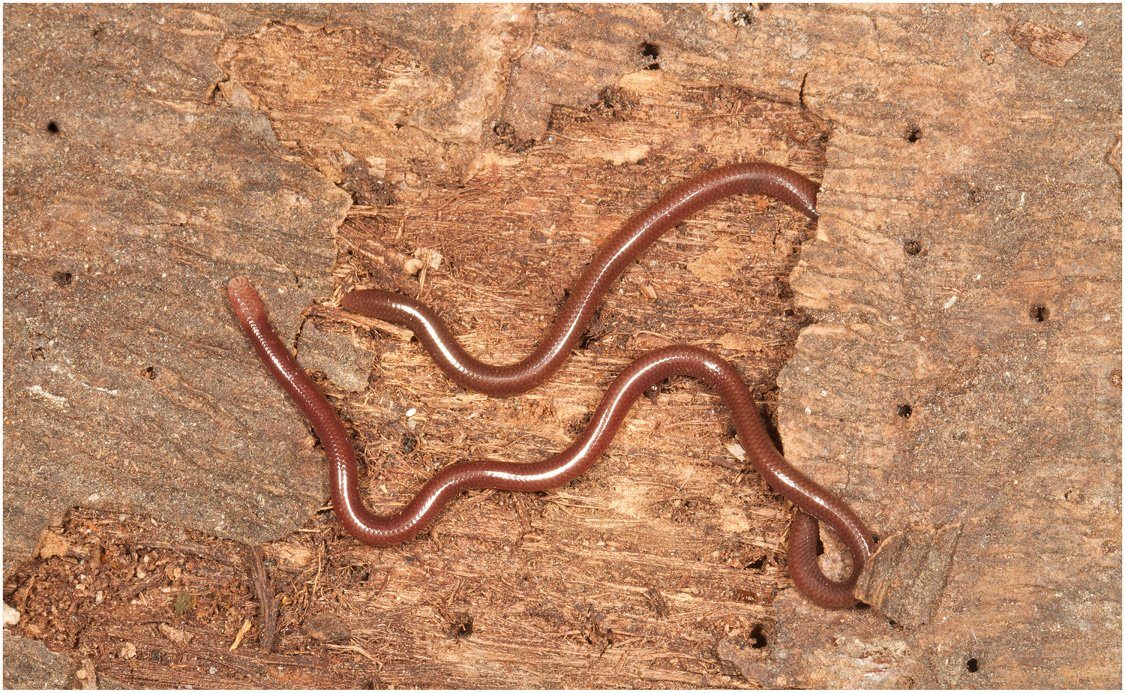
The Fantastic Voyage
Photo from O'Shea et al. 2023, Canadian Journal of Zoology
At half past twelve on 3 July 2012 we were setting up a place to prepare specimens at the Franciscan Convent of St. Antony in Fatucahi, on Timor-Leste's south coast. Someone lifted a rock we meant to use as a doorstop. Under it sat a common Asian toad. Hanging out of its back end, head first, was a live snake.
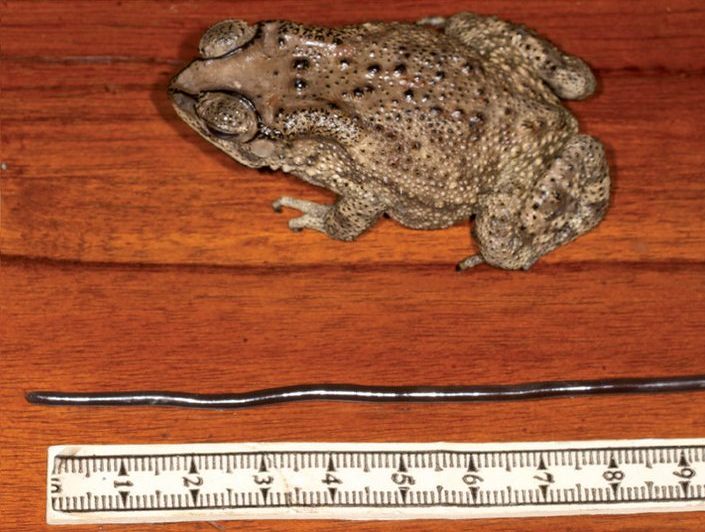
About 60 percent of the snake was already outside. When the toad hopped away, the snake went with it. We caught both, photographed them, and within a few minutes the toad pushed the snake out completely. It was a Brahminy blindsnake (Indotyphlops braminus), a small burrowing snake that looks like a shiny earthworm. At 106 mm it was longer than the toad's 58 mm body. The only explanation was that the toad had swallowed the snake whole and the snake had travelled the entire length of its gut.
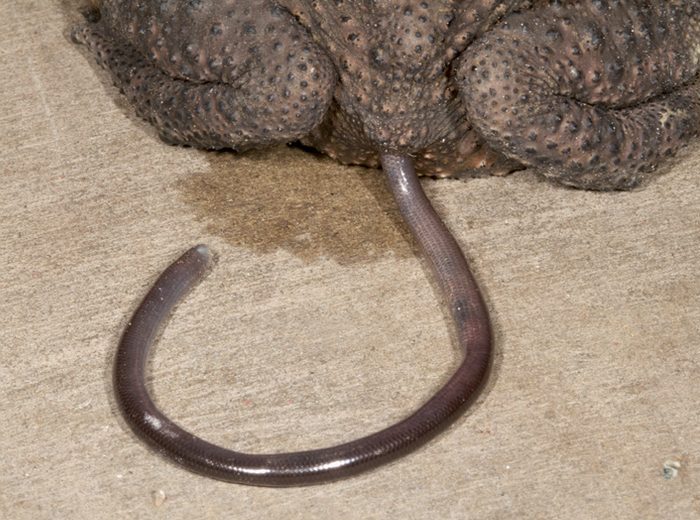
We named the paper "Fantastic Voyage," after the 1966 film in which a submarine crew is shrunk and injected into a scientist's bloodstream. Under a strong light we could see the snake's heart beating and blood moving. A narrow waist showed where the toad's muscles had last squeezed it. It made weak movements until at least nine that evening, and by the next morning it had died. As far as we could find, no one had ever reported a live animal passing all the way through a toad. This was also the first record of this toad eating any animal with a backbone.
Two newcomers
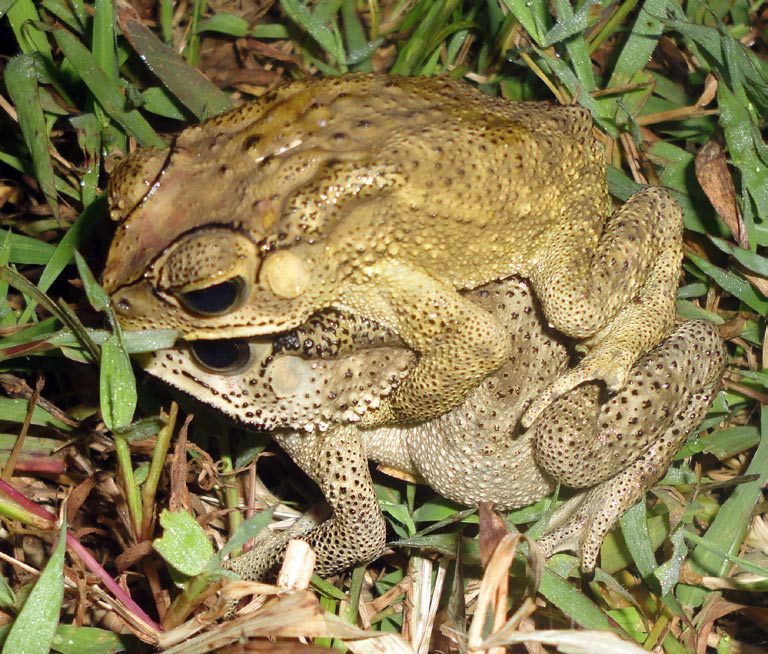
Neither animal belongs in Timor. The toad (Duttaphrynus melanostictus) arrived fairly recently, probably during the upheaval around independence. Timorese call it manduku INTERFET, the "INTERFET toad," after the international peacekeeping force of 1999. By 2011 it had spread over more than half the country. News reports in 2008 called it the cane toad and alarmed Australians, but it is a different, smaller species.
The blindsnake is a stowaway of another kind. Every Brahminy blindsnake is female. They reproduce without males, so a single snake in a flowerpot can start a new population. That is how it became the most widespread snake on Earth, and why it is often called the flowerpot snake. We even found it in the garden of the old Portuguese governor's guesthouse at Maubisse, 1,495 m up, where it had presumably arrived in potted plants.
What do the toads actually eat?
The voyage raised a serious question. If invasive toads eat small vertebrates, they could threaten Timor's many lizards and snakes found nowhere else. So our colleagues at Marburg University in Germany, Britta Döring and Sven Mecke, opened the stomachs and intestines of 83 preserved toads from five kinds of habitat. Along the way they settled on a U-shaped cut that opens the belly cleanly, and we described it in 2016 so that others could use the same method.
The count took patience. They identified 5,581 prey items, from earthworms and snails to beetles and insect larvae. Ants made up 61.6% of the total and termites another 23.4%. There was not a single vertebrate. The Asian toad turned out to be what it is in its native range, a generalist that eats small invertebrates. The exception may be vertebrates that look like invertebrates, such as a small burrowing snake easily mistaken for a worm.
That result mattered beyond Timor. In 2014 the same toad turned up in Madagascar, and other scientists called in Nature for its swift eradication. Sven Mecke wrote a reply on behalf of twelve of us, urging caution. We pointed out that draining ponds could harm native wildlife. Well-meaning volunteers destroying spawn could kill native frog tadpoles by mistake. And comparing this toad with the cane toad was not justified by the data. Before you declare war on an invader, you need to know what it is really doing.
Anteaters under the airport
The blindsnake story had a sequel. On our tenth expedition, in August 2014, the manager of the fuel depot at Dili's Presidente Nicolau Lobato International Airport gave our team of eight special access. There were stories of Macklot's water pythons and other snakes turning up around the containers there. The airport has a history of its own. It opened in 1934 as the Aeródromo Humberto da Cruz, named after a Portuguese aviator who had just flown from Lisbon to Dili.
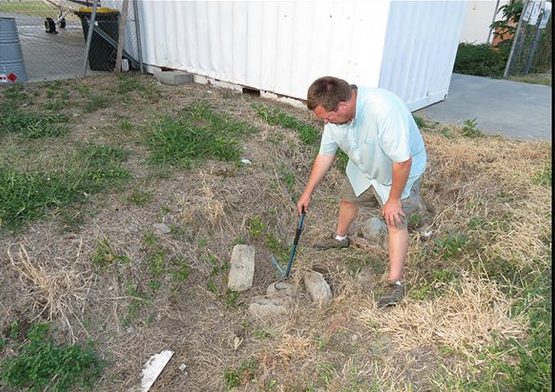
We found no pythons. Near the light-aircraft and helicopter hangar I lifted a layer of rounded stones, then a few flat boulders. Underneath was a colony of black ants. Under the last flat rock were several narrow tunnels and a blindsnake. It thrashed wildly, and between its thinness and the angry ants it took some effort to catch. It was 10 August 2014, and it was the last specimen we collected before leaving the country two days later.
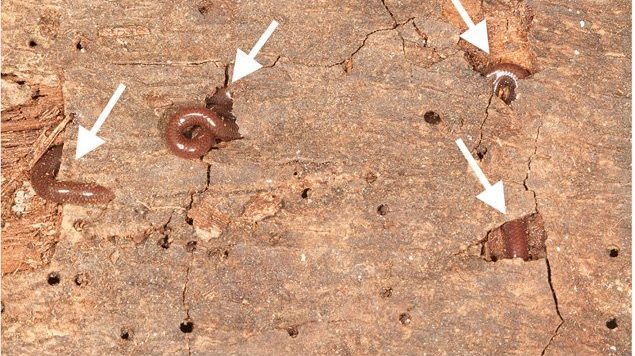
Mark saw at once how extraordinary it was. The snake was 121 mm long and only 1.7 mm wide, about as thick as a strand of spaghetti. Its body looked out of proportion to its length. When we tried to photograph it on coconut bark in our hotel room, we looked away for a moment to get the camera and it vanished into the bark. For minutes at a time it moved through the fibres between the layers.
With blindsnake expert Van Wallach, we showed that it was a species new to science. We described it in 2023 as Indotyphlops laca, Laca's Wormsnake. We had offered to name it after all our Timorese teammates together. They asked us to honour Agivedo "Laca" Varela Ribeiro instead, the teacher-trainee from Lautém who had worked with us since the beginning. Our paper's title, "Anteaters under the airport," comes from the blindsnakes' habit of eating ants and termites.
"The Age of Discovery in this part of the globe is far from over." — O'Shea et al. 2023
Why it matters
Both snakes came from places nobody would call wilderness: a convent courtyard and an airport apron beside a fuel depot. One was an invader that survived being swallowed. The other had perhaps been living underground in ant nests while a runway was built over its home. Timor-Leste now has three known species of blindsnake, and I would be surprised if that were the end of it. Some of the most interesting animals are the ones you only meet when you turn over the next rock.
The papers
- (2013) ‘Fantastic Voyage’: a live blindsnake (Ramphotyphlops braminus) journeys through the gastrointestinal system of a toad (Duttaphrynus melanostictus) Herpetology Notes 6: 467–470
- (2014) Review risks before eradicating toads Nature 511: 534
- (2015) Herpetological diversity of Timor-Leste: updates and a review of species distributions Asian Herpetological Research 6(2): 73–131
- (2016) A proposed optimal incision method to obtain gut contents from preserved anurans Amphibia-Reptilia 37(4): 437–440
- (2017) Food spectrum analysis of the Asian toad, Duttaphrynus melanostictus (Schneider, 1799) (Anura: Bufonidae), from Timor Island, Wallacea Journal of Natural History 51: 607–623
- (2023) “Anteaters” under the airport: a slender new species of blindsnake, genus Indotyphlops, from Timor-Leste (Scolecophidia: Typhlopidae: Asiatyphlopinae) Canadian Journal of Zoology 101: 486–498