Hidden Passengers
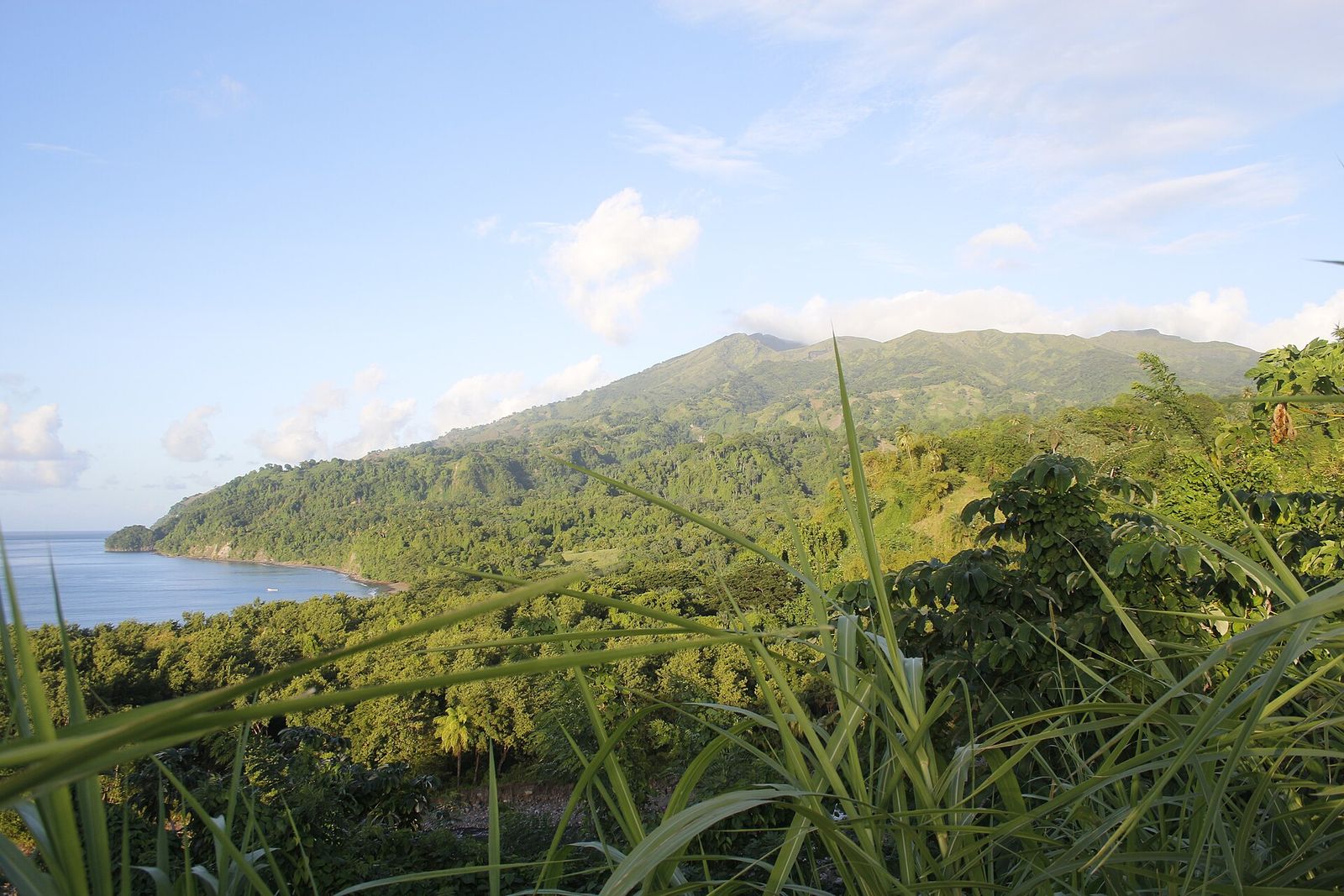
Photo: DavidMPyle, CC BY-SA 4.0, via Wikimedia Commons
Between 1989 and 1992 I brought hundreds of small Caribbean frogs back alive to my lab at McGill University in Montréal. I needed tissue samples from them. Comparing proteins, and later chromosomes, was how I hoped to sort out which island populations were separate species. It was slow, careful work at the dissecting microscope.
Every so often, though, something unexpected turned up inside a frog: a tiny coiled worm, a little capsule on the stomach wall, a cyst near the liver. The frogs, it turned out, were carrying passengers. Nobody had looked for them before.
Worms with a story
I kept every parasite I found and sent them to František Moravec at the Institute of Parasitology of the Czech Academy of Sciences in České Budějovice. He is an expert on nematodes, the roundworms, a huge group of animals that includes many parasites. Between 1994 and 1995 we published four new nematode species together, plus a series of reports on others.
The first surprise came from one Martinique whistling frog, Eleutherodactylus martinicensis, that I had collected with my cousin Helmut Schwarten on La Désirade, a small, dry island off Guadeloupe. Tucked in a cyst beside its liver were three slender white worms, each a few millimeters long. Moravec placed them in the genus Trichospirura. Until then its members were known only from mammals and lizards. The best-known species lives in the pancreatic ducts of marmosets, small South American monkeys. We named the new worm Trichospirura amphibiophila, "the amphibian-lover," because it was the first of its kind found in an amphibian.
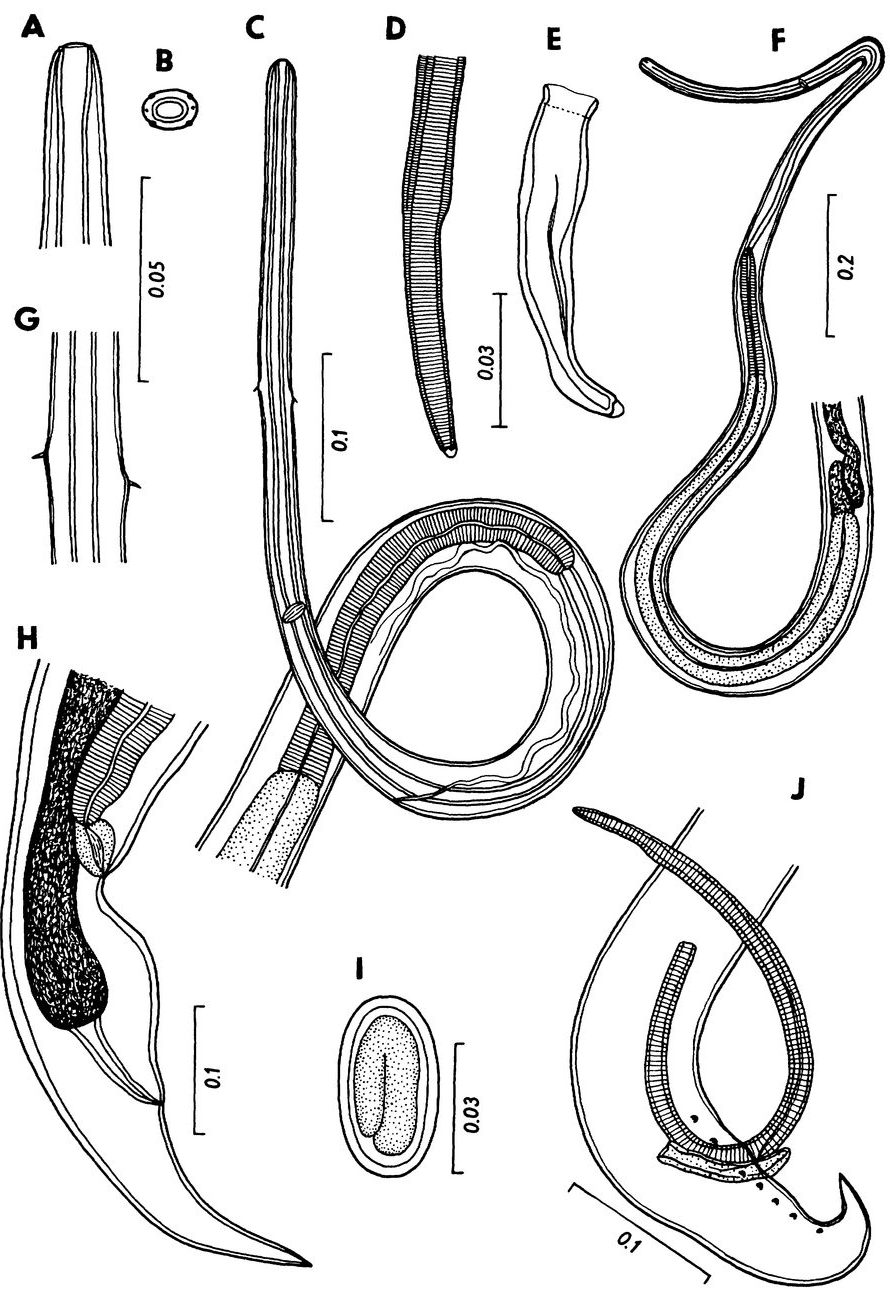
The copper-eyed frog, Colostethus chalcopis, which Heather Gray and I found on the slopes of Martinique's Montagne Pelée, had its own worm too. Only five of them came from two frogs, but they were enough. Male nematodes have a pair of spicules, stiff needle-like structures they use during mating. This worm's spicules were so long, the longest in its genus, that we had to rewrite the official definition of the genus Cosmocerca to make room for it. We called it Cosmocerca longispicula. It was the first Cosmocerca recorded anywhere in the Caribbean, and we did not find it in any of the more than 80 whistling frogs that live alongside the copper-eyed frog.
Waiting to be eaten
In a small tree frog, Hyla minuta, that Heather Gray and I collected in Trinidad's Arima Valley in August 1990, I found 22 tiny capsules sitting on the surface of the stomach. Each held a coiled larva of Brevimulticaecum, a rare worm whose adults live in crocodilians and snakes. It was the first time this worm had been found in a tropical frog. The frog was simply a stop on the way, a snack waiting for a caiman or a snake.
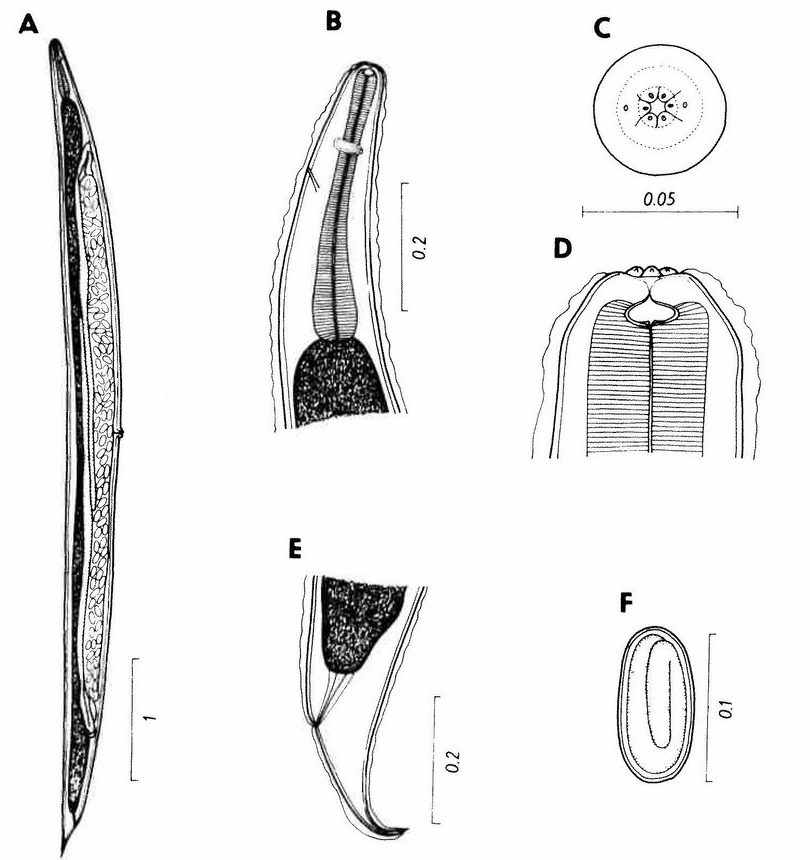
That turned out to be a theme. In 1995 Moravec and I summarized everything I had collected: thirteen kinds of roundworms, plus larval tapeworms and thorny-headed worms. Many lived in the frogs only as larvae, waiting for a predatory reptile or bird. Two of them were new species:
- Rhabdias tobagoensis, from the lungs of the Tobago frog that we were about to describe as Eleutherodactylus charlottevillensis. Rhabdias worms get into a frog through its skin and grow up in its lungs. Their eggs then travel down to the gut and leave with the droppings.
- Oswaldocruzia brevispicula, the "short-spiculed" worm, from the intestine of the St. Vincent frog E. shrevei, collected at 750 m on the Soufrière volcano.
Why does this matter? Parasites often track their hosts' history closely. Our small survey already suggested that the Lesser Antilles, Trinidad and Tobago may have many parasites found nowhere else, just as they have many frogs found nowhere else. Later, working with Stephen Goldberg and Charles Bursey in 1998 and 2002, we added more host records from Dominica, Tobago, St. Vincent, Grenada and Trinidad.
Passengers in the cells
After my PhD I moved to Germany for a postdoctoral fellowship from the Boehringer Ingelheim Fonds, at the Institute of Human Genetics at the University of Würzburg. There I worked with Michael Schmid, one of the world's leading experts on amphibian chromosomes. Chromosomes are the packages that hold an animal's DNA. Staining them in different ways, a method called chromosome banding, shows up differences between species that you could never see from the outside.

The frogs that surprised us most were two I knew well. In 1994 David Green, Jerry Hardy and I had shown that the whistling frogs of Grenada and St. Vincent were not just local forms of the Trinidad frog E. urichi. They were two separate species, E. euphronides on Grenada and E. shrevei on St. Vincent. Over four expeditions between 1990 and 1993, my field companions and I collected 86 E. shrevei and 61 E. euphronides for chromosome studies. Some came from the rim of the Soufrière crater at 950 m.
The giant W is packed with heterochromatin, tightly coiled DNA made largely of repeated sequences that do little or nothing. It is so big that it shows up as a dark blob inside the nucleus of female cells. These were the first amphibians shown to have such a "W-chromatin body," and in 2002 we reported them as the largest heterochromatic W chromosomes known in any amphibian.
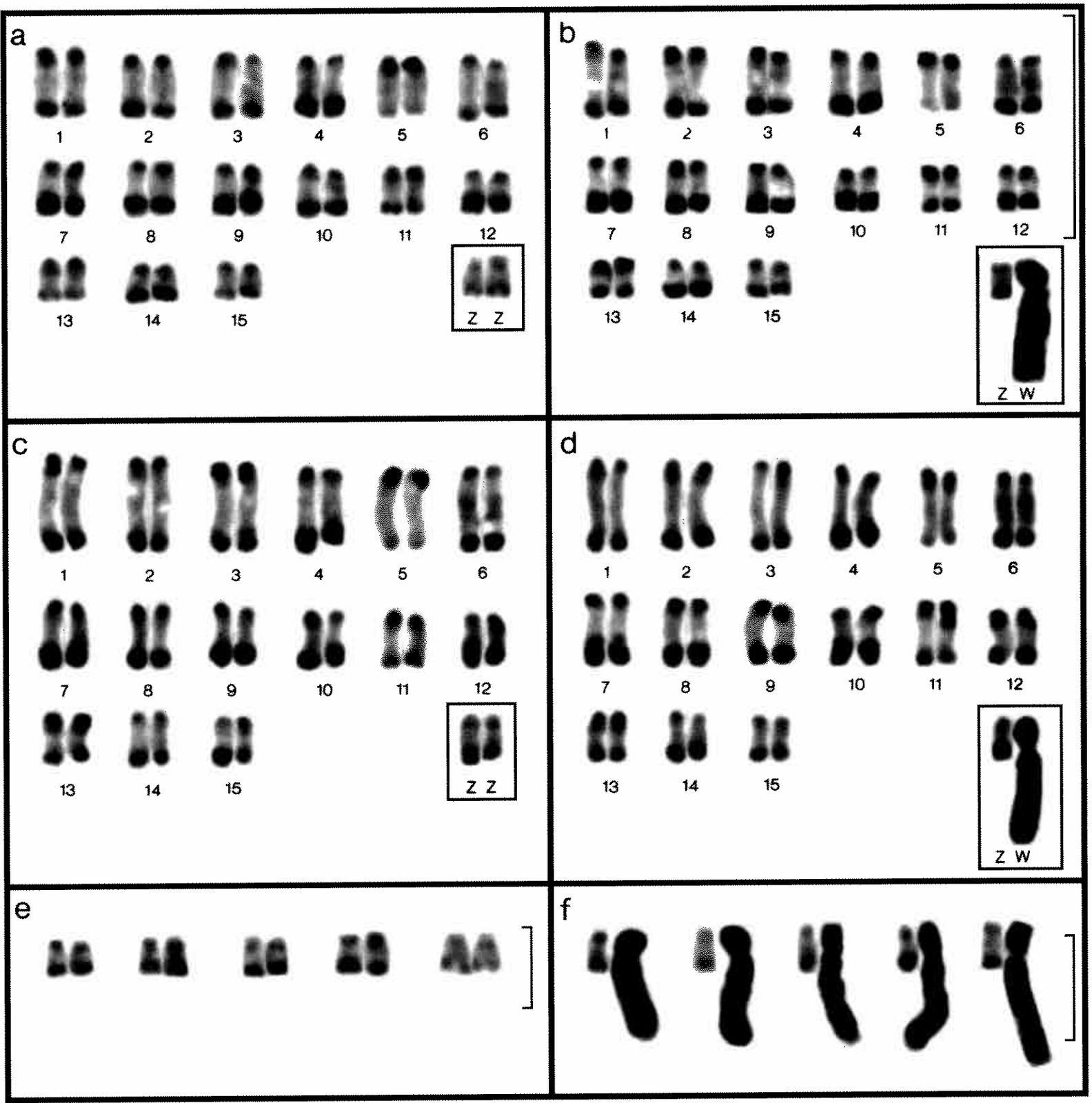
There was a second twist. Apart from that bulky W, these frogs have remarkably little DNA. A male E. shrevei cell holds just 1.71 picograms of it, one of the smallest genomes of any amphibian. A female holds 2.22 picograms, and the difference is almost all in that one giant W chromosome.
The chromosomes told other stories too. The copper-eyed frog turned out to have fewer chromosomes than its relatives. In Costa Rican tree frogs we found that a Caribbean-coast population of Hyla ebraccata had its nucleolus organizer (a stretch of chromosome that builds the cell's protein factories) in a different position from other populations. Differences like that within a single species had never been seen in amphibians before.
Looking inside
Looking back, I think this is one of the quiet lessons of those years. You can describe a frog completely from the outside, with its color, size, toes and call, and still know very little about it. Look inside and you find worms that ride through food chains from frogs to crocodiles, and chromosomes shaped by forces we still don't fully understand. Each small island frog turned out to carry a whole hidden world.
The papers
- (1994) Description of Cosmocerca longispicula sp. n. (Nematoda: Cosmocercidae), a parasite of a dendrobatid frog from Martinique, French Antilles Parasitology Research 80: 29–32
- (1994) Trichospirura amphibiophila n. sp. (Nematoda: Rhabdochonidae) in the frog Eleutherodactylus martinicensis from La Désirade, French Antilles Journal of Parasitology 80: 121–125
- (1994) Brevimulticaecum sp. larvae (Nematoda: Anisakidae) from the frog Hyla minuta Peters in Trinidad Journal of Parasitology 80: 154–156
- (1995) Helminth parasites from West Indian frogs, with descriptions of two new species Caribbean Journal of Science 31: 252–268
- (1996) Chromosomal investigation of three Costa Rican frogs from the 30-chromosome radiation of Hyla with the description of a unique geographic variation in nucleolus organizer regions Genetica 98: 95–102
- (1998) Gastrointestinal helminths of five species of Eleutherodactylus (Anura: Leptodactylidae) from the West Indies Caribbean Journal of Science 34: 146–149
- (2002) Intestinal helminths of seven frog species from Trinidad and Tobago Caribbean Journal of Science 38: 147–150
- (2002) Chromosome banding in Amphibia. XXIII. Giant W sex chromosomes and extremely small genomes in Eleutherodactylus euphronides and Eleutherodactylus shrevei (Anura, Leptodactylidae) Cytogenetics and Genome Research 97: 81–94
- (2003) Chromosome banding of six dendrobatid frogs (Colostethus, Mannophryne) Herpetologica 59: 203–218