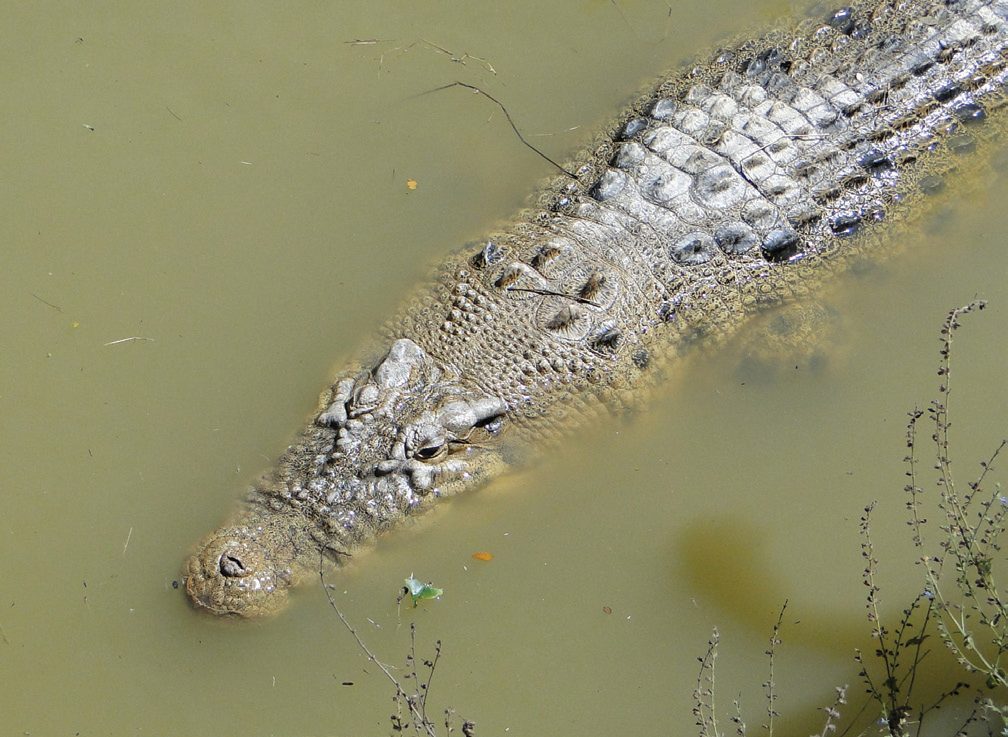
Grandfather Crocodile and the Card Game
Photo: Hinrich Kaiser, from Kaiser et al. 2011, ZooKeys
Timorese tradition says the island of Timor is the body of a crocodile. In the story a boy helps a stranded young crocodile reach the sea. Years later the grateful animal carries him across the ocean, and when it dies its back becomes the mountains of Timor. Many Timorese call the saltwater crocodile Avô Lafaek, "Grandfather Crocodile." The same animal also kills people.
Our first paper from Timor-Leste, in 2009, was about exactly that tension. It came out in the newsletter of the IUCN Crocodile Specialist Group. Over the following years I learned that in Timor-Leste you cannot study reptiles without studying how people live with them. It became one of the most rewarding parts of the whole project.
A crocodile that came toward us
In July 2009 we saw crocodiles several times from the coast road. One adult, about four metres long, was swimming under a bridge over the Malailada River near Lautém. One of us slapped the water with a hand to imitate splashing prey. The crocodile, in our words, "immediately and rapidly changed direction to approach the splashing." We had seen crocodiles in Papua New Guinea and Australia, and they did not behave like this. We stopped at once.
The lesson was sobering. Where people hunt crocodiles, crocodiles learn to fear them. Where crocodiles are revered, they don't. Timorese children walk long distances along rivers and help their parents fish and wash at the water's edge. A 16-year-old boy was killed near Com in 2007, and a 10-year-old near Betano in 2009. The friendly crocodile of the carvings and school murals, we wrote, "can be considered misleading."
We met captive crocodiles too. In the mountain town of Aileu, a young adult caught near Betano had been kept for a decade in an enclosure at the police post. It seems Portuguese peacekeepers had put it there after 1999, and successive UN units had fed it. It had grown to 3.5 metres and lived in the middle of town. Nearby, a small crocodile was kept in a barrel, held shut only by a lid with a rock on top. We argued for education and for alternatives for the people most at risk, such as fishermen who wade in to catch fish. We did not think removing crocodiles was the answer. By 2015 we were asking the government to make crocodile attacks officially reportable and to set up a task force across several ministries.
Pythons in the bedroom
Then there were the pythons. President José Ramos-Horta had heard our presentations and publicly worried about large "pet" snakes kept near children. He asked us to help release three reticulated pythons, each more than 3.5 metres long, from two households in Dili. The Commander of the Presidential Guard escorted us.
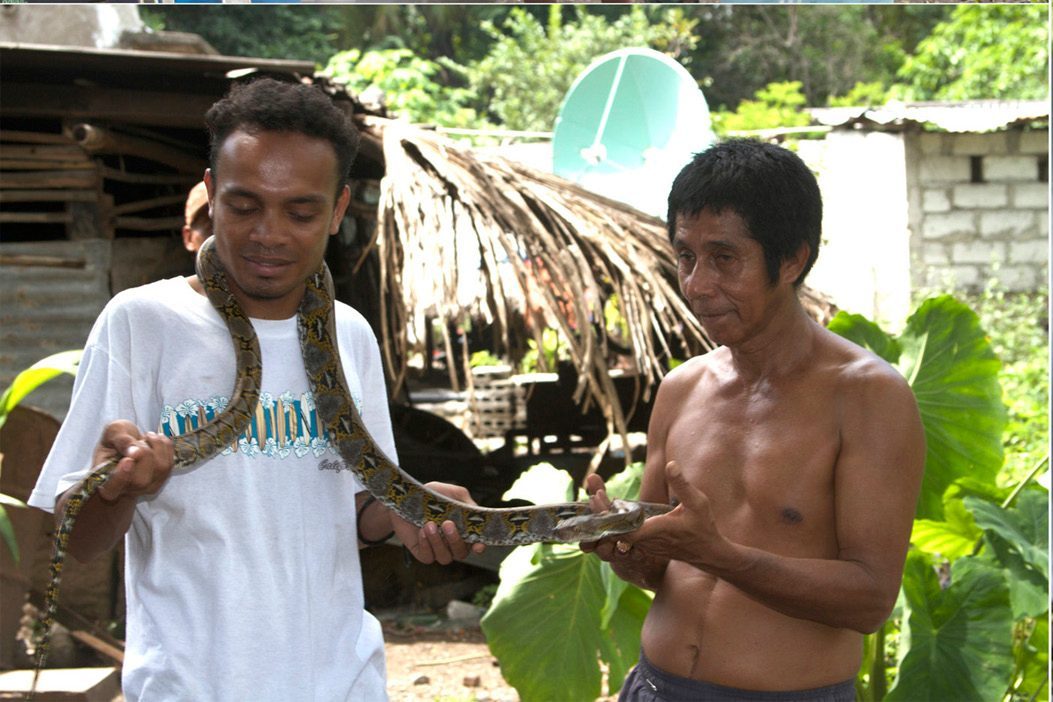
Two of the snakes lived loose in a young man's one-room home. He told us they gave him spiritual strength, a powerful "energy." Nobody had told him the neighbours had arranged to give his snakes away. We did not want a standoff with the Guard, so we talked with him. He accepted a rooster, candles, matches and the promise of a meeting with the President. The owner of the third snake had kept it in a wire cage for 15 years, and it had mouth rot. He asked for US$20 to hire a spiritual adviser, plus a rooster.
When we came back for the two snakes, the young man asked us to stay while he said farewell. In the dark room, by candlelight, he sacrificed one rooster and let its blood drip on the pythons and the floor so that some of their power would stay in the room. We wrote that restraining "the rapidly tongue-flicking pythons took some doing." We washed and rehydrated all three snakes in our hotel shower and showed them to the President at the Presidential Palace. Then they were released far from the capital.
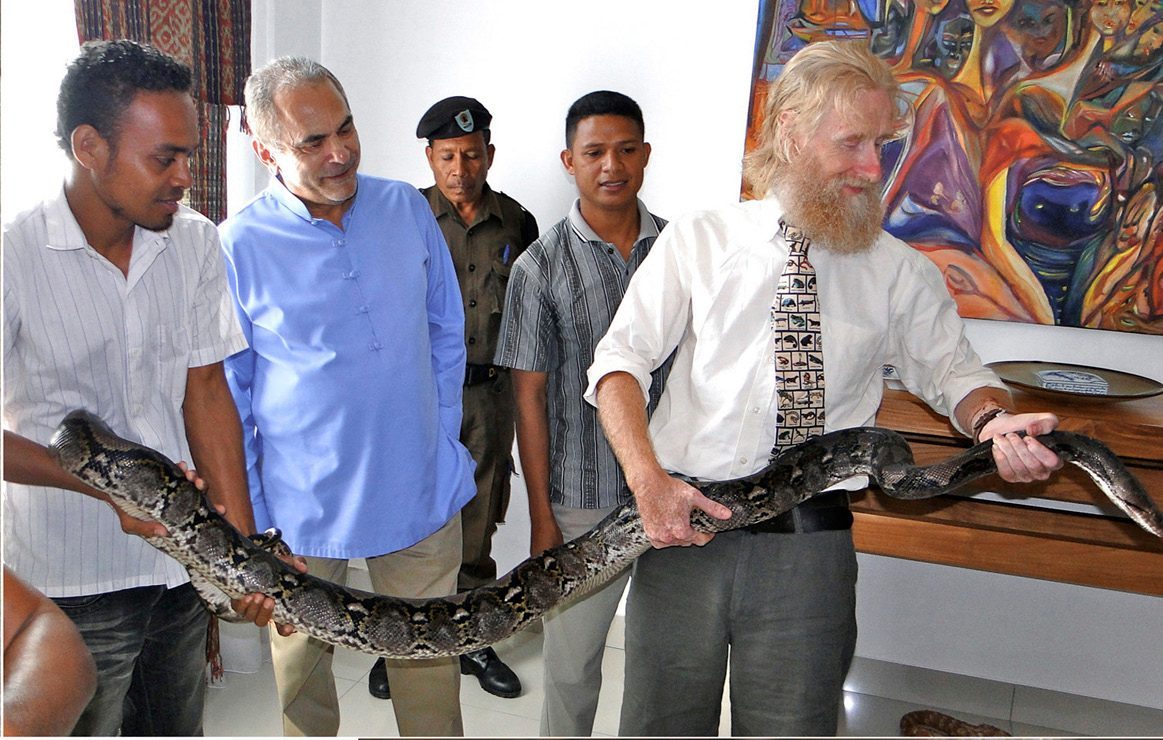
The Oecusse python went differently. The family would not give it up, because the snake was a status symbol. So we took it out of its sheet-metal cage, measured it and let the children watch. A little girl was the first to dare touch it, and over the next hour the whole family grew more and more comfortable. By the time we left, the owner was holding his python for the first time and a better cage was being built. As we put it, a status symbol "deserved an enclosure worthy of its status."
Turtles through palace security
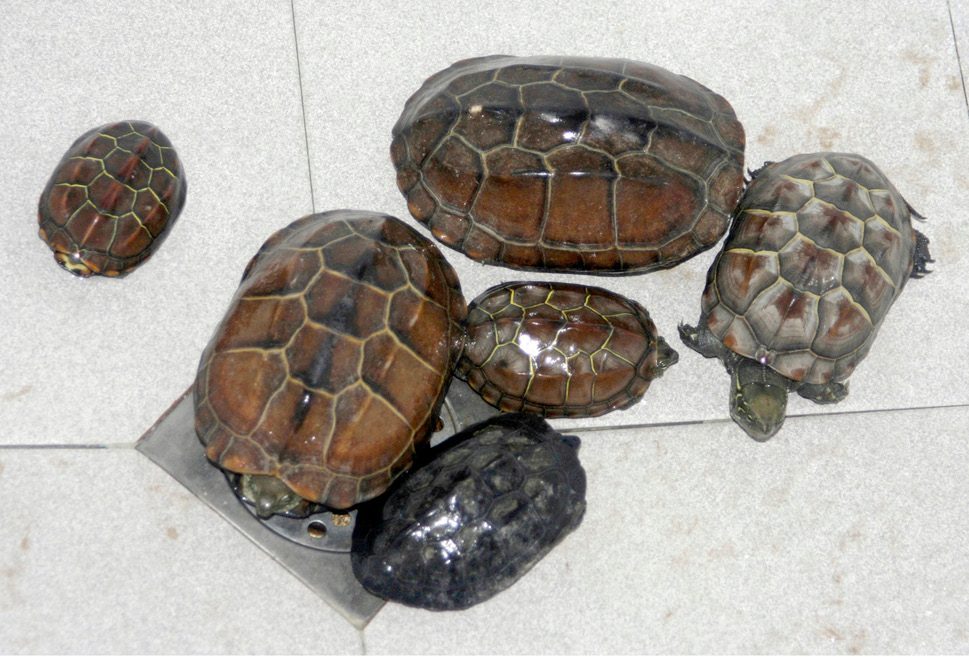
One day in February 2011 I was walking to the Palácio do Governo when I saw a bucket of turtles changing hands on the street. The buyer planned to release them for good luck at Chinese New Year. I offered to do it for her, showed my business card and survey shirt, and took the bucket. I carried it to my government meetings and through Palace security. They were Chinese pond turtles (Mauremys reevesii), about 3,700 km from the southern edge of their native range. Elderly residents remembered them in Dili's swamps since at least 1969.
Working with a full deck
All this taught us that villagers often know far more than visiting scientists. In late 2011 Mark came up with Species Identification Cards. The deck had 99 photo cards the size of playing cards, covering about 86 species. Harmless animals had a green border. Venomous snakes and the crocodile had a red border and a skull and crossbones.
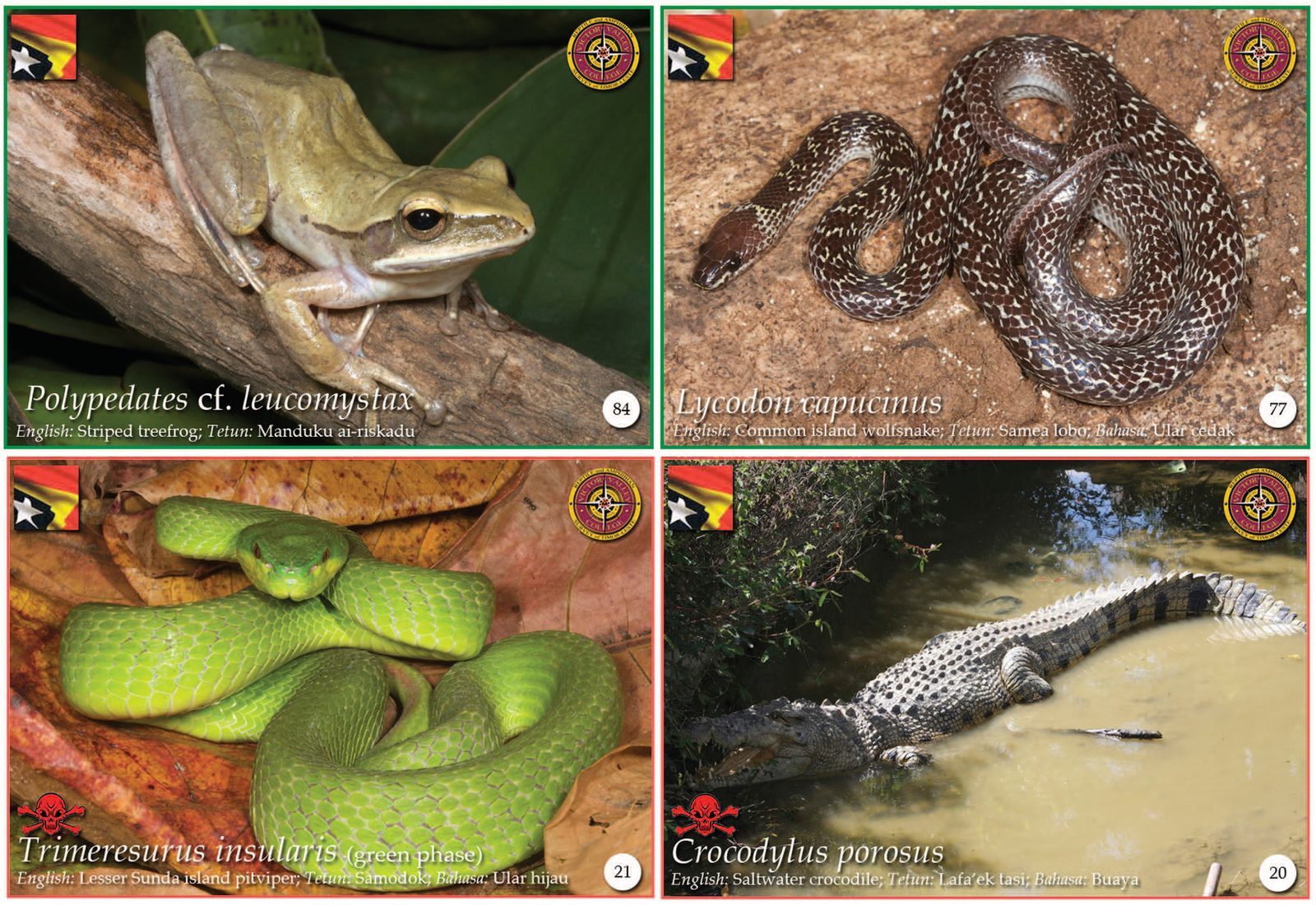
The instructions were simple. Sort the cards into three piles: animals seen near your village, animals seen elsewhere in Timor, and animals never seen. We had meant to leave decks in villages. Our Timorese colleagues said it would work better if they ran the interviews themselves and we malaes, the Tetum word for foreigners, kept our distance. On 29 January 2012 Zito Afranio Soares ran the first card game in Anartutu, a mountain village on Ataúro.
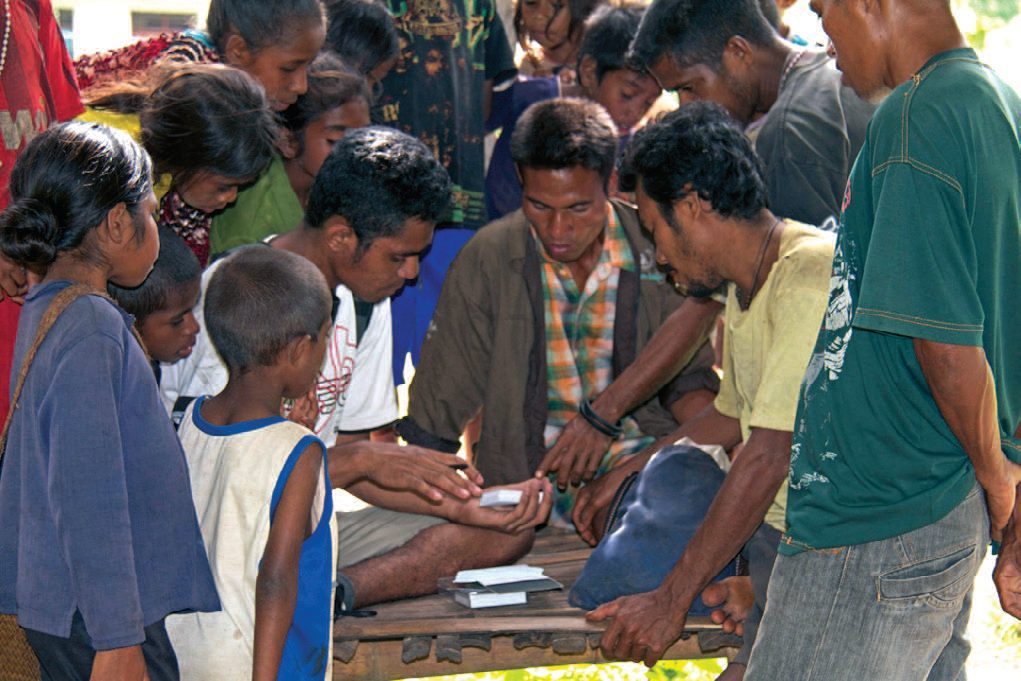
Across the two interviews we analysed, 79% of the villagers' choices agreed at least partly with what our own collecting had found. The Anartutu villagers matched our survey 70% of the time. Workers interviewed by their Australian employer at a beach resort matched only 51%. We wondered whether they were trying to please their boss. We had not found a single species on Ataúro that at least one group had not already picked out. The villagers also told us things we could never have caught in a trap. One belief in Anartutu, we heard, is that a feuding couple may air their grievances in a hut with a captive monitor lizard, and the lizard is then carried back to the coast, taking the bad feelings with it.
Why it matters
Timor-Leste had just come through five centuries of hardship. Water, food and electricity were more urgent than laws about keeping reptiles. Conservation there cannot be imported. It has to grow from conversations with the owner of a python, a family with a status symbol, or a village elder sorting cards. We hoped that one day conservation would be "no longer an abstract foreign-born concept but an internal need." Over those years I watched a President become, in our words, a reptile conservation "advocate." That gave me hope that it could happen.
The papers
- (2009) Status report on Crocodylus porosus and human-crocodile interactions in Timor-Leste Crocodile Specialist Group Newsletter 28(3): 12–14
- (2010) A widely traveled turtle: Mauremys reevesii (Testudines: Geoemydidae) in Timor-Leste Herpetology Notes 3: 93–96
- (2013) Working with a full deck: the use of picture cards in herpetological surveys of Timor-Leste Herpetological Review 44: 68–76
- (2013) Conservation education in a post-conflict country: five herpetological case studies of Timor-Leste Salamandra 49: 74–86
- (2014) Amphibians of Timor-Leste: a small fauna under pressure Conservation Biology of Amphibians of Asia (H Heatwole & I Das, eds.). Natural History Publications (Borneo), Kota Kinabalu, Sabah, Malaysia pp. 350–361
- (2015) Herpetological diversity of Timor-Leste: updates and a review of species distributions Asian Herpetological Research 6(2): 73–131