A Blank Canvas Called Timor
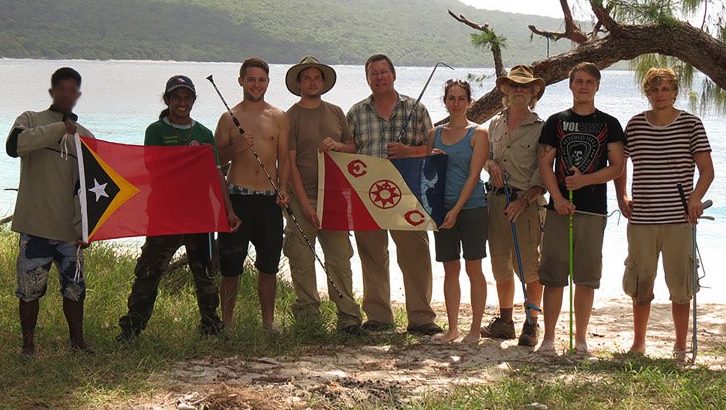
Photo from O'Shea et al. 2023, Canadian Journal of Zoology
When we started, there was almost nothing to start from. In 2009, the eastern half of Timor, a country that had been independent for only seven years, had essentially no museum record of its frogs and reptiles. Portugal had ruled it for centuries without much interest in its wildlife. The few specimens its naturalists did send home burned in 1978, in the fire at the Museu Bocage in Lisbon. After that came 24 years of Indonesian occupation, and nobody went out collecting lizards in a war zone.
Mark O'Shea and I later wrote that we "embarked on the first comprehensive herpetofaunal survey of Timor-Leste in 2009 working from an almost blank canvas." (Herpetofauna is the scientists' word for a region's amphibians and reptiles.) That was not an exaggeration. When we checked the world's museums in 2010, the only frog specimens we could find from what is now Timor-Leste were a handful at the University of Papua New Guinea, collected in the mid-1980s.
A course that became a country survey
The project grew out of the way I like to teach. At Victor Valley College in California I run field courses that take students to the tropics, on the idea that people learn science best by doing it. Timor-Leste was an extraordinary place to try this. It sits where the animals of Asia meet the animals of Australia and New Guinea, and hardly anyone had looked.
Nothing would have happened without the country's leaders. Our first survey report opens its acknowledgments with Prime Minister Xanana Gusmão, "with whose explicit written permission this research was carried out." President José Ramos-Horta supported us too. His senior adviser, Claudia Abate-Debat, opened door after door for us. In one paper we called her "the wind beneath our wings."
Our first field season, which we called Phase I, ran from 15 to 30 July 2009. We covered 18 localities, and the trip was paid for by a federal grant to the college and by student-government travel grants to three of our students. Mark, a British herpetologist and snake specialist, co-led every expedition with me. By 2014 we had run ten of them.
Benny and the Jets
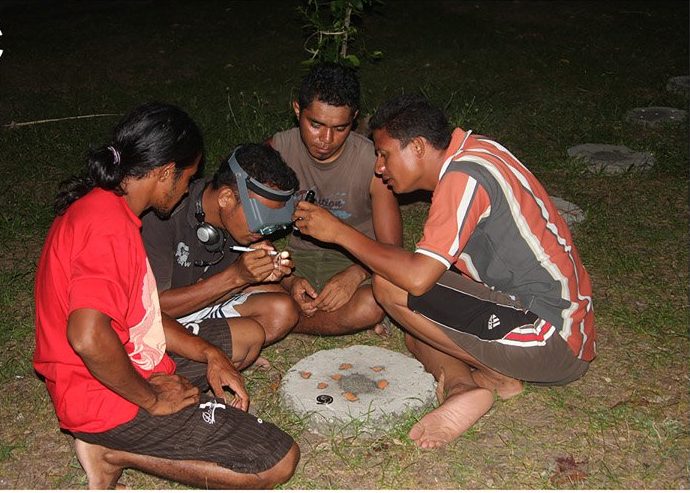
The most important decision we made was to work with Timorese students. Our first co-author from the national university, Universidade Nacional Timor Lorosa'e, was Venancio "Benny" Lopes Carvalho. Benny introduced us to three friends who were training as science teachers: Agivedo "Laca" Varela Ribeiro, Zito Afranio Soares and Luis Lemos de Araujo. They wanted to write research theses in biology for their teaching degrees, which no one there had done before. We decided to help.
Mark named the four of them "the Jets", after Elton John's song "Bennie and the Jets." They translated between languages, fixed problems and found animals, and they became our close friends. Zito wrote his thesis on frogs in moist and dry habitats near Maliana. He later ran the first village interviews with our picture cards, and he took the photograph of mating toads in our frog report. Laca graduated and went on to mangrove replanting and environmental art. Years later a new species was named after him.
What we found
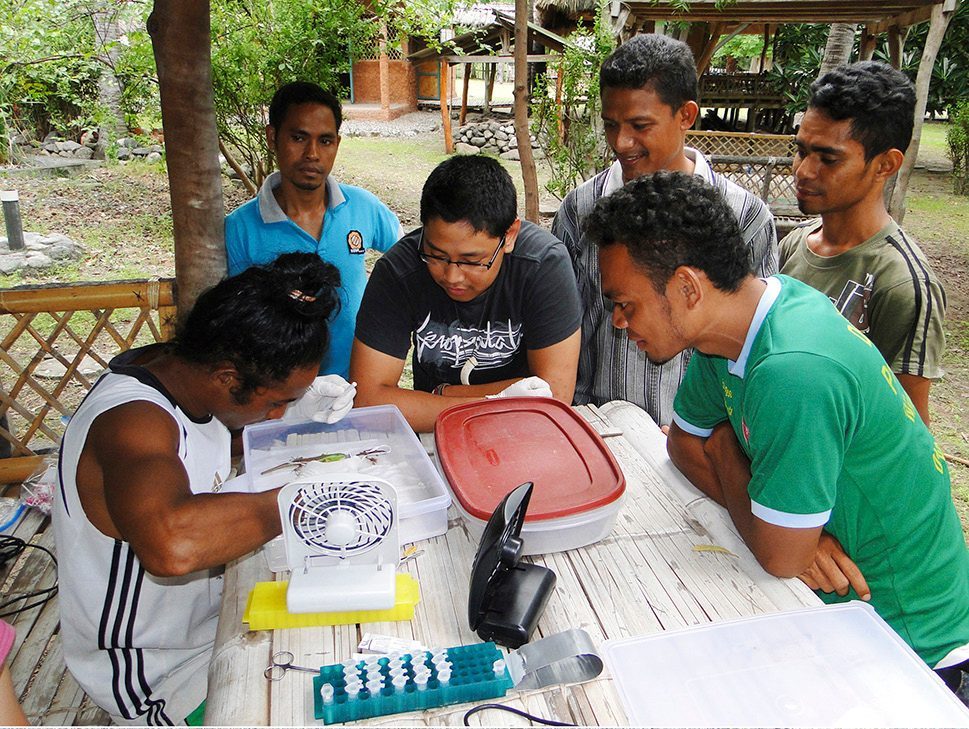
Our first full survey report came out in 2011 in the open-access journal ZooKeys. It was 68 pages long and covered 263 specimens from 2004 and 2009. It included a glossary for non-specialists, because we wanted it to work as a first field guide to the country's frogs and reptiles.
The surprises started right away. Three kinds of rice paddy frogs (genus Fejervarya) all turned out to be undescribed species. Two frog names that had been used for Timor for years had been misidentifications all along. We found a bent-toed gecko (genus Cyrtodactylus) new to science in the Same valley. Pitvipers, green venomous snakes, made up more than a quarter of the snakes we caught.
In the dry coastal forest at Loré we watched six lizard species share the same trees at different heights. Four-fingered skinks (Carlia) hunted in the dead leaves. Wedge skinks (Sphenomorphus) held the roots and buttresses. Snake-eyed skinks ran up the trunks one to four metres off the ground, and emerald tree skinks lived higher still. At the very top, male flying lizards (Draco) displayed from the best perch of all.
"Some of the specimens we collected may have shared their habitat with freedom fighters and their local supporters less than a decade earlier." — Kaiser et al. 2011
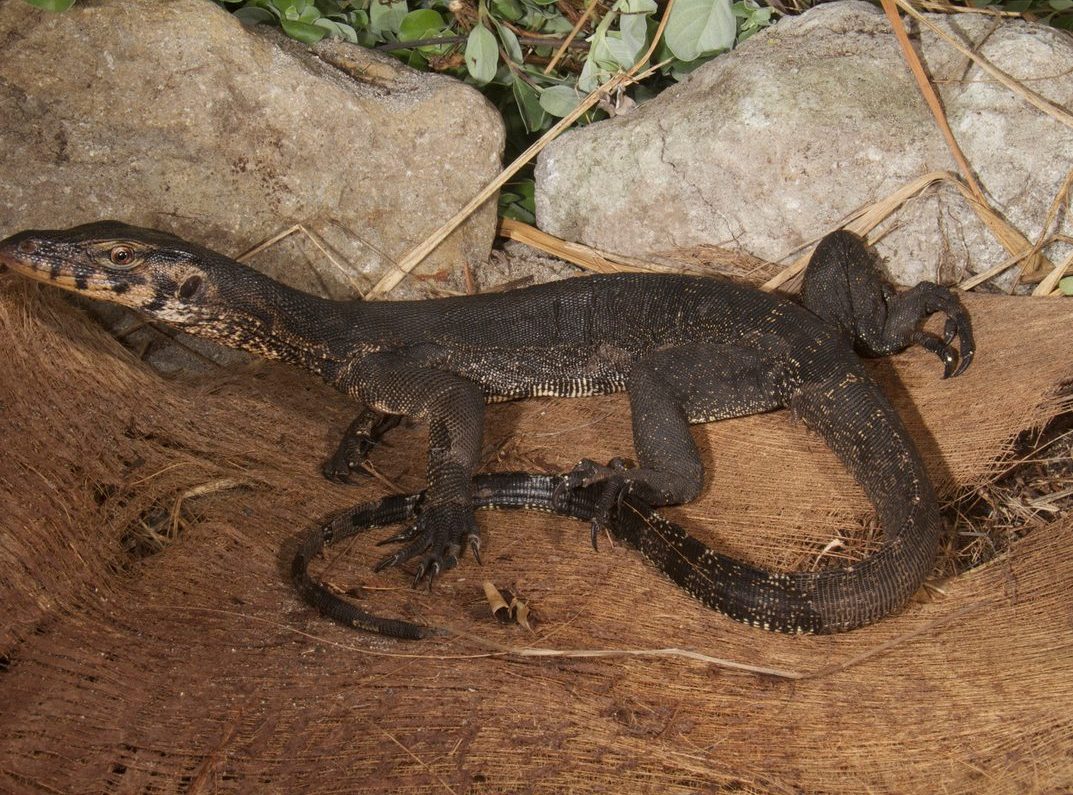
We kept going back. In July 2010 we made the first survey of the reptiles and amphibians of Oecusse, and Caitlin Sanchez, one of our Victor Valley students, led the report that followed. Oecusse is a small piece of Timor-Leste hemmed in by Indonesian West Timor on the landward side, and we reached it by driving through Indonesia. On Ataúro Island, 25 km off the capital, Dili, we found no frogs, turtles or crocodiles at all. We did find what looked like new geckos and skinks, and a monitor lizard that no one could place.
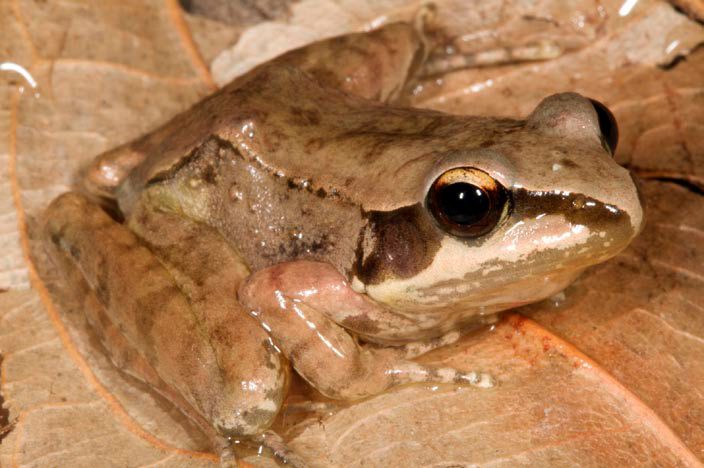
In 2011 we published the country's first report on frogs, in the amphibian newsletter FrogLog. At the time only five frog species were confirmed, and just one of them, the Timor river frog, is found on Timor and nowhere else. By 2015 our review of the whole country had raised the number of known amphibians and reptiles from 22 before our surveys to more than 60. Over 20 of them were species not yet described.
Stamps, specimens and a flag
Some of what came out of the survey was not printed in journals. On 28 November 2010, the 35th anniversary of the country's first proclamation of independence, Prime Minister Gusmão launched a set of six postage stamps showing Timor-Leste's reptiles and amphibians. They pictured the Timor river frog, the Timor snake-necked turtle, the island pitviper, the Timor monitor, the Timor bronzeback snake, and the saltwater crocodile on a one-dollar stamp. Mark and I supplied the photographs. It was a strange and lovely feeling to see animals we had caught travelling on the country's mail.
The specimens themselves went to the Smithsonian's National Museum of Natural History in Washington, DC, with tissue samples for DNA work. For the first time, scientists anywhere can study Timor-Leste's frogs and reptiles from modern, well-documented material. For some species it was the first fresh material since the 1820s. Our last two expeditions, in 2014, carried Explorers Club Flag #97. The hero photograph above shows the Phase X team on Jaco Island, at the country's eastern tip.
Why it mattered
Timor-Leste is not rich. Most rural families live on what they farm, and centuries of sandalwood cutting, coffee plantations and firewood gathering have stripped many hillsides. We wrote that the country "poses a conundrum: while biodiversity is high, it is in peril." You cannot copy another country's conservation laws onto a place where a family's next meal comes from the land. What you can do is teach, train and write down what is there.
That is why I am proudest of the people. Timorese students got teaching degrees through real research. Government park staff got survey methods and a deck of identification cards. The friendships have lasted too. President Ramos-Horta later asked me to represent him on the board of the PeaceJam Foundation, which brings young people together with Nobel Peace laureates, and in 2026 I became its chair. It all began with a blank canvas and a group of students willing to turn over rocks.
The papers
- (2009) Status report on Crocodylus porosus and human-crocodile interactions in Timor-Leste Crocodile Specialist Group Newsletter 28(3): 12–14
- (2011) The herpetofauna of Timor-Leste: a first report ZooKeys 109: 19–86
- (2011) New beginnings – a first report on frog research in Timor-Leste FrogLog (99): 44–45
- (2012) First report on the herpetofauna of the Oecusse District, an exclave of Timor-Leste Herpetology Notes 5: 137–149
- (2012) First Update to Herpetofaunal Records from Timor-Leste Asian Herpetological Research 3: 114–126
- (2013) First Report on the Herpetofauna of Ataúro Island, Timor-Leste Check List 9(4): 752–762
- (2013) Working with a full deck: the use of picture cards in herpetological surveys of Timor-Leste Herpetological Review 44: 68–76
- (2013) Conservation education in a post-conflict country: five herpetological case studies of Timor-Leste Salamandra 49: 74–86
- (2014) Amphibians of Timor-Leste: a small fauna under pressure Conservation Biology of Amphibians of Asia (H Heatwole & I Das, eds.). Natural History Publications (Borneo), Kota Kinabalu, Sabah, Malaysia pp. 350–361
- (2015) Herpetological diversity of Timor-Leste: updates and a review of species distributions Asian Herpetological Research 6(2): 73–131
- (2023) “Anteaters” under the airport: a slender new species of blindsnake, genus Indotyphlops, from Timor-Leste (Scolecophidia: Typhlopidae: Asiatyphlopinae) Canadian Journal of Zoology 101: 486–498