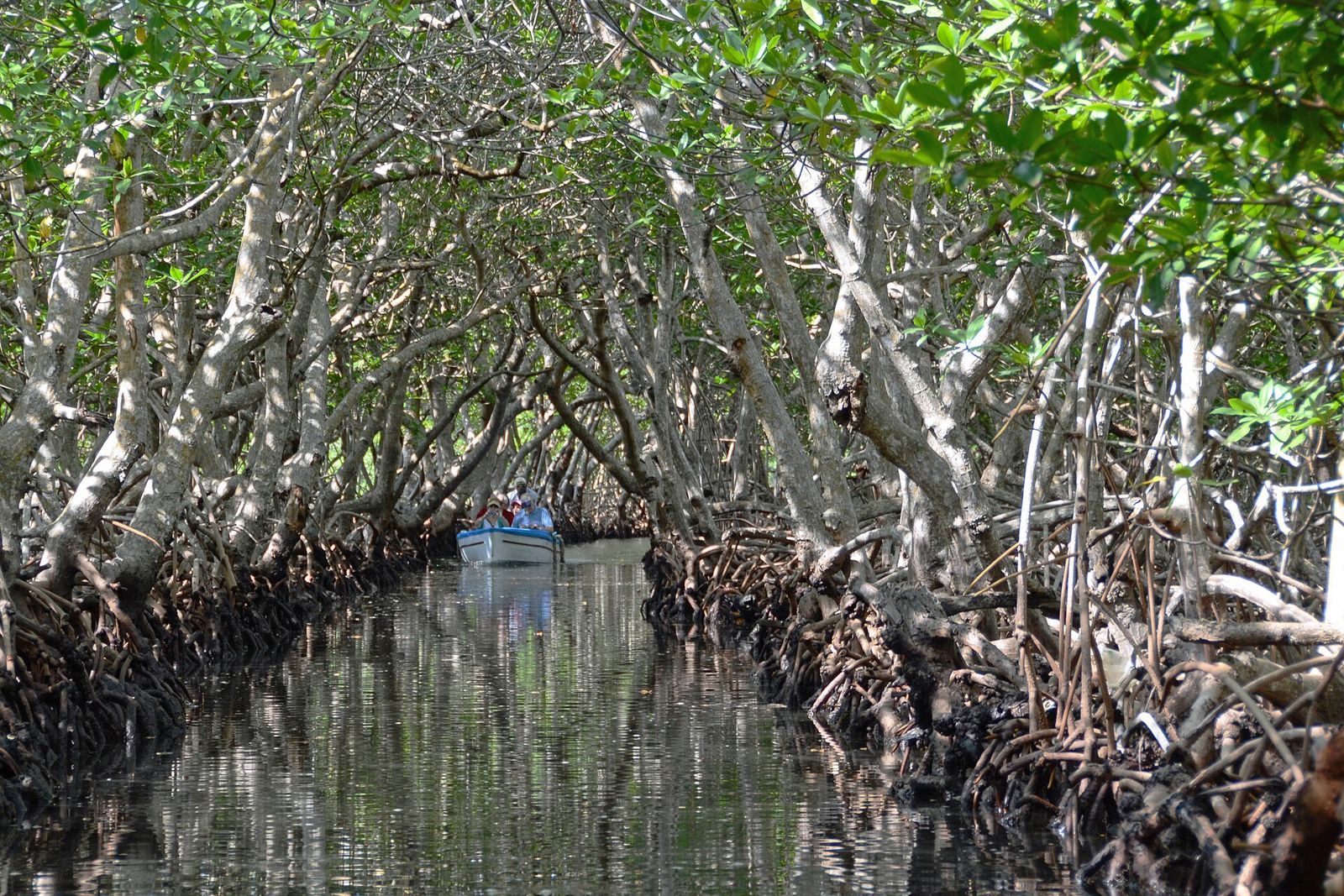
The Crocodile in the Burrow
Photo: Woody Hibbard, CC BY 2.0, via Wikimedia Commons
The crocodile that started it all was dead. It was small and dried, about 60 centimetres from snout to vent, and it was on display in one of the places where my students and I were staying on Roatán, an island off the Caribbean coast of Honduras. Nobody knew where it had come from. But it made us ask a simple question: were there any live crocodiles on this island?
According to the scientific literature, probably not. The standard survey of the Bay Islands, the Islas de la Bahía, had concluded in 1973 that American crocodiles (Crocodylus acutus) had most likely been wiped out on Utila and Guanaja. Remote corners of Utila and Roatán might hold a few. Marine scientists working on Roatán thought the occasional crocodile was a stray that had swum over from the mainland near La Ceiba. The whole record for the islands rested on three museum specimens.
A class goes looking
I had joined La Sierra University in Riverside, California, in 1997. There, together with my colleague Lee Grismer, I ran a summer course in tropical field biology. It is built on a conviction I still hold: students learn science best by doing it, not by hearing about it. The Bay Islands were our first classroom. The crocodile question was exactly the kind of problem a class could actually answer.
In July 1999 we started the simple way, by asking people. Everybody seemed to have a crocodile story, though hardly anyone could say exactly where. A fisherman from Crawfish Rock on the north coast told us of a crocodile about a metre long that had been dug out of its burrow in 1998, in a small brackish inlet east of the village square. A bigger one, he said, still lived there.
He was right. The burrow sat on the south-facing side of a shallow estuary, and a crocodile's tail had left drag marks in the sand at the entrance. When we shone flashlights inside, we saw a large animal, roughly two metres long. We tried to coax it out by digging, and then with nets. Both attempts failed, though, as we wrote in the paper, "we experienced two unexpected encounters with a large snout and teeth in the process." Without a capture or a clear photograph we had no proof, so we went home to rethink.
Eyeshine in the mangroves
When we came back in July 2000, the locals told us the same crocodile was still in its burrow. This time we left it alone and went where crocodiles like to be: the undisturbed mangrove swamp at Roatán's eastern end. It is a tangle of trees and channels, about four kilometres by two, stretching toward the neighbouring island of Santa Elena.
We worked from a boat after dark, using flashlights and a powerful search light. At night a crocodile's eyes reflect light back as a glowing dot, called eyeshine, so you can spot one long before you see its body. Between about 7:30 and 9:00 p.m. we saw three crocodiles in one channel. One lay completely submerged in a narrow side channel and then escaped beneath our boat. Over two nights of slow boating past the mangroves we counted more than a dozen eyeshines.
Then, in a side channel near New Port Royal, we found what we had really been hoping for: at least seven hatchlings, with an adult female watching over them. One hatchling still had visible umbilical scars and sat on a mangrove branch with its siblings only a few metres away. We caught the mother, measured her at 2.06 metres, photographed her with the whole team, and let her go.
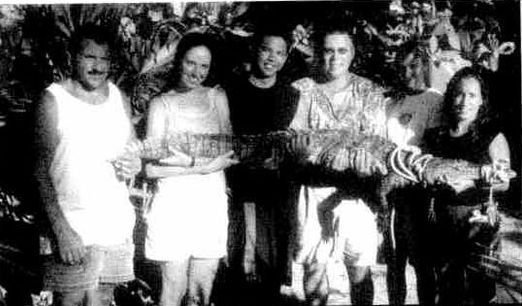
A mother with babies changes everything. Strays from the mainland do not raise families. Roatán had what our paper called "a viable, reproductively active population," and every mangrove on the island was potential crocodile habitat.
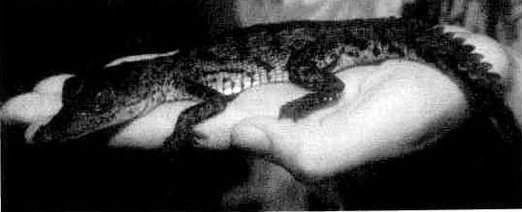
We published the find in Herpetological Review in 2001, with four students from the course as co-authors. That same year Lee and I wrote a longer account for the newsletter of the IUCN Crocodile Specialist Group. We asked why a large predator on a well-visited island had gone unconfirmed for so long. Our guess was that the islands were famous for their reefs, not their reptiles, so nobody had come to look. The course had given us both the time and the reason to look.
"It is through these that opportunity and preparedness met in the search for Bay Island crocodiles." — Kaiser & Grismer 2001
We were also worried about Guanaja, the easternmost island. Local people said crocodiles had lived in its northeastern mangroves for generations. Then, in October 1998, Hurricane Mitch destroyed almost all of Guanaja's mangroves. We suspected that the population had died or moved somewhere else. As mainland crocodiles lose ground to coastal development, we argued, island populations like these may become important reservoirs for the species.
The iguana that shouted
The crocodile hunt was not the only surprise. On the morning of 4 July 2000 we pushed into the same eastern mangroves by day. Our boat captain told us people almost never went there, because there was nothing worth selling and the biting sand flies were terrible.
We came upon about six Roatán spiny-tailed iguanas (Ctenosaura oedirhina), a species found only on Roatán and its neighbouring islets, basking on branches and sand. We got within about ten metres before the largest one noticed us. It gave a loud squawk and fled through a shallow saltwater pool into the roots. At that call, every other iguana ran too. Within 15 seconds all of them were gone.
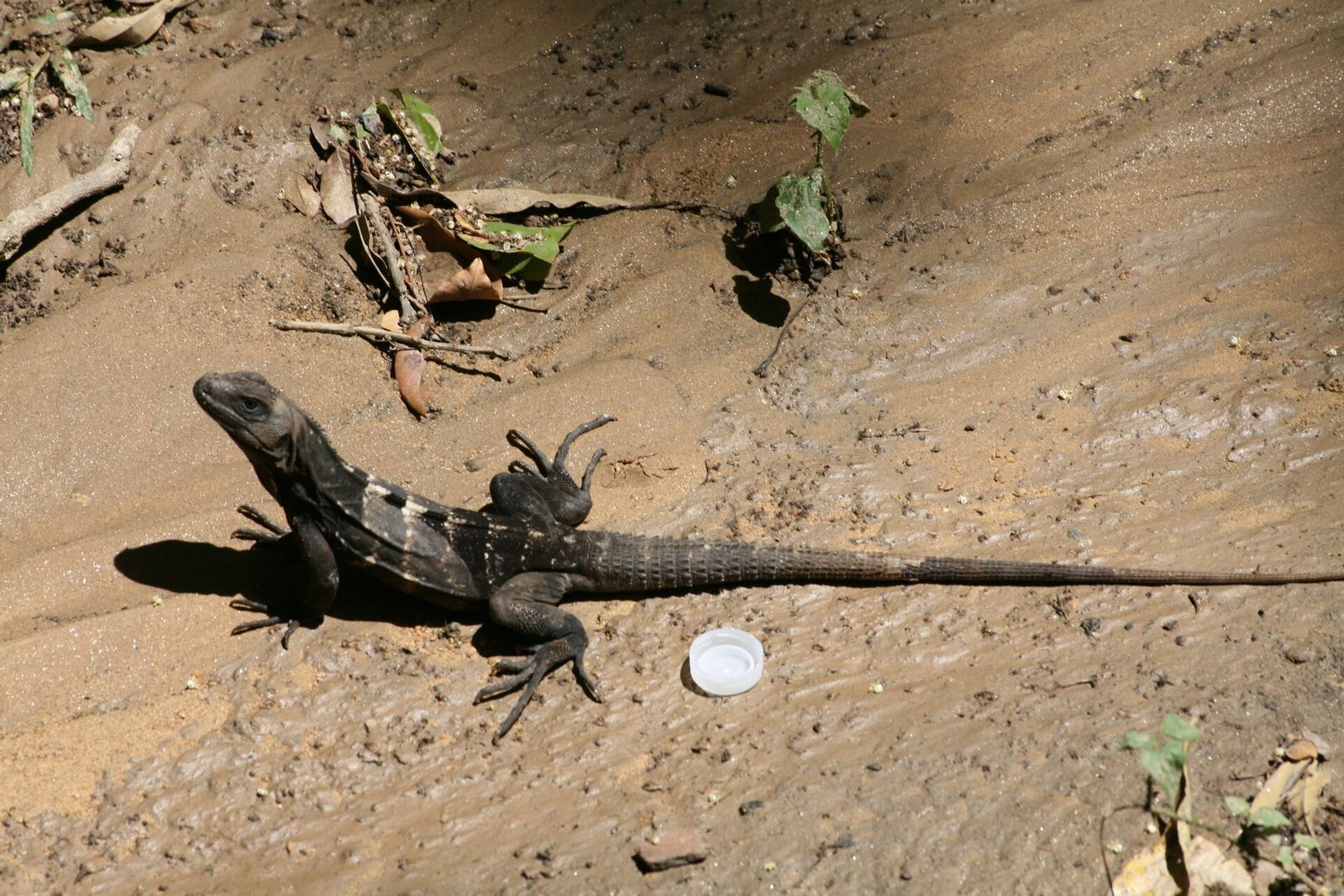
That mattered because iguanas are not supposed to make calls at all. Colleagues who had worked with related species had heard hissing, but never a vocal alarm. In a dense mangrove where the lizards cannot see far, a warning call makes sense. It also suggests these iguanas have a richer social life than anyone had assumed. Five students from the class are co-authors on that note.
Nine days later we spent a day on three tiny islands east of Roatán that no herpetologist had ever properly surveyed. Barbareta was privately owned, and one of its owners was rumoured to shoot at the motors of boats bringing poachers, because green iguanas are a prized food on Roatán. The result was what we called an "ecological peace": iguanas more than a metre long were everywhere. In the acknowledgements we thanked a Barbareta resident "for not shooting at our boats." On Big Pigeon Cay, a speck of sand and scrub only 60 by 20 metres, we found seven spiny-tailed iguanas. They must have reached it by crossing open water.
Field notes count
That September, one of my La Sierra students, Raul Diaz, and I were at Simla, a research station in Trinidad's rainforest. We turned two everyday scenes there into published observations. A pair of male turnip-tailed geckos had divided the eaves on either side of a bright insect-collecting lamp into territories. When one male strayed into the other's half, the resident hissed and attacked. No one had reported that sound from this species before. Below the kitchen window, where scraps attracted insects, two male spiny tree lizards fought so hard that they fell a metre and a half from a branch, still biting each other's thighs.
None of this required expensive equipment. It required being there, paying attention, and writing it down properly. That was what I wanted my students to learn: science is not something that only happens somewhere else, to other people. A group of undergraduates with flashlights and a boat corrected the record for a threatened crocodile, and their names are on the paper. Those early contributions were the start of a series of student research trips that would carry my classes to Malaysia, Cambodia, Timor-Leste and beyond.
The papers
- (2001) New herpetological records for the Islas de la Bahía, Honduras Herpetological Review 32: 134–135
- (2001) A breeding population of American crocodiles, Crocodylus acutus, on Roatán, Islas de la Bahía, Honduras Herpetological Review 32: 164–165
- (2001) Natural history notes. Ctenosaura oedirhina (Roatán spiny-tailed iguana). Behavior Herpetological Review 32: 253–254
- (2001) Natural history notes. Thecadactylus rapicauda (turnip-tail gecko). Behavior Herpetological Review 32: 259
- (2001) Natural history notes. Tropidurus plica (spiny tree lizard). Behavior Herpetological Review 32: 260
- (2001) Crocodiles in the Islas de la Bahía Crocodile Specialist Group Newsletter 20(4): 83–85