Snakes on a Plane
Photo courtesy of Mark O'Shea
Our fourth field season in Timor-Leste, Phase IV, began with a problem and ended with a pilot refusing to let my luggage on his plane. In between were three weeks that took us to every corner of the country we had not yet seen.
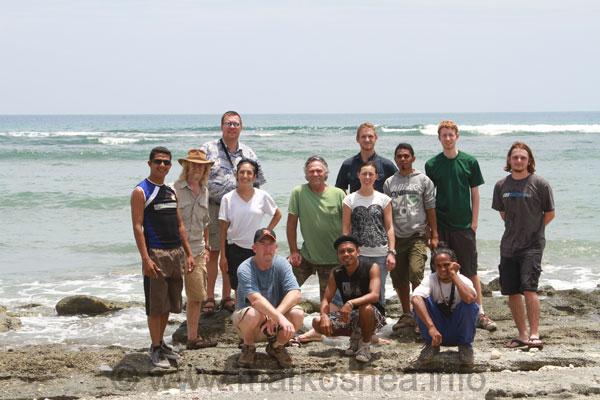
We arrived on 18 January 2011, on the Air Timor flight from Singapore. There were thirteen of us. I led eight people from Victor Valley College: Robert Sewell, the college administrator who sponsors the Associated Student Body, which paid for part of the students' travel, and six students, Caitlin Sanchez, Scott Heacox, Paul Landry, Joanna Flores, Kyle Olsen, and David Taylor. Mark O'Shea came from England as my deputy. And the four Timorese students we called the Jets were waiting for us: Benny, Laca, Luis, and Zito. Mark wrote that on our first night all thirteen of us sat down to "pizza and chips with salt and vinegar," washed down with Tiger and Bintang beer.
Plan B
The next morning we learned that the Nakroma, the ferry to Ataúro Island, would be out of service for at least a month. Without it we could not take our vehicles across, and Ataúro had been a big part of the plan. So we made a Plan B. We would make only a short trip to Ataúro in a small local boat. The rest of the time we would spend on a ten-day loop down to the south coast, to survey two protected areas and to reach Covalima, the only district (today a municipality) we had not yet visited.
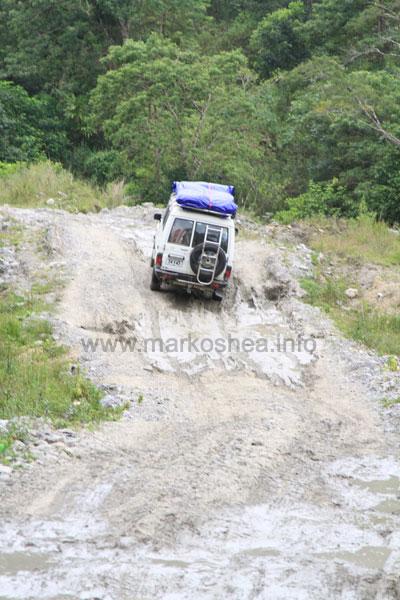
On 21 January we drove east from Dili along the dry north coast to Manatuto, then south over the central mountains. It was only 157 km, but in Mark's words the trip "had taken 7.5 hours due the poor state of the road in the mountains." One of his photographs of that road is captioned "Is that a road?" We drove through wet forest in thunderstorms, passed water buffalo in their wallows, and waited for a funeral procession to pass. That night we reached the Franciscan convent of St. Antony of Lisbon at Fatucahi, where Father Cornelius made us very welcome. It became our base on the south coast, and we came back to it the following year.
A snake nobody had recorded
On 22 January we went into Nancuro. It was then a proposed nature reserve, described by Mark as "a strip of coastal forest almost 4 kms by 0.5kms on the southern coast of Timor-Leste, south of Natarbora." Getting there meant driving off-road through swamp.
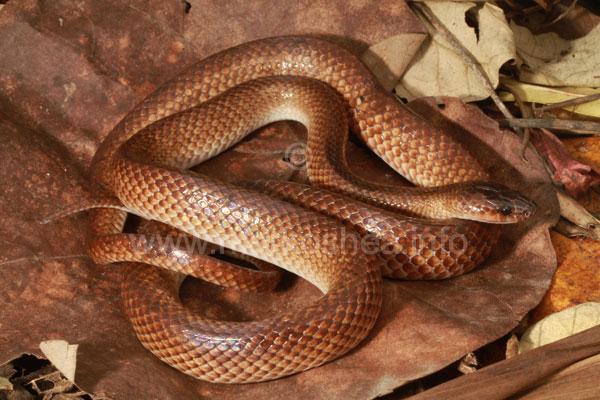
The forest was worth it. We found rice paddy frogs, geckos, skinks, and huge centipedes. And we found a groundsnake of the genus Stegonotus, which Mark called "another genus not previously recorded from Timor." That evening we prepared the specimens in our makeshift laboratory. At the time it was simply a surprising new record. Only after we went back to Nancuro in July 2012, and after years of work on old museum specimens, did it become clear that the groundsnakes of this forest are a species of their own. We named it Stegonotus nancuro in 2021.
Crocodile lake and a jumping monitor
The next day we looked for a place to search at night and tried Lake Lenas, a short drive away. It turned out to hold what Mark called "a large population of Saltwater crocodiles" with a reputation for attacking people. The lake edge was thick with vegetation, full of places for a crocodile to wait in ambush. We were not going to walk students around it in the dark with flashlights. We went back to Nancuro instead.
After that we worked our way west into Covalima. On 27 January, with Casimiro Mendes of the national parks department, we drove up into the Tilomar Forest Reserve near Suai, climbing from sea level to about 1,000 m in 39 km. Turning rocks was no use: Mark wrote that "every rock appeared to be home to a colony of aggressive ants." The trees were better. We caught a green emerald tree skink and a Timor flying lizard, and we found two Macklot's pythons killed on the road.
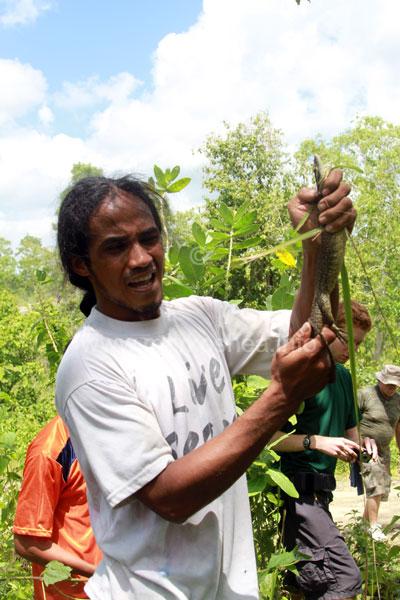
Then someone spotted a Timor monitor lizard on a roadside tree. Laca climbed up after it. The lizard did what monitors do and let go. It "jumped, straight into the waiting throng of herps below," as Mark put it, and we caught it.
From the frying pan into the fridge
To avoid rivers swollen by the rain, we took the long way back through Ainaro: 105 km from Suai to Maubisse in about three and a half hours. Maubisse sits at about 1,500 m, and we stayed at the Pousada, which had been the Portuguese governor's residence until 1975. After the heat of the south coast, Mark wrote, "the chill of the Maubisse evening and the cold of the Maubisse night were especially apparent." Along the way we found more road-killed Macklot's pythons, and whenever they were fresh enough we took tissue for DNA.
On 30 January we stopped in Aileu on the way back to Dili, to look at a saltwater crocodile the Environment Department had asked us to help move. It lived in a chain-link enclosure where, Mark noted, Portuguese peacekeepers had put it in 2004. We estimated it at about 3.5 m and "easily lured it out of the water onto dry land." We drew up a plan to capture and relocate it on our next trip.
On 31 January I went across to Ataúro with a small group, in the same small local boat we had used in 2010. Mark described "a calm, sunny three hour crossing" to the Tua Ko'in Eco-Resort. On our first visit the year before, we had found a bent-toed gecko there that was new to science. We came back to Dili on 2 February.
Snakes on a plane
Our last day, 5 February 2011, was the most eventful. Benny, Laca, and Zito came to the airport to see us off, along with some of the Turkish UN police officers we had got to know.
The trouble began at passport control. When I had arrived, the Director of Immigration had waived the usual formalities for me. As a result my passport had an entry stamp but no visa, Mark called it an "incongruity," and the immigration officers had to work out how to let me leave. Luckily Claudia Abate-Debat, Special Adviser to Prime Minister Xanana Gusmão, was on the same flight and sitting in the VIP lounge. When Mark told her what was happening, she immediately phoned the minister responsible, who happened to be in the airport. Mark called him the Minister for Infrastructure, but there was no such minister; it was most likely Pedro Lay, the Minister for Transport and Communication. That settled it. The plane was never held up. For me it was just half an hour of worrying whether I would be allowed to leave the country at all.
Then came the specimens. I was carrying preserved snakes that our Timorese students had collected for their thesis research. They were "all preserved and packed correctly for transit," with the export and import papers in order. But at the foot of the aircraft stairs, a coil of preserved snake showed through the clear plastic. The pilot would not have it in the cabin. The snakes went into the hold.
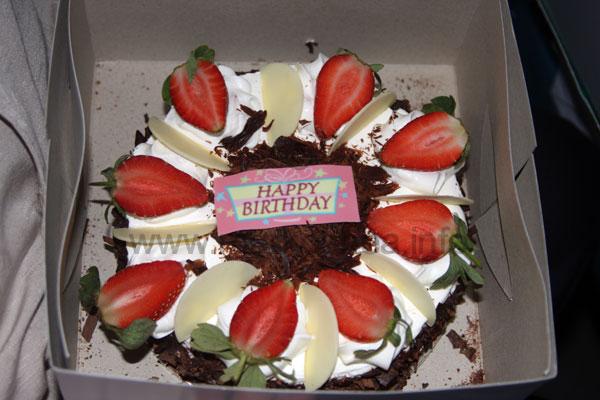
About two-thirds of the way to Singapore, a cardboard box appeared. Inside was a birthday cake. My birthday had actually been two days earlier, on 3 February, but the Air Timor team, led by Faridah, who had met us at the aircraft door, got me a cake anyway. They had brought it from Singapore on the outbound SilkAir flight so that they could present it to me on the flight back from Dili. Quite a surprise. Mark declared it "the first convergence of snakes and cake on a plane!"
Singapore had one more surprise. Scott, Paul, and Kyle had packed their field machetes in their checked bags, which is normally fine. But in Singapore machetes turned out to be "prohibited items." The customs officers and airport police treated it as the innocent mistake it was, and gave the machetes back. Mark flew on to England the next day, and most of the team flew home to the United States a day later.
Why it matters
Plans in the field almost never survive the first week. A ferry breaks down, a lake turns out to be full of crocodiles, a passport is missing a visa. What made Phase IV work was the people: a convent that took us in, a park ranger who knew the forest, a Timorese student willing to climb a tree after a monitor lizard, and a prime minister's adviser with the right phone number. And in a strip of swampy forest we had reached only because Plan A fell through, we met a snake that would one day carry the name Nancuro.
Sources: Mark O'Shea's Phase IV expedition page, markoshea.info/research_fieldwork_timor11.php, and his field notes for 18 January, 19 January, 21 January, 22 January (continued), 23 January, 27 January, 29 January, 30 January, 31 January, and 5 February 2011 (continued).
The papers
- (2013) Conservation education in a post-conflict country: five herpetological case studies of Timor-Leste Salamandra 49: 74–86
- (2021) A new species of Stegonotus (Serpentes: Colubridae) from the remnant coastal forests of southern Timor-Leste Zootaxa 5027(4): 489–514