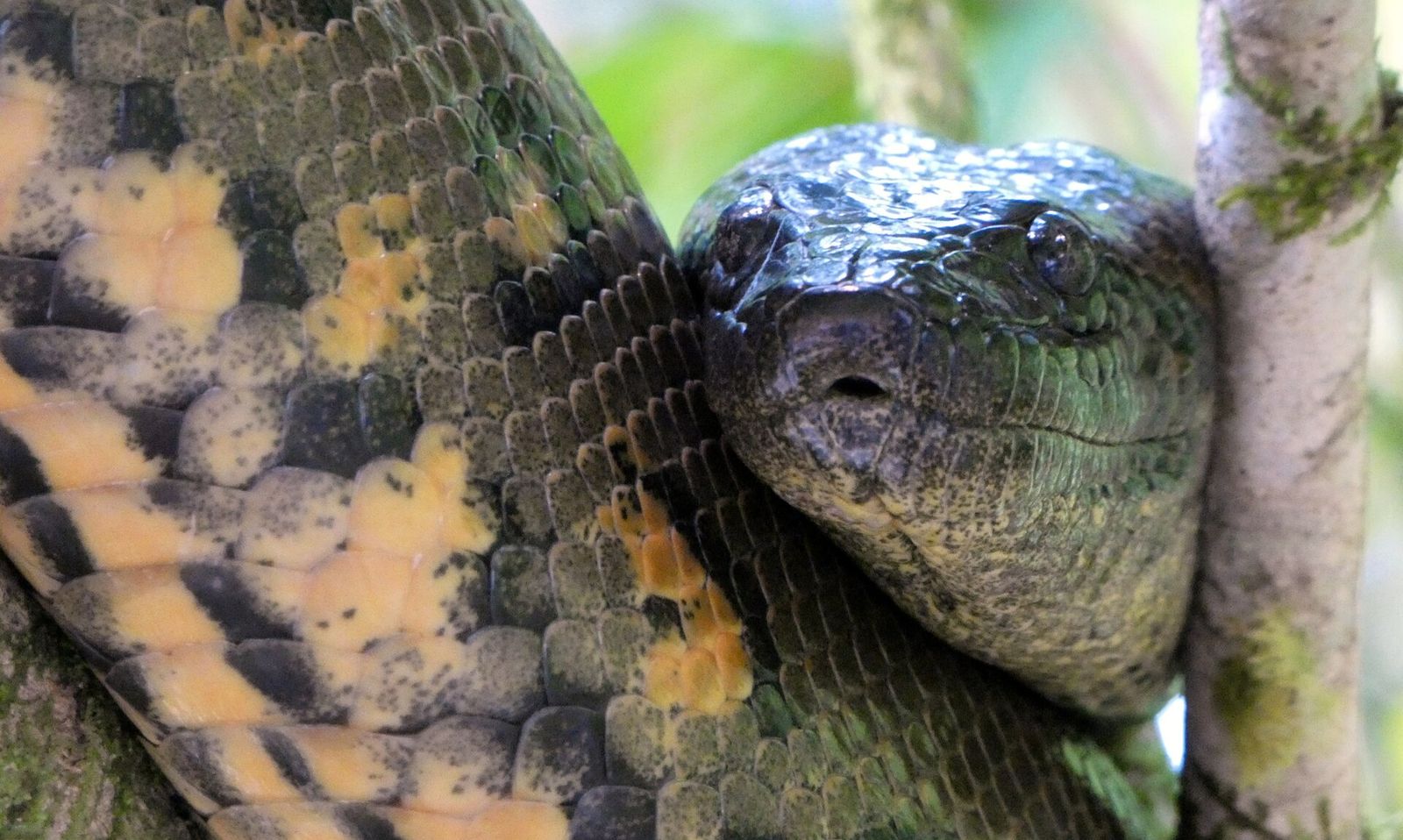
A Tangle of Anacondas
Photo: Kai Squires, CC BY 4.0, via Wikimedia Commons
In mid-February 2024 the news went around the world: a new species of green anaconda, one of the largest snakes on Earth. A well-known team had split the northern populations off as Eunectes akayima, the "northern green anaconda". The story had everything: a giant snake, the Amazon, famous names on the author list.
Within a month it had fallen apart. Two separate groups of scientists showed that the new name could not stand. It was at best a later duplicate of an older name, and probably not a valid name at all. Later that year I joined 15 colleagues, led by my long-time collaborator Wolfgang Wüster, to work out what had gone wrong and what we actually know about anacondas. Along the way the investigation led somewhere unexpected: to a hand-coloured engraving from 1735 and a single preserved snake in St Petersburg.
How not to describe a species
First, a word of fairness, which we also put in print. The lead author, Jesús Rivas, is a leading authority on anacondas, and his work is internationally respected. Our criticism was of one paper, not of the people who wrote it.
That paper, though, made several classic mistakes. Its case rested entirely on mitochondrial DNA. Mitochondria are the small energy factories in our cells, and they carry their own DNA that passes only from mother to offspring. That makes it a useful clue but a poor judge. Two groups can differ in their mitochondrial DNA while still freely interbreeding. That is a real possibility in anacondas, where males appear to do most of the travelling. The authors said they had looked at genes from the cell nucleus as well and found no differences, but they never made those sequences public. No one could check.
The difference they reported between northern and southern green anacondas, about 5% in one widely used gene, sounds large. It isn't decisive. Some clearly separate species of cobra differ by less than that. Some populations of kingsnake and ratsnake that belong to one species differ by more.
The paper was also rushed. It went from submission to publication in 32 days, which is very fast for an article of more than 10,000 words. After it went online, the "published" version kept being changed. Under the rules this matters: a name only counts once it appears in a fixed, final version.
Most basic of all, a new name has to come with a statement, in words, of how the new species differs. The authors had written that the two anacondas were "truly cryptic" and could not be told apart by their appearance. They listed genetic distances but no differences in words. We agreed with Dubois and colleagues that this made akayima a nomen nudum, a "naked name" with no description attached. Under the Code, the International Code of Zoological Nomenclature that governs all animal names, a name like that has never officially existed.
"Taxonomy is neither a service industry providing names on demand … nor is it a conceptually simple discipline that anyone can 'dabble' in." — Wüster, Kaiser et al. 2024
The name that was already there
There was a second problem. At least six older scientific names for green anacondas already existed, dating back as far as 1758. The authors had not considered any of them. Instead they argued that the Indigenous word akayima should take priority over names coined by "Western science".
The wish to honour Indigenous knowledge is a good one; the appeal I mention below calls such intentions "laudable". But the Principle of Priority applies only to names published under the Code. It cannot sort out a claim made on behalf of one language among the many spoken across the anaconda's range. One of the older names they ignored, Boa aboma from 1803, was itself taken from an Indigenous Surinamese name. The same year, more than 1,500 scientists, me among them, signed an appeal in BioScience for stable, neutral scientific names that work in every language. The appeal was translated into 12 languages, from Arabic and Chinese to Farsi, Korean and Turkish. It pointed to the anaconda case as an example of what goes wrong when that principle is set aside.
A snake drawn in 1735
To know which anaconda owns which name, you have to go back to the name-bearing specimens. Every species name is anchored to type specimens: the actual animals the original author based the name on. When Linnaeus named Boa murina, today's Eunectes murinus, in 1758, one of the animals he relied on was a snake engraved in the second volume of the Thesaurus of the Amsterdam collector Albertus Seba (1665–1736), published in 1735. Earlier in 2024, Dubois and colleagues had picked the real snake shown in that engraving as the lectotype, the single specimen chosen later to fix a name for good. They believed it was lost.
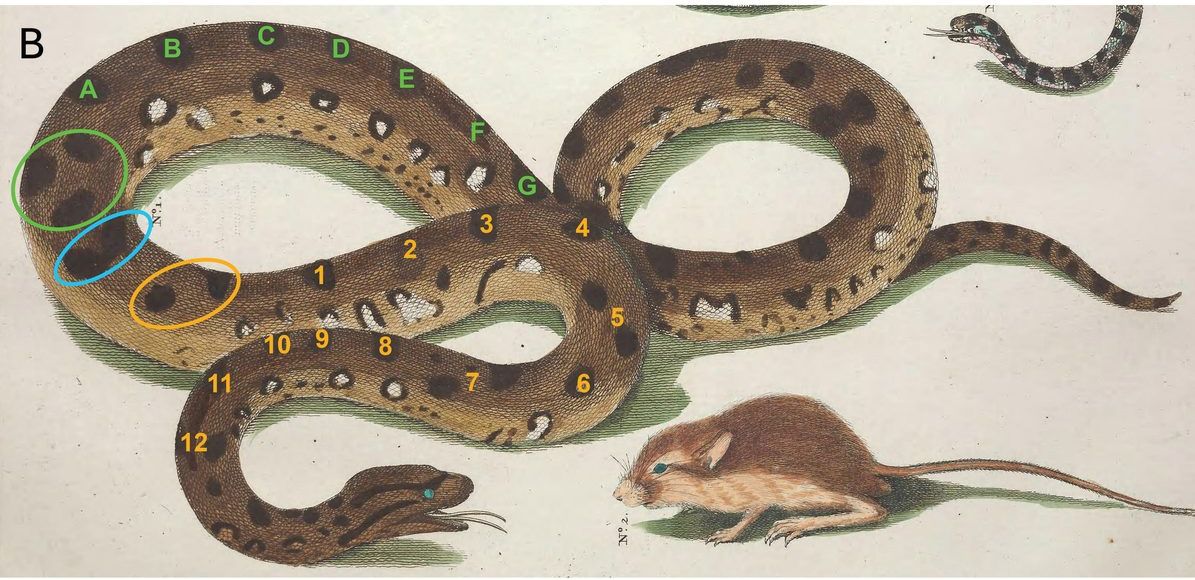
Seba's text said the snake came from the "Spaansche West-Indiën", the Spanish West Indies. One earlier author had read that as the Greater Antilles, such as Cuba or Hispaniola, where anacondas do not live. But the Dutch-Latin edition makes it more specific. The only part of the Spanish West Indies inside the anaconda's range is the island of Trinidad. Anacondas still live there today.
That changed everything. The earlier study's own DNA data placed all five of its Trinidad anacondas in the northern group. So the oldest name, murinus, belongs to the northern anacondas, the very ones that had just been given a "new" name. If the two groups ever do turn out to be separate species, it is the southern anaconda that will need a different name, perhaps one of the other old ones.
Found in St Petersburg
Next we asked whether Seba's snake was really lost. His second collection was auctioned in Amsterdam in 1752, and a broker named Sluyter bought 70 of its snakes. Two alcohol-preserved anacondas reached St Petersburg in the 1780s, after Sluyter's death, and are now in the Zoological Institute of the Russian Academy of Sciences. One could not be found in March 2024. The other, ZISP 1441, was still on the shelf.
My colleague Konstantin Milto photographed it, and we compared it with the engraving spot by spot. The number, shape and position of the black blotches on the back and flanks match. So does the stripe behind the eye, once you allow for the artist having mirrored part of the drawing. We also measured the specimen. It is an adult male about 1.7 metres long. Its scale counts put it firmly with anacondas from north of the Amazon, just as a Trinidad snake should.
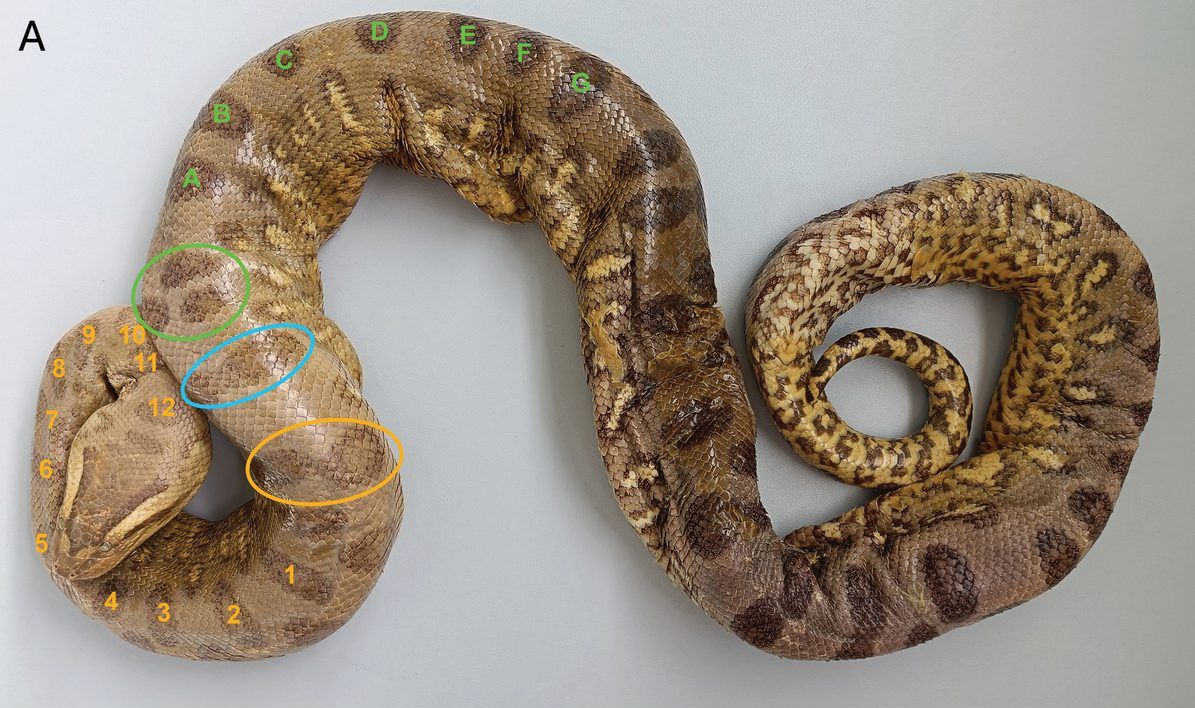
We concluded that ZISP 1441 is almost certainly the snake in Seba's plate, and so the anchor of the green anaconda's name. Taking all the evidence together, we recommended keeping the four long-recognised anaconda species until someone collects the nuclear DNA and dense sampling that the question deserves.
Why an old engraving still matters
People are sometimes surprised that a book from 1735 can settle a question in 2024. But taxonomy, the science of naming and classifying species, is cumulative in a way most sciences are not. An 18th-century description can matter as much as one from last year, because the name is permanently tied to the animal. In 2016 I was one of 34 signers of a letter to Nature arguing that the rules allow a species, in rare cases, to be named from photographs when no specimen can be collected. The Code is flexible about many things. It is not flexible about evidence.
The anaconda affair was not a scandal. It was a teachable moment. Good science was done too fast and, as we argued, published without review by specialists in naming species. It rewrote a famous animal's name on the strength of one kind of evidence. The fix took a team working in ten countries, a fresh look at the available DNA and body measurements, and a close look at a picture nearly 300 years old. That is slower than a press release. It is also how you get a name that will still be right 300 years from now.
The papers
- (2013) Case 3618. Kalophrynus pleurostigma Tschudi, 1838 (Anura: Microhylidae: Kalophryninae): proposed conservation of the genus Kalophrynus by designation of a neotype for its type species K. pleurostigma Bulletin of Zoological Nomenclature 70(2): 86–88
- (2014) Comment on the proposed conservation of Kalophrynus Tschudi, 1838 (Amphibia, Anura, Microhylidae) by designation of a neotype for its type species Kalophrynus pleurostigma Tschudi, 1838 Bulletin of Zoological Nomenclature 71(1): 28
- (2016) Species can be named from photos Nature 537: 307
- (2024) How not to describe a species: lessons from a tangle of anacondas (Boidae: Eunectes Wagler, 1830) Zoological Journal of the Linnean Society 201(4): zlae099
- (2024) Protecting stable biological nomenclatural systems enables universal communication: a collective, international appeal BioScience 74(7): 467–472