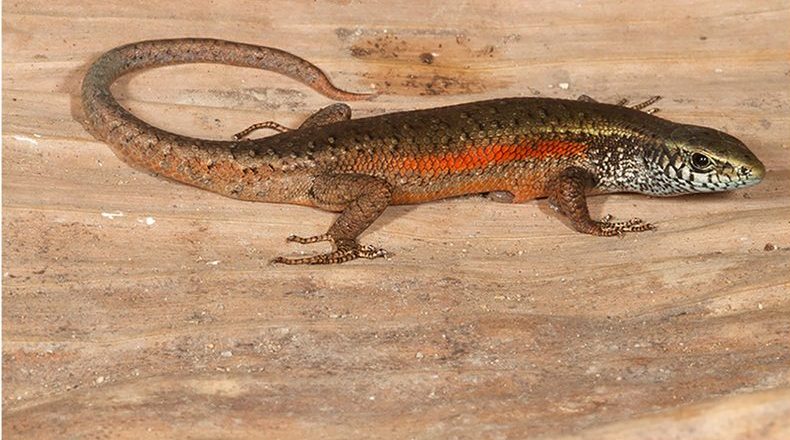
Skinks, Mites and Ticks
Photo: Mark O'Shea, from Oda et al. 2023, Ticks and Tick-borne Diseases
A survey like ours does not end when the expedition flies home. For years afterwards, samples we collected in Timor-Leste kept turning into papers. Some of the best of them are about very small things: a few skinks in a German terrarium, some red dots on a flying lizard's wing, and a tick on a skink's armpit.
A riverbank at 1,200 metres
Many of these stories start in one place, the Meleotegi River near Eraúlo in Ermera District. It runs through montane rainforest about 1,200 m up, a cool, wet place that gets around 2,600 mm of rain a year. There are old Japanese buildings from the Second World War nearby. The forest is probably secondary growth, but it has come to look much like the original.
It is also full of lizards. By October 2012 we had recorded at least seven species there. Among them were a flying lizard, two probably new four-fingered skinks (Carlia), two probably new forest skinks (Sphenomorphus) and two night skinks (Eremiascincus). The same streambed is where we first found the Timor river frog in Timor-Leste.
Babies without eggshells
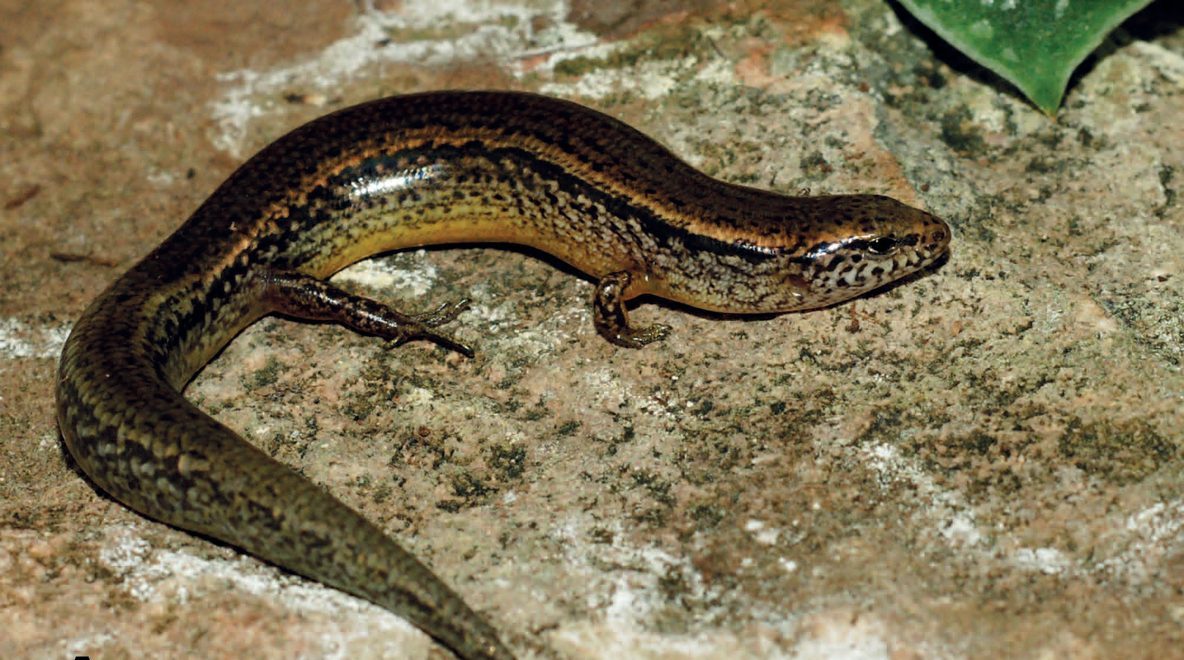
One of the night skinks is an elongated, short-legged animal with a yellow belly. It has no scientific name yet, and we call it Eremiascincus "Ermera." It hides by day under rocks and logs. In wet weather we found up to four under a single rock pile, often a pile that people had stacked up themselves.
To learn how it lives, we brought four live adults to Philipps University in Marburg, Germany, in February 2012. Sven Mecke and his students kept them in a planted terrarium. In October 2012, during routine cleaning, they found four babies, each about 40 mm long. In December there were three more. There were no eggshells anywhere, and it is unlikely the adults had eaten them. So this skink gives birth to live young, which is useful when working out how the Timor night skinks are related to their Australian cousins.
Hitchhikers
Whenever we prepared a specimen in the field, we also looked for parasites. We removed them with fine forceps, stored them in alcohol and filed them away. Some of those vials waited nearly a decade for the right expert. That turned out to be a team of Brazilian parasite specialists, and our collaboration with them produced two papers.
The first, in 2021, was about scale mites. These are tiny, often red relatives of spiders that live permanently on lizards. We recovered 52 female mites of the species Geckobia bataviensis from five geckos collected on Ataúro and the mainland. They sit in a sheltered spot between a gecko's claw and its sticky toe pads. One of the hosts was an Indo-Pacific tree gecko (Hemiphyllodactylus typus), and no one had recorded this mite on that gecko before.
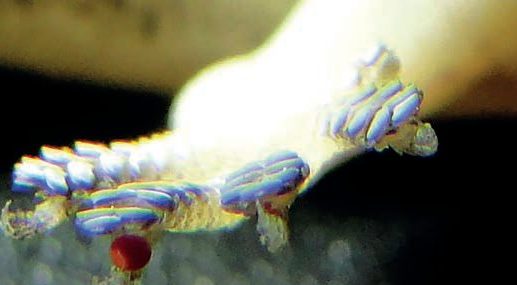
The prettier find came from a Timor flying lizard (Draco timoriensis). These lizards glide from tree to tree on "wings" of skin stretched over their ribs. On the underside of the left wing of one female we found two adult mites and a scatter of red nymphs, the young mites. Out of our entire collection she was the only flying lizard carrying them. It was only the second record ever of this mite, Pterygosoma dracoensis, on this lizard, and the first for Timor-Leste. The nymphs could not be extracted intact with the tools in our field laboratory.
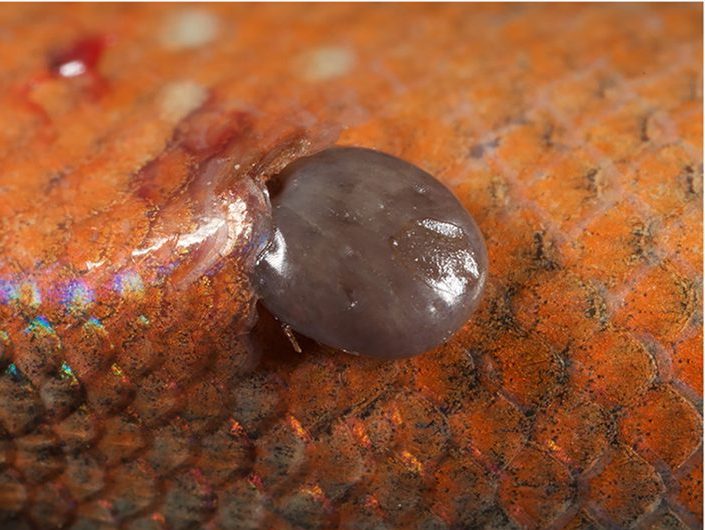
The second paper, published in 2023, was about ticks. We checked 21 reptiles, most of them skinks from the Meleotegi River and the nearby Santa Bakhita Mission, and four had ticks. Engorged tick nymphs were attached to the four-fingered and forest skinks, tucked into their armpits or wedged between belly scales. An adult male tick was on a Lesser Sunda racer, a harmless snake that a local resident had noosed, beaten to death and thrown onto the road. The tick was Amblyomma helvolum. It had never been recorded in Timor-Leste or on any of these three hosts.
A skink on a jetty
Some finds came from other people entirely. In August 2015 Tom Martin and Barnabas Harrison, two researchers from Britain, photographed small snake-eyed skinks on the rocky shore of Jaco Island. Jaco is a 10 km² uninhabited island off Timor-Leste's eastern tip. Their photographs became a museum record in the Smithsonian's image collection, and we published it together.
These skinks (Cryptoblepharus cf. schlegelianus) live in the splash zone of rocky shores and on concrete jetties, often in crowds. Their supposed namesake species was described from a specimen labelled "Timor." We think it was really collected on Semau, a small island near the old port of Kupang. Ships' cargo from the region was routinely labelled as coming from Timor. So even a photograph of a beach lizard helps correct an old museum label.
Why small things matter
Skinks are easy to overlook, but people use them a great deal. In 2024 I joined Jordi Janssen and colleagues in a worldwide review of how people use skinks. We found records for 400 species, about 23% of all skinks, used as food, medicine, pets or trade goods, or featuring in folklore. The common sun skink (Eutropis multifasciata), which also lives in Timor-Leste, is grilled whole in some places and sold as medicine in Indonesian markets. In a folk belief recorded among the Nage people of the Lesser Sunda Islands, it can even father piglets.
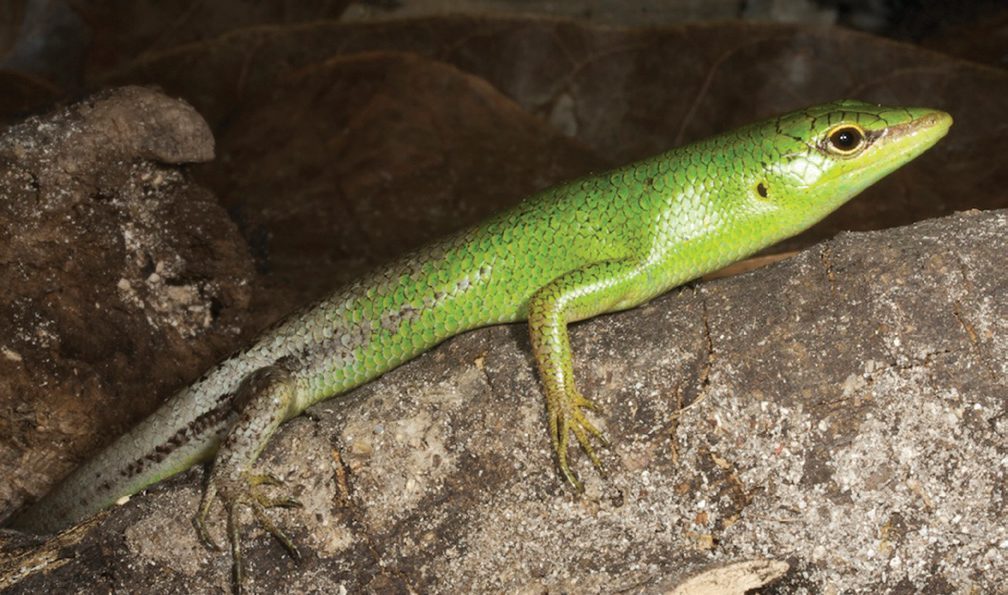
A new country needs more than a list of its big, charismatic animals. It needs to know which parasites live on its wildlife, how its lizards reproduce and where its museum labels went wrong. None of that is glamorous. All of it depends on someone in the field taking the time to pick a mite off a gecko's toe.
The papers
- (2015) Geographic distribution. Cryptoblepharus cf. schlegelianus (Timor North Coast Snake-eyed Skink) Herpetological Review 46(4): 568
- (2016) First captive breeding of a night skink (Scincidae: Eremiascincus) from Timor-Leste, Lesser Sunda Islands, with remarks on the reproductive biology of the genus Salamandra 52(2): 178–188
- (2021) New records of the mites Geckobia bataviensis Vitzthum, 1926 and Pterygosoma dracoensis Jack, 1962 (Trombidiformes: Pterygosomatidae) from Timor-Leste Entomological Communications 3: ec03041
- (2023) Ticks (Acari: Ixodidae) of three Timor-Leste reptiles: first country record of Amblyomma helvolum, with new interactions and an updated list of host species Ticks and Tick-Borne Diseases 14: 102060
- (2024) Ethnozoological review on the trade, human alimentation, and cultural use of skinks (Reptilia, Scincidae) Journal of Ethnobiology 44(3): 221–233