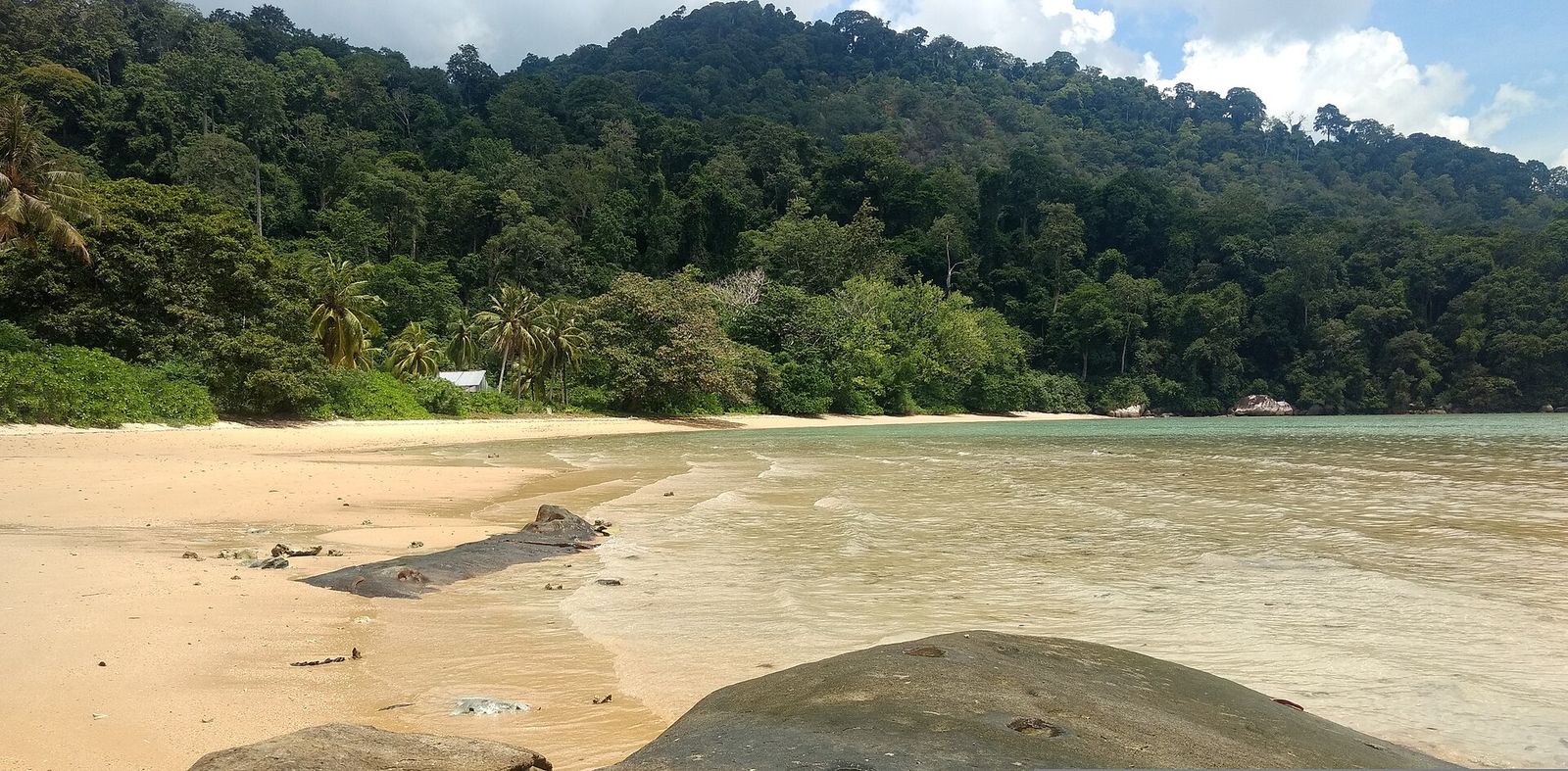
Island-Hopping with a Classroom
Photo: Lunaloop, CC BY-SA 4.0, via Wikimedia Commons
On the evening of 23 July 2002 a gecko fell out of a tree on Pulau Tinggi, an island off the east coast of Malaysia, and landed on a student's shoulder. We know this because it is in the scientific record. The line "One specimen observed at night fell from a tree and landed on a students shoulder" appears in the journal Hamadryad, in a paper with some two dozen authors. Most of them were students on my summer course.
That gecko sums up what those summers were about. We did not bring students along to watch scientists work. The students were the scientists: turning boards, searching tree trunks by flashlight, catching, photographing and recording. When the work was done, their names went on the paper.
Scouting an island
It began with a short scouting trip. From 2 to 6 November 2000, my La Sierra University colleagues Lee Grismer and Roland Sosa and I visited Pulau Tioman. Pulau is Malay for island, and Tioman is the largest of the Seribuat Archipelago, a scatter of about 32 islands in the South China Sea. We wanted to know whether Tioman could host a summer course in field biology.
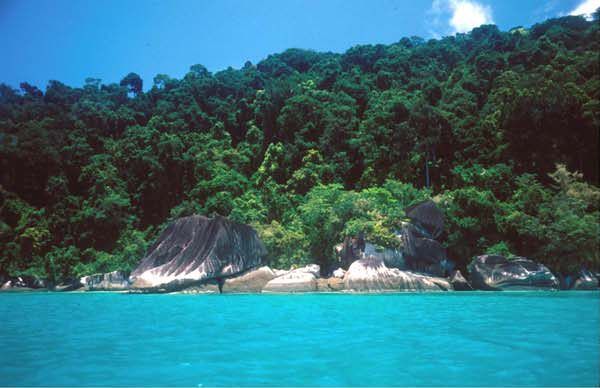
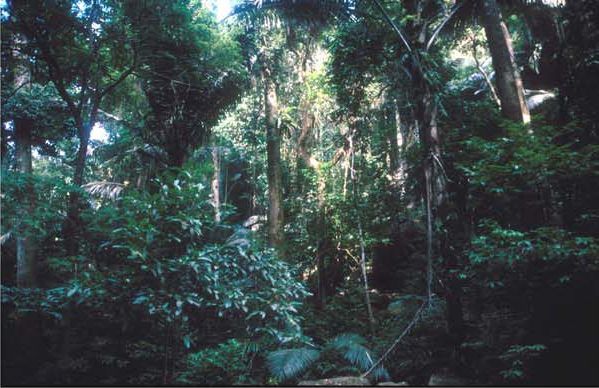
The island answered for itself. It rises steeply to more than a thousand metres. Granite boulders the size of houses are stacked along its slopes, and fast streams tumble through lowland rainforest dominated by dipterocarps, the giant trees of Southeast Asian forests. Tioman had been studied by naturalists for most of a century. Even so, in those five days we confirmed five lizards and three snakes that had never been verified there. If three people could do that in a few days, a whole class could do a great deal more.
A new island almost every summer
The course, Tropical Field Biology, ran each July. Lee and I taught it together with a changing cast of colleagues, and it drew both American and Malaysian students. Tioman was our base, but the smaller islands kept calling. Their reptiles and frogs had barely been looked at, and a class could survey one in a day or two.
In July 2001 we went to Pulau Aur, 63 kilometres offshore, the most isolated island in the archipelago. Before our visit, its entire published herpetology amounted to a single snake mentioned in a book, plus a handful of old museum specimens in Singapore. In two days, on 15 and 16 July, we added twelve species. In one boulder cave, reachable only by crawling, we found a patch of ground just 20 by 20 centimetres holding an estimated 200 to 250 gecko eggshells. That suggested many females were laying in the same spot, and coming back to it. Villagers told us of cicak kubing in the forest, which we took to be flying lizards or gliding geckos. We could not confirm them, so they went into the paper as a lead for the future, not as a record.
Just before that, from 13 to 15 July, we had been on Pulau Tulai, a T-shaped islet about 1.6 kilometres long. There, under a cement bag in bamboo leaf litter, the class turned up a legless, burrowing skink of the genus Larutia. It proved to be a species new to science and was later named Larutia seribuatensis. Tulai also posed a puzzle: we found no flying lizards and no amphibians at all. The lack of frogs is probably explained by the island's lack of permanent fresh water.
The pattern continued. We visited Pulau Tinggi for a single afternoon and evening in July 2002 and recorded 15 species (and one gecko on a shoulder). In July, August and September 2003 we surveyed Pulau Besar and Pulau Sibu. The Sibu paper lists twenty-two authors, and most of them were students.
The snake in the bucket
Back on Tioman, the class set up pitfall traps: containers sunk flush with the forest floor, with low drift fences that steer small ground-dwelling animals into them. The traps lined the trail that crosses the island from Tekek to Juara. On 22 July 2002, one of them held a small, slender snake, dark brown above with narrow cream bands, a blunt head and a stubby tail. The next day, the same trap held another.
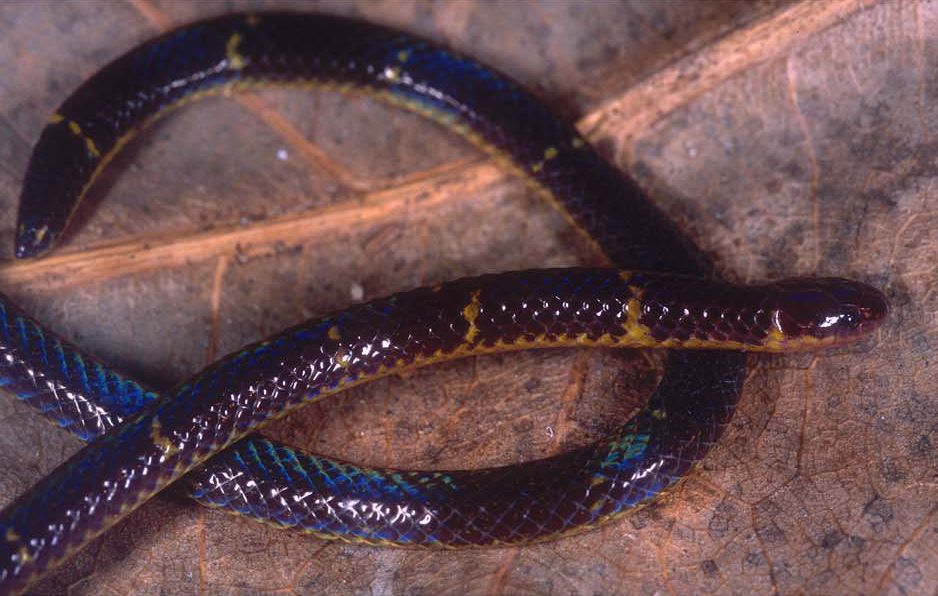
These were reed snakes, genus Calamaria. They are small burrowers that spend their lives in soil and leaf litter, which is why they are so rarely seen. Tioman already had two known species, but this one matched neither. Its scales, teeth and colour pattern were a unique combination. In 2004 Lee Grismer, our Malaysian colleague Norsham Yaakob and I described it as Calamaria ingeri. The name honours Robert F. Inger of the Field Museum in Chicago, whose monumental 1965 revision of reed snakes made it possible to tell them apart. As far as we know, it lives only on Tioman.
That same year the class's work came together in a checklist of Tioman's amphibians and reptiles. It listed 97 species, including 15 new island records and eight species that were newly described or awaiting description. At least 11 species were known from nowhere else. We also mapped which vegetation zone each species lives in, from mangroves to the mossy ridge forest on the summit of Gunung Kajang. Nearly three-quarters of Tioman's species turned out to live in the lowland dipterocarp forest, where boulders and streams create a maze of small habitats. The paper's acknowledgements thank "all the Malaysian and American students of the Tropical Field Biology classes."
An ant with a gecko
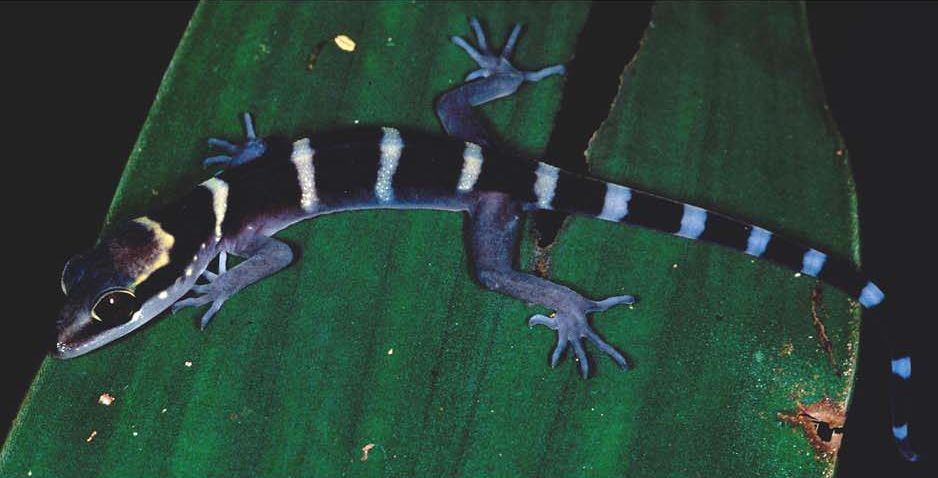
Some discoveries are not new species but new facts about old ones. At about three in the afternoon on 24 July 2003, on the same trail, my colleague Walter Wuertz and I saw a Malaysian giant forest ant, Camponotus gigas, carrying something unusually large in its jaws. This ant is one of the largest in the world, nearly three centimetres long. Its prey was a small Kendall's rock gecko, Cnemaspis kendallii. Plenty of frogs and lizards eat ants. As far as we could find, though, nobody had ever reported a single ant killing an amphibian or reptile. We guessed the gecko had simply bumped into the ant by bad luck.
To Cambodia's highest mountain
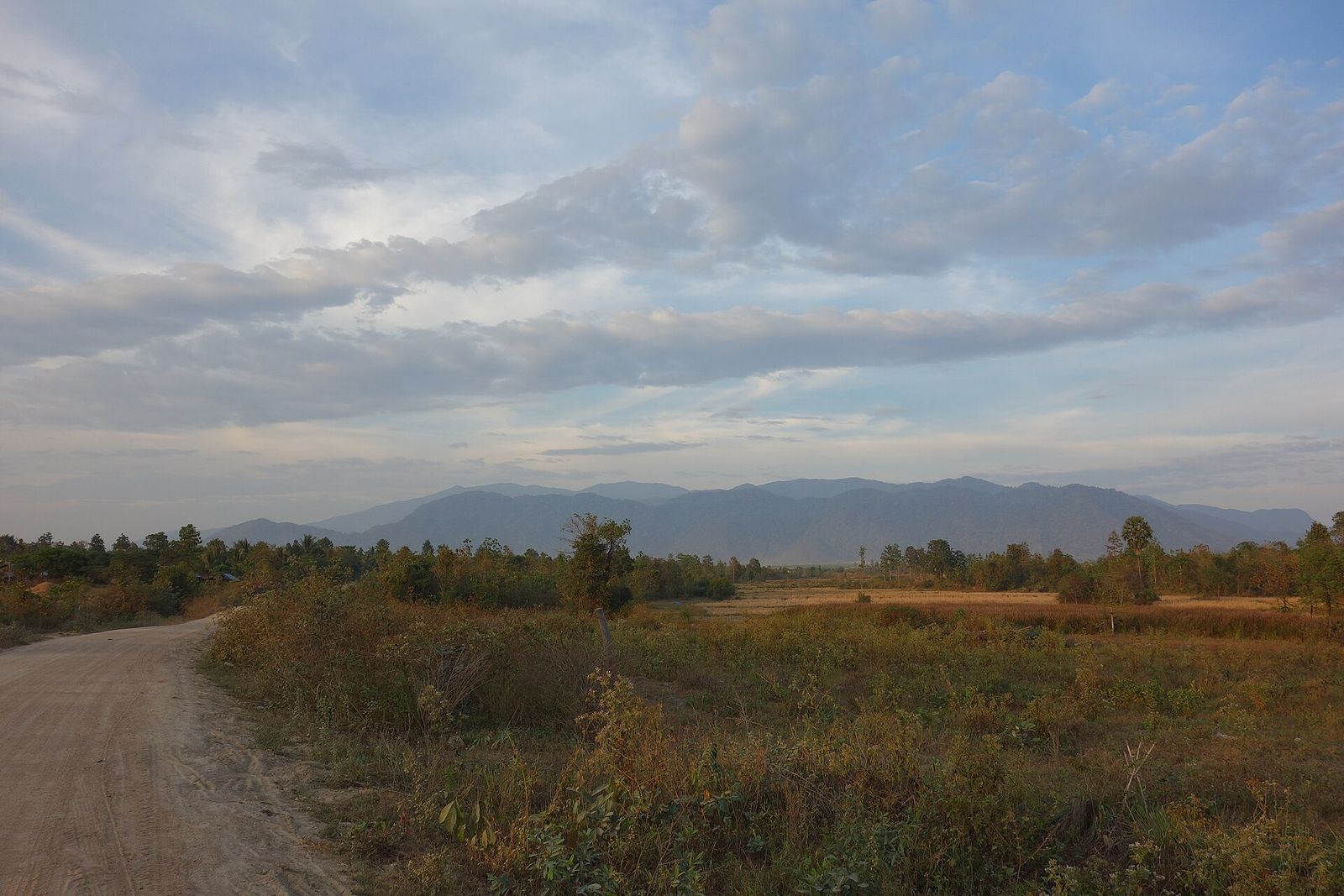
The same approach took us inland in August 2005, to Phnom Aural in Cambodia's Cardamom Mountains. At 1,831 metres it is the country's highest peak. As our paper put it, "years of political turmoil and genocide" had all but halted biological fieldwork in Cambodia, and the country lagged far behind its neighbours in what was known about its wildlife. Our team included colleagues from Cambodia's Forestry and Environment ministries and from Fauna & Flora International, along with La Sierra students Perry Wood, Timothy Youmans and Armando Ponce.
From 4 to 10 August we worked from a village in the dry lowland forest, through camps at about 550 and 1,120 metres, up to a summit wrapped in fog where the daytime temperature never passed 14°C. Local dogs helped us find turtles and snakes. We recorded 16 frogs, a tortoise, 18 lizards and 9 snakes. One of the snakes, Dendrelaphis subocularis, was new for the entire Cardamom range. We also documented something sadder: the sanctuary was protected on paper but still suffered from considerable illegal logging.
A species list is a promise: this is what lived here, on these dates, and anyone may check.
What the checklists are for
A checklist can look like the least glamorous thing in science: a list of names. But on islands and mountains that nobody has surveyed, it is the baseline everything else depends on. Without it, you cannot notice when a species disappears. We counted a species as confirmed only when a preserved specimen or a catalogued photograph backed it up. Everything else was flagged as an unconfirmed sighting, so others could check our work.
For the students, those lists were something more personal. A long list of authors at the top of a paper can look like padding. In our case it was the literal truth: each name belonged to someone who had spent nights on a forest trail with a headlamp, and whose observations were now part of the permanent record of those islands.
The papers
- (2001) First report on the herpetofauna of Pulau Aur, Johor, West Malaysia Hamadryad 26: 350–353
- (2001) Report on the herpetofauna of Pulau Tulai, West Malaysia Hamadryad 26: 369–371
- (2002) Revised checklist and comments on the terrestrial herpetofauna of Pulau Tioman, Peninsular Malaysia Herpetological Review 33: 26–29
- (2003) First report of the herpetofauna of Pulau Tinggi, Johor, West Malaysia Hamadryad 27: 259–262
- (2004) Species diversity and checklist of the herpetofauna of Pulau Tioman, Peninsular Malaysia, with a preliminary overview of habitat utilization Asiatic Herpetological Research 10: 247–279
- (2004) A new species of reed snake of the genus Calamaria H. Boie, 1827, from Pulau Tioman, Pahang, West Malaysia Hamadryad 28: 1–6
- (2004) A first report on the herpetofauna of Pulau Besar, Johor, West Malaysia Hamadryad 28: 106–109
- (2004) First report of the herpetofauna of Pulau Sibu, Johor, West Malaysia Hamadryad 28: 116–119
- (2006) Natural history notes. Cnemaspis kendallii. Predation Herpetological Review 37: 463–464
- (2007) The herpetofauna of the Phnom Aural Wildlife Sanctuary and checklist of the herpetofauna of the Cardamom Mountains, Cambodia Hamadryad 31: 216–241