Five New Frogs in the Clouds
Photo: Mayke De Freitas, from Kaiser et al. 2015, Journal of Threatened Taxa (CC BY 4.0)
The frog that may be the smallest in Venezuela is 13 millimetres long, about the length of a fingernail. The only preserved specimen was caught on 15 November 1978 by Stefan Gorzula. It then sat in a museum jar for 37 years before anyone gave it a name. That name, Pristimantis pariagnomus, "the gnome of Paria," was one of five we published together in 2015. All five came from the same misty mountainside.
The mountain at the end of the Andes
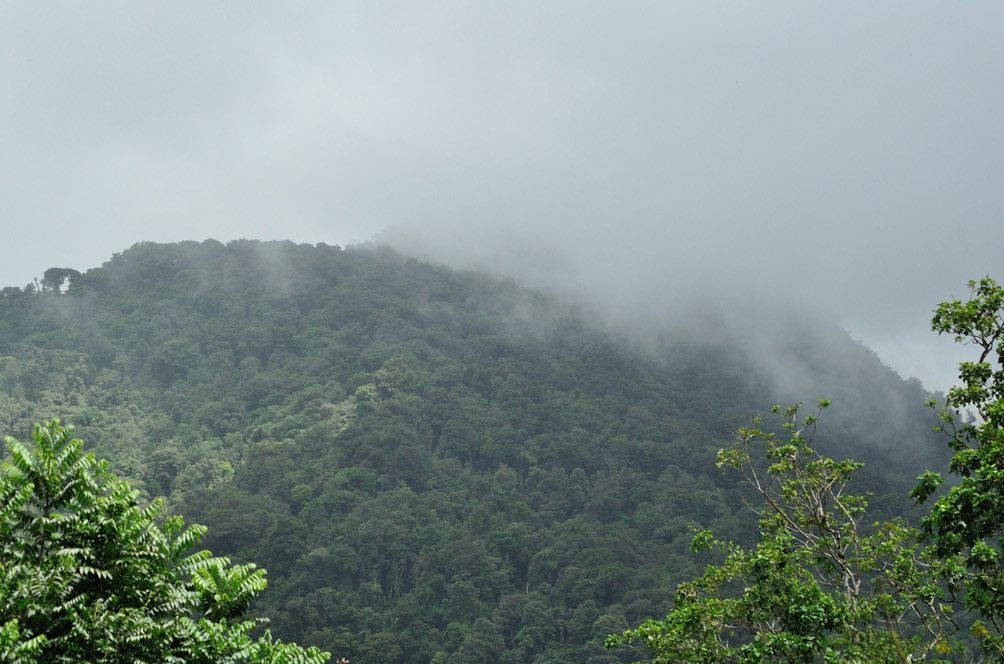
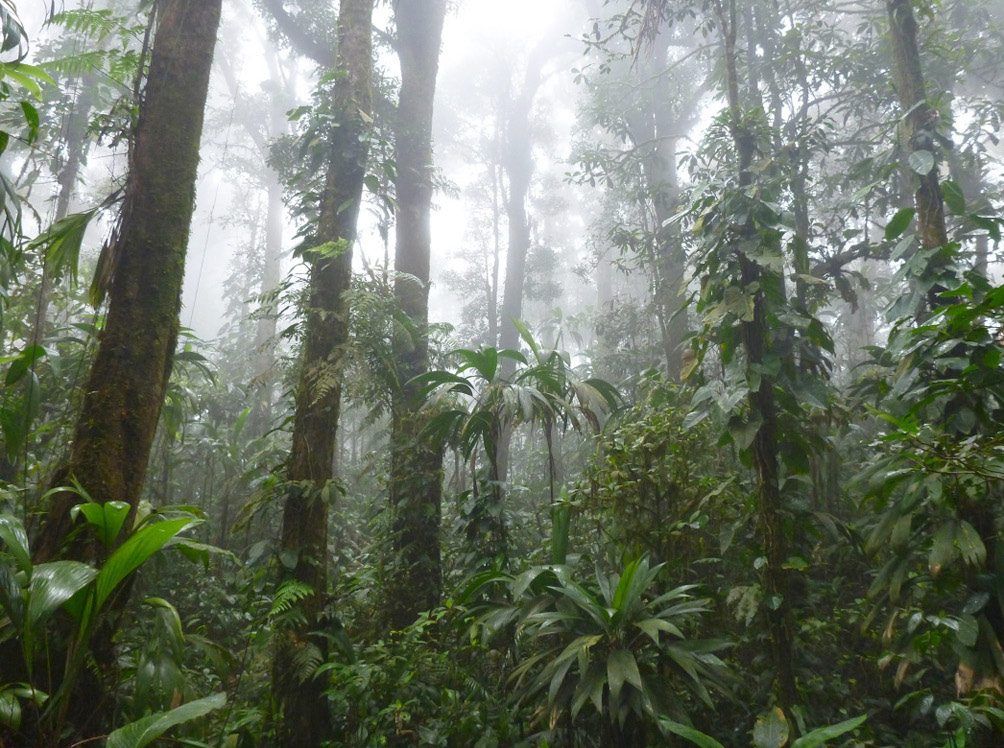
The Península de Paria is a narrow finger of land in the far northeast of Venezuela, pointing east toward Trinidad. Along its spine runs the last stretch of the coastal mountains that branch off from the Andes and cross northern Venezuela. Above roughly 600 metres its steep slopes are cloaked in cloud forest, where trees drip with moss and the peaks spend much of their time hidden in fog. The highest of those peaks, Cerro El Humo, is literally "Smoke Mountain."
For me, Paria was a natural next step. My doctoral research had been on the frogs of Trinidad, Tobago and the Lesser Antilles, and Paria is the mainland right next door. In September 2000, Lee Grismer and I were in Paria. Near the village of Manacal, at night, we photographed a false coral snake (Siphlophis compressus) foraging at the base of a bush. It was the first record of the species for the state of Sucre and the northernmost anywhere in Venezuela.
The real expedition came a year later. From 3 to 9 September 2001 I worked on the southern slopes of Cerro El Humo with the herpetologist César Barrio-Amorós, a grant from La Sierra University, collecting permits arranged by our Venezuelan colleague Gilson Rivas, and a student named Jason Trujillo. All of our later papers from Paria thank him, one of them as a "delightful and competent" companion in the field.
The student's frog
On 6 September, at about 1,050 metres, Jason caught a small brown frog with dark brown flanks, a faint pale stripe along each side, and a belly washing from orange to white. It turned out to be a species new to science, and Jason collected the holotype, the single specimen that officially defines a species. We found only three animals, all females. One sat at the entrance of a hole at the edge of a forest path, perhaps an armadillo burrow. The other two were in a dry streambed. All of them moved fast and were hard to catch.
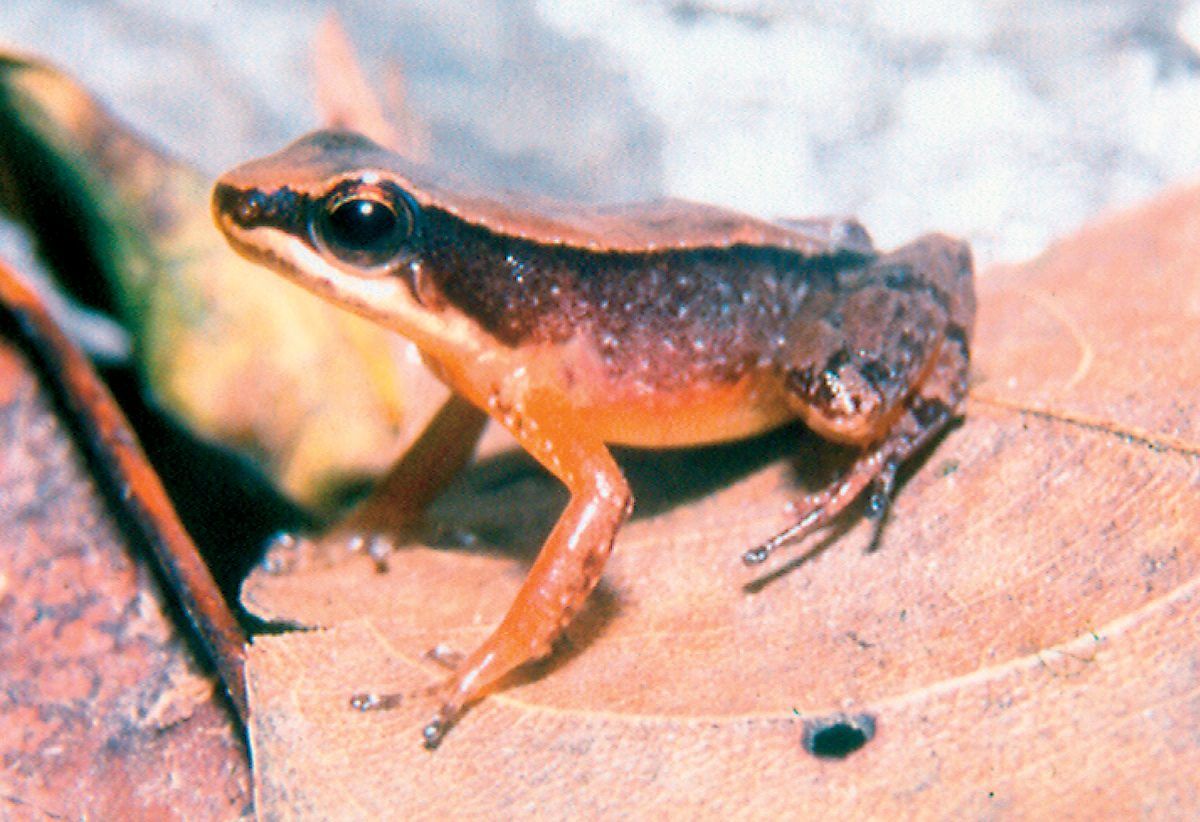
In 2006 we described it as Colostethus caribe. It has since been moved to the genus Allobates. We named it for the Carib people, who once lived along the coasts of the sea that now carries their name.
"Because their culture and voice have nearly disappeared, we name this frog, which inhabits some of Venezuela's ancient caribe lands, for one of the ancestral people of the Caribbean." — Barrio-Amorós, Rivas & Kaiser 2006
Brief return visits to the spot in August 2002, July 2003 and December 2003 never turned it up again, although nobody was searching for it specifically. By 2018 it was still known only from those three females.
Names that did not fit
Paria kept forcing us to fix old mistakes. For about a century, the small stream-dwelling "rocket frogs" of Venezuela's coastal mountains had been called Mannophryne trinitatis, a name based on frogs from Trinidad. I examined the original specimens from 1879 at Harvard's Museum of Comparative Zoology. Together with chromosome differences I had documented earlier, the evidence showed that the name belongs to Trinidad alone. That left the Venezuelan populations, probably several species, without a name at all.
Its Paria relative, Mannophryne riveroi, is an endangered giant of its genus, and the literature had it wrong too. It had been described as active at night, unlike all its relatives. We found it to be mainly a daytime frog, even if disturbed animals will hop away at night. More worrying was that two-thirds of the individuals we examined had malformed limbs, and one in three of all their limbs was deformed in some way. We could not pin down a cause, but we flagged it as a possible early warning of environmental damage.
Five rain frogs
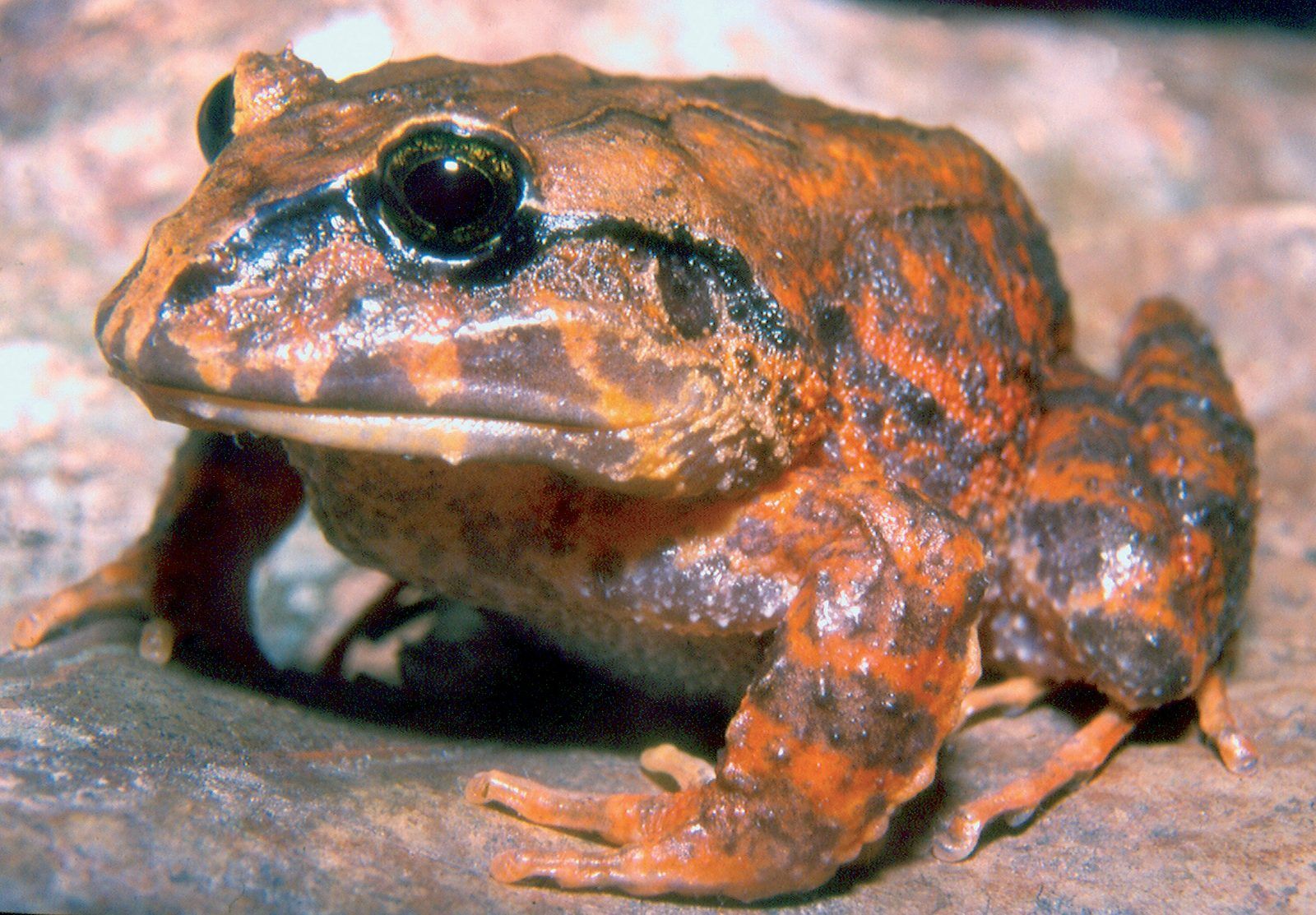
The biggest haul from 2001 was a set of rain frogs, genus Pristimantis. These frogs skip the tadpole stage altogether: their eggs hatch directly into tiny froglets. We searched along forest paths and creeks by day and night, and after dark we let the frogs' calls guide us.
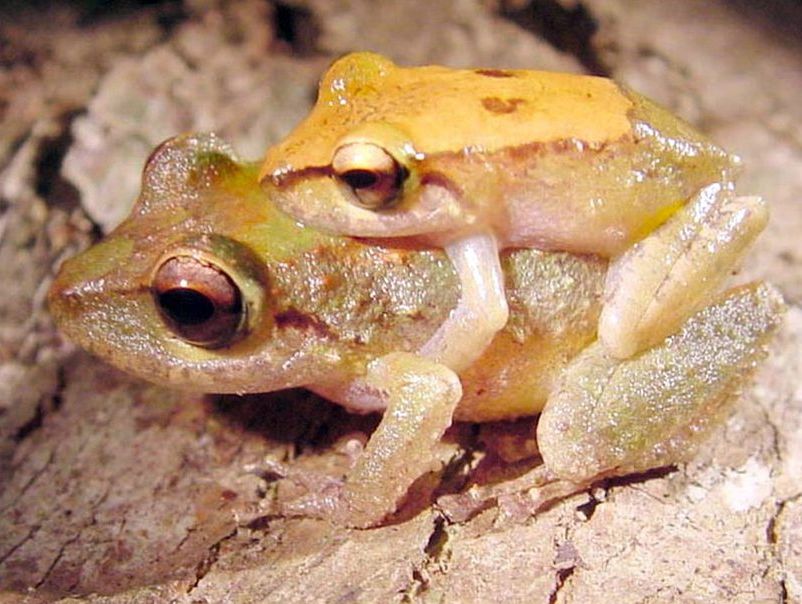
One species was everywhere. Males started calling at dusk and had mostly stopped by 9 p.m. One pair we caught stayed locked in amplexus, the mating embrace, even while we set them up for photography. We named it Pristimantis nubisilva, from the Latin for "cloud forest."
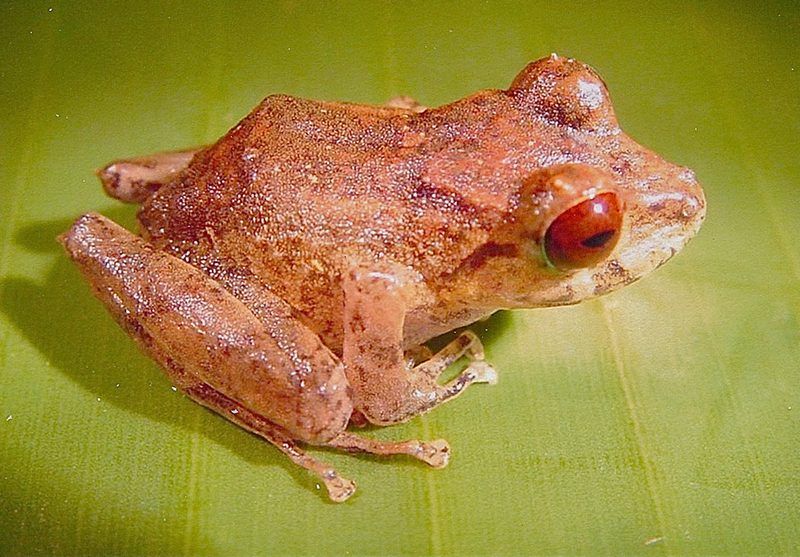
A second, much larger species with bright red eyes lived only along rocky creeks. It sat on sheer rock walls, in crevices and even in the spray of waterfalls, places hard for people to reach. Males guarded clutches of 15 to 20 white eggs tucked at least 10 centimetres deep inside tangles of roots overhanging the water.
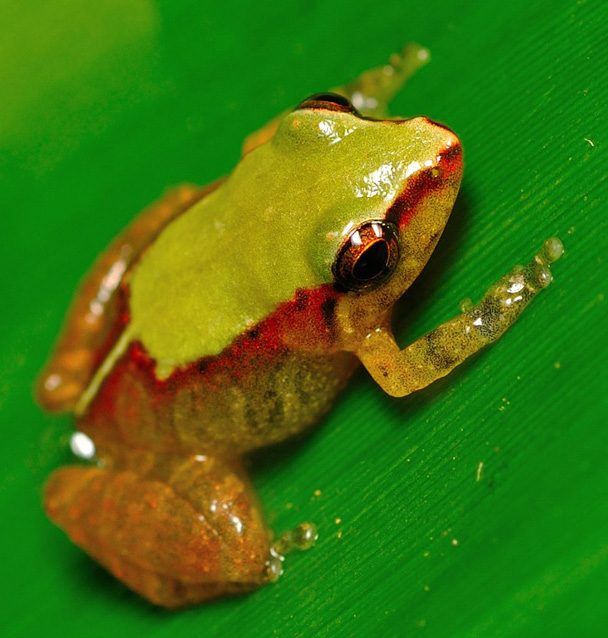
The other three were rarer. One lived in bromeliads, the rosette plants that grow high on tree branches. Checking ten bromeliads from about four metres up gave us two frogs. It looked so much like Pristimantis urichi from Trinidad that we named it geminus, "twin." A fourth species was represented by a single male with an oddly long body and short legs. We had first mistaken it for nubisilva, so we named it longicorpus, "long body." The fifth was the tiny gnome.
Help from old jars
Our own collection was not enough. We needed museum specimens too, and some of the most important had been collected on the same mountain in the late 1970s by Stefan Gorzula and Marinus Hoogmoed. Marinus, a former curator at the national natural history museum in Leiden, had recognised that some of these frogs might be new. He generously let us describe them instead. The red-eyed waterfall frog is named Pristimantis hoogmoedi in his honour. Gorzula's jars also held the only preserved gnome.
Putting 44 specimens into five species took fourteen years and a lot of help. Claus Steinlein and Michael Schmid in Würzburg, where I had once been a postdoctoral researcher, studied the frogs' chromosomes. They found 36 in nubisilva but only 26 in hoogmoedi. I X-rayed skeletons at the Smithsonian so we could compare skulls and hand bones without dissecting the rare single specimens. An artist on the other side of the Atlantic drew the hands and feet, working only from instructions we emailed. The paper came out in 2015, open access, in the Journal of Threatened Taxa, with artwork of hoogmoedi on the cover.
A treasure worth guarding
Five new species on one slope of one mountain says a great deal about Paria. It is one of the richest places in Venezuela for amphibians and reptiles, and its frogs are strikingly similar to those of Trinidad and Tobago. That is tangible evidence of a close link between the faunas of these lands.
The forests are protected on paper, inside a national park created in 1979. In practice, as we wrote in 2015, two rangers with one guard post and almost no equipment cover 37,500 hectares. Logging, hunting, slash-and-burn farming and fires are common. In 2013 and 2014 Gilson Rivas could not find hoogmoedi at places where it had been common a decade before.
So in 2018 Gilson, Mayke De Freitas, César, Tito Barros and I published a small pocket guide to the amphibians of Paria. By then ten frog species were known to live nowhere else. The guide was written for anyone curious about those forests, not only for scientists. Its closing words make the case plainly:
"We hope that the readers of this pocket guide agree with us that frogs are one of nature's great treasures, deserving of our attention and our protection." — Rivas et al. 2018
It is a long way from a student with a flashlight on a muddy slope in 2001 to a field guide anyone can carry. But that is the whole arc of the work: first you find out what is there, then you give it a name, and then you give people a reason to care.
The papers
- (2003) Geographic distribution. Siphlophis compressus (false coral snake) Herpetological Review 34: 170
- (2006) New species of Colostethus (Anura, Dendrobatidae) from the Península de Paria, Venezuela Journal of Herpetology 40: 371–377
- (2006) Mannophryne trinitatis (Anura: Dendrobatidae) is a Trinidadian single-island endemic Herpetological Review 37: 298–299
- (2008) Distribution of Strabomantis biporcatus (Terrarana: Strabomantidae) in northern Venezuela, with comments on its phenotypic variation Salamandra 44: 248–254
- (2010) Intraspecific variation in the endangered frog Mannophryne riveroi (Anura, Dendrobatidae, Aromobatinae), with comments on coloration and natural history Herpetology Notes 3: 151–160
- (2015) Five new species of Pristimantis (Anura, Strabomantidae) from the coastal cloud forest of the Península de Paria, Venezuela Journal of Threatened Taxa 7(4): 7047–7088
- (2018) Amphibians of the Península de Paria: a pocket field guide Chimaira, Frankfurt am Main, Germany