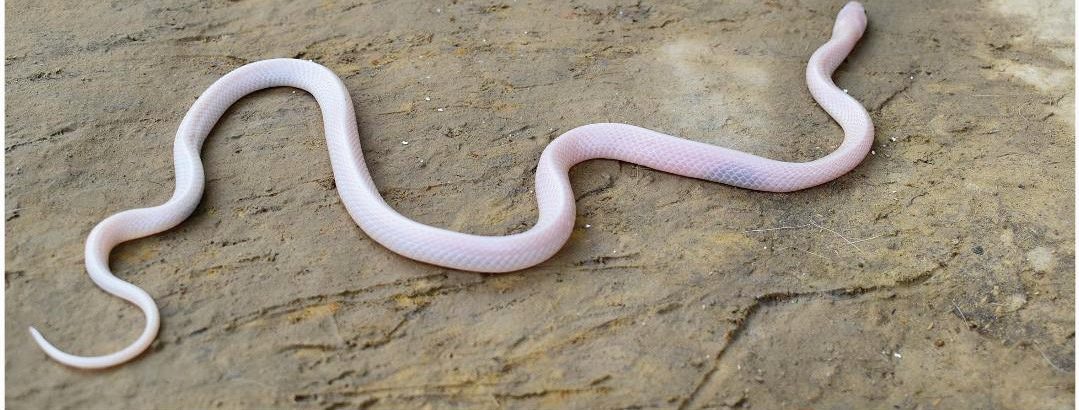
Which Snake Bit You?
Photo: from Devkota et al. 2020, Herpetology Notes
On the evening of 25 April 2020, a snake rescue team in Dhanusha District, in the lowlands of southeastern Nepal, answered a call to a traditional homestead in the village of Matiarba. A strange snake had been found inside a clay pot: pink skin, black eyes, curled among dragonflies.
The rescuers coaxed it out and recognized the shape of a krait, genus Bungarus: a slender, glossy snake with smooth scales and a highly dangerous venom. They photographed it, caught it, and released it well away from any houses.
On 3 June, barely 1.1 kilometres away in the village of Kishanpur, the people of another homestead found another pink snake. The rescuers' first thought was that they had caught the same animal again. It was a reasonable guess. But when my Nepali colleagues Kamal Devkota, Dev Narayan Mandal and Ganesh Sah looked closely at the scales on its head and counted the rows of scales around its body, the numbers did not match. The first snake had 17 rows of scales around its body; the second had 15, with a row of enlarged scales down the middle of its back.
They were two different species.
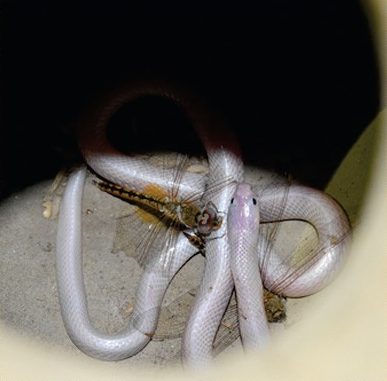
Two rare snakes in disguise
Both kraits were leucistic. Leucism is a genetic condition in which an animal lacks most of the pigment in its skin, but, unlike a true albino with pink eyes, keeps its dark eyes. The Matiarba snake was Wall's Krait, Bungarus walli. The Kishanpur snake was the Greater Black Krait, Bungarus niger. Neither had ever been reported with leucism before.
They were also both far from home. The Greater Black Krait had been confirmed in Nepal only twice before, so this was the country's third record. The Wall's Krait was about 130 kilometres further northwest than any previous record in Nepal.
The rescue teams had handled more than 1,000 snakes, and only 81 of them had been kraits: 72 Common Kraits and 9 Banded Kraits. These two pink snakes were the first of their species to turn up in the rescue records, and the only snakes of unusual colour.
"Leucism or albinism in venomous snakes makes for a potentially deadly combination." — Devkota et al. 2020
Why deadly? Because treating a snakebite starts with knowing which snake did the biting. A krait that looks like no krait anyone has seen, in a place where that species is not supposed to live, is exactly the kind of snake that gets misidentified. So we urged snake rescuers and doctors who treat snakebite to look carefully at the body and scales of any oddly coloured snake. And we noted something hopeful: in both cases, the villagers called for a rescue instead of trying to kill the snake themselves.
The viper on the lawn
Most of those deaths happen in rural Asia and Africa, among farmers and labourers, and a handful of snakes cause a great share of them. One of the worst is Russell's Viper, Daboia russelii. It is an ambush hunter that waits in rice paddies and beside forest paths, and it causes tens of thousands of envenomings every year.
In November 2019, Dikansh Parmar rescued a Russell's Viper from the campus of Veer Narmad South Gujarat University in Surat, India. It was a normal, healthy-looking adult, except for a long white patch down the middle of its back, where the scales were white, oversized and without their usual ridge, and the muscle beneath seemed to have been scooped out.
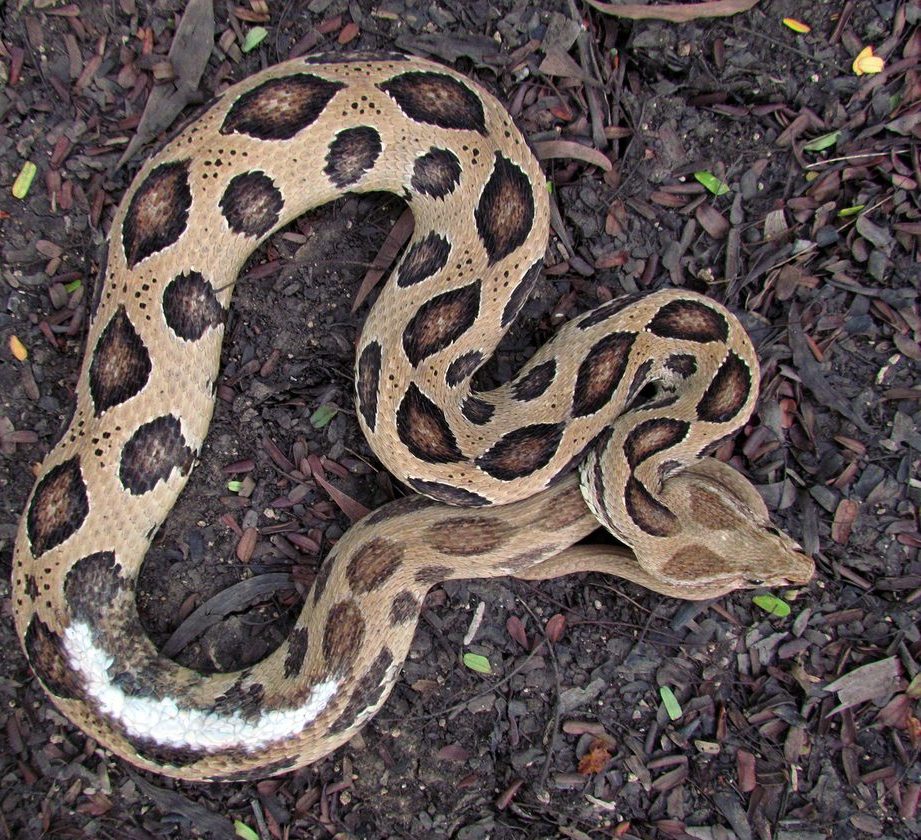
We think the snake had been hiding in the grass when a campus worker's string trimmer swept over it. There is an irony in that. Long-handled trimmers keep workers much farther from a hidden viper than a hand sickle does, which makes them safer for people. They are just much worse for the viper.
A mountain viper in the lowlands
Snakes also turn up in places where nobody is prepared for them. The Blunt-nosed Viper, Macrovipera lebetina, is a heavy, medically important viper that in northern Pakistan was known mainly from the mountains. In May 2025 a juvenile was photographed next to a livestock shelter in a village at 2,195 metres in the Bumburet Valley.
Then, on the night of 8 May 2026, during a night survey, my co-author Mudassar Basri came upon an adult resting under stones and roots near a guest house in Jungrai village, in Nowshera District, at just 393 metres above sea level. As far as we know, that is the lowest verified record for the species in the Lesser Himalayas, and it lies about 200 kilometres from the nearest previously published locality in Pakistan.
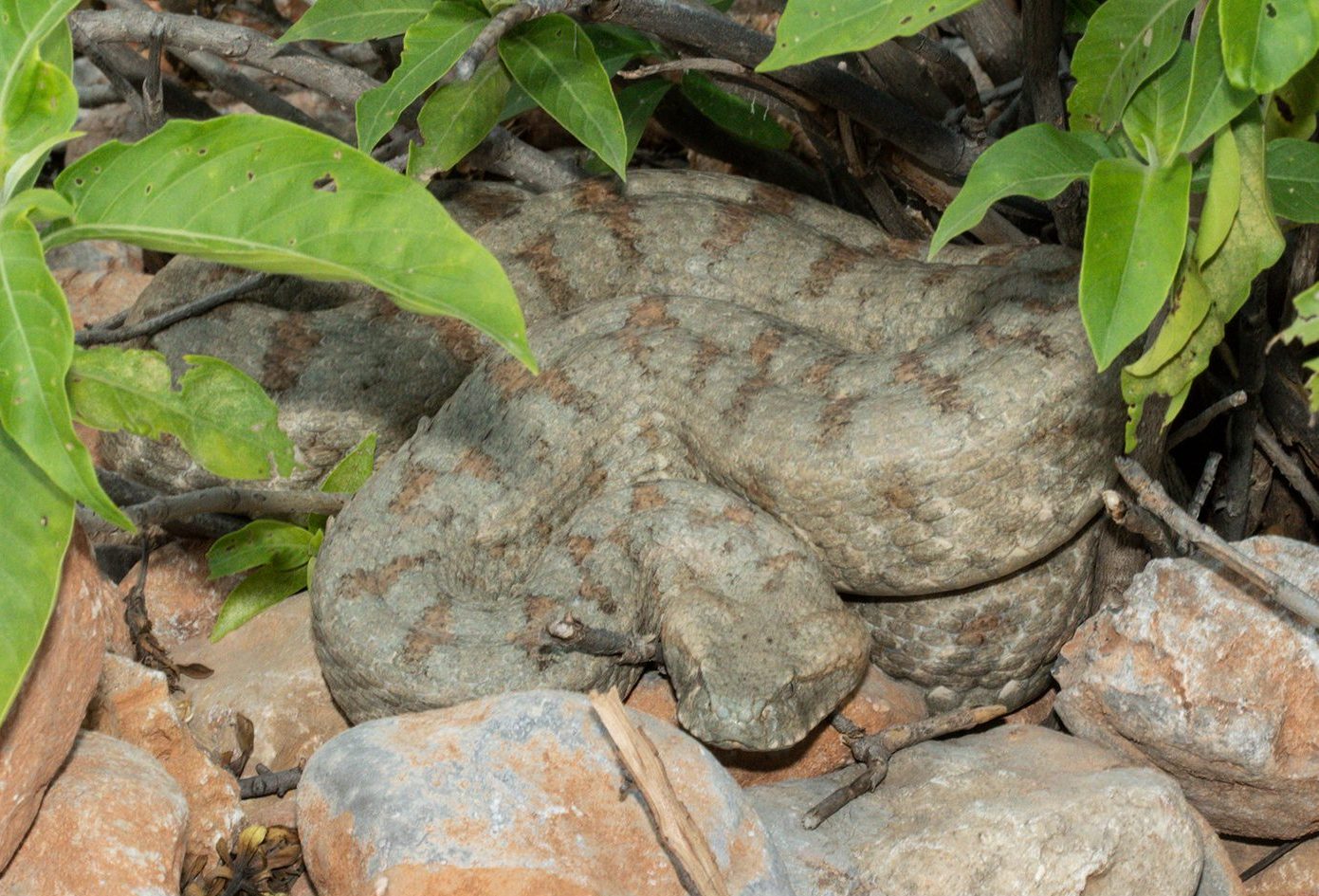
This matters because far more people live in the lowlands than in the mountains. A dangerous viper living at lower elevations means more chances for people and snakes to meet, especially around houses where rats and mice attract it. We called it what it is: a previously unrecognized lowland snakebite hazard.
What's in a name
Knowing your snake also means using the same name for it. Scientific names are how a doctor in one country finds what another has learned about a venom. That is why, in 2025, Wolfgang Wüster, Wolfgang Böhme, Wolfgang Denzer and I argued in the journal Zootaxa against changing the long-established names for the European Nose-horned Viper, Vipera ammodytes, even though historical research had found that the specimen Linnaeus described came from near Istanbul, not the western Balkans. Swapping the names of its subspecies would make decades of medical and scientific literature harder to use. We called the principle "nomenclatural parsimony": when history forces a change, choose the path that changes the fewest names.
I had met this viper myself. On 4 September 2022, on a field trip during the congress of the Societas Europaea Herpetologica in Belgrade, Serbia, a group of us hiked with national park rangers above the Iron Gates of the Danube and uncovered two young Nose-horned Vipers in the debris of a small rockslide. Both had ticks buried in the skin of their heads, one of them at least eight.
With Wolfgang Denzer, Esther Dondorp of the Naturalis museum and Wolfgang Wüster, I also went back to the beginning of the Javan Spitting Cobra's name, Naja sputatrix, coined in the 1820s. We examined every specimen in the collection in Leiden that could have been one of the original type specimens, the animals on which the name was based, and checked other European museums. None matched. The name has no specimen anchoring it, and we explained what to do if one is ever needed.
Venom, antivenom, and Hong Kong
The one proven treatment for a serious snakebite is antivenom, which is produced using the venom of particular snakes. When the snakes that actually bite people are misidentified, or when populations differ in their venom, treatment can fall short. In India, as our king cobra work reminded us, there is not even an antivenom made specifically for the king cobra.
That is the thread I am following now. In July 2026 I became an Honorary Professor in the School of Biological Sciences at the University of Hong Kong, and I am leading a multinational project on the venoms of Asian snakes. It brings together what the stories above keep pointing to: getting the species right, understanding how populations differ, studying what is in their venoms, and testing how well antivenoms work against them. The aim is simple to say and hard to do: fewer people dying or losing limbs to snakebite.
It starts, every time, with a rescuer looking closely at a strange pink snake and asking which one it really is.
The papers
- (2020) First report of leucism for the kraits Bungarus walli Wall, 1907 and B. niger Wall, 1908, with updates on their geographic distribution in Nepal (Serpentes, Elapidae) Herpetology Notes 13: 817–825
- (2022) An unusual white dorsal patch in Russell’s Viper, Daboia russelii (Shaw & Nodder, 1797), from Surat District, Gujarat State, India Herpetology Notes 15: 679–682
- (2022) Ticks (Acari: Ixodidae) on Nose-horned Vipers, Vipera ammodytes (Linnaeus, 1758), at the Danube’s Iron Gates, Serbia, with a brief review of tick infestations on European vipers Herpetology Notes 15: 781–784
- (2025) Nomenclatural historians are kindly requested to respect the intent of the Code: “Nomenclatural parsimony” and the case of the Nose-horned Viper, Vipera ammodytes (Linnaeus, 1758) Zootaxa 5696(3): 385–397
- (2025) Notes on the type series of the Javan Spitting Cobra, Naja sputatrix Boie, 1827, and designation of a lectotype for Naja tripudians sondaica Schlegel, 1844 Zootaxa 5679(4): 585–599
- (2026) Down the mountain: new locality records of the Blunt-nosed Viper (Macrovipera lebetina) in Pakistan highlight a previously unrecognized lowland snakebite hazard Herpetology Notes 19: 675–680
- (2026) Snakes on trains: railways may sway Goa’s king cobra distribution Biotropica 58(1): e70157